
We have audited the consolidated financial statements of Tiger Brands Limited and its subsidiaries (the group) set out here, which comprise the consolidated statement of financial position as at 30 September 2025; and the consolidated income statement and consolidated statement of comprehensive income; the consolidated statement of changes in equity; and the consolidated statement of cash flows for the year then ended; and notes to the consolidated financial statements, including material accounting policy information.
In our opinion, the consolidated financial statements present fairly, in all material respects, the consolidated financial position of Tiger Brands Limited and its subsidiaries as at 30 September 2025, and its consolidated financial performance and consolidated cash flows for the year then ended, in accordance with IFRS Accounting Standards as issued by the International Accounting Standards Board and the requirements of the Companies Act of South Africa.
We conducted our audit in accordance with International Standards on Auditing (ISAs). Our responsibilities under those standards are further described in the Auditor’s Responsibilities for the Audit of the Consolidated Financial Statements section of our report. We are independent of the group in accordance with the Independent Regulatory Board for Auditors’ Code of Professional Conduct for Registered Auditors (IRBA Code) and other independence requirements applicable to performing audits of financial statements in South Africa. We have fulfilled our other ethical responsibilities in accordance with the IRBA Code and in accordance with other ethical requirements applicable to performing audits in South Africa. The IRBA Code is consistent with the corresponding sections of the International Ethics Standards Board for Accountants’ International Code of Ethics for Professional Accountants (including International Independence Standards). We believe that the audit evidence we have obtained is sufficient and appropriate to provide a basis for our opinion.
In terms of the IRBA Rule on Enhanced Auditor Reporting for the Audit of Financial Statements of Public Interest Entities, published in Government Gazette No. 49309 dated 15 September 2023 (EAR Rule), we report:
We define materiality as the magnitude of misstatement in the consolidated financial statements that makes it probable that the economic decisions of a reasonably knowledgeable person would be changed or influenced. We use materiality both in planning the nature and extent of our audit work and in evaluating the results of our work.
Based on our professional judgement, we determined materiality for the financial statements as a whole as follows:
| 2025 financial statements | 2024 financial statements | ||
| Overall materiality | R225 million | R200 million | |
| How we determined it | It represents 5.9% of operating income before impairments and non-operational items, from continuing operations. | It represents 5.7% of restated profit before taxation. | |
| Rationale for benchmark applied | A key judgement in determining materiality is the appropriate benchmark to select, based on our perception of the needs of shareholders. We considered which benchmarks and key performance indicators have the greatest bearing on shareholder decisions. | ||
| In the current period, due to the disposals of businesses and discontinued operations, we have changed the benchmark applied for materiality to be based on operating income before impairments and non-operational items. | |||
Our group audit was scoped by obtaining an understanding of the group and its environment, including the structure and organisation of the group, and assessing the risks of material misstatement at the group level.
We selected components at which audit work in support of the group audit opinion needed to be performed in order to provide an appropriate basis for undertaking audit work to address the risks of material misstatement. Our selection was informed by taking into account the component’s contribution to relevant classes of transactions, account balances or disclosures.
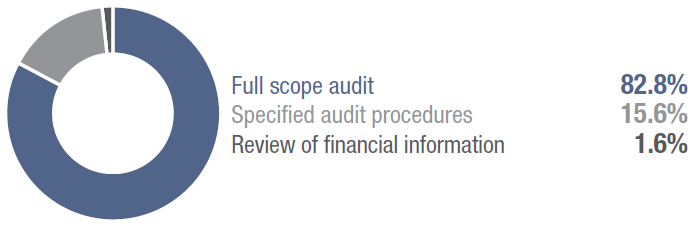
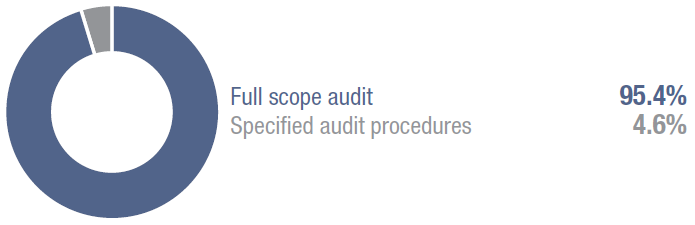
Based on our assessment, we performed work at 22 of the components, representing the group’s most material business operations. The number of components in scope has remained largely consistent with the prior year.
The following audit scope was applied:
The 22 components account for 98.4% of the group’s net assets and 100% of the group’s revenue from continuing operations.
Net assets (%)
Revenue (%)
Key audit matters are those matters that, in our professional judgement, were of most significance in our audit of the consolidated financial statements of the current period. We have determined that there are no key audit matters to communicate in our report.
The directors are responsible for the other information. The other information we obtained prior to the date of this auditor’s report comprises the information included in the document titled “2025 Group annual financial statements” for the year ended 30 September 2025, which includes the directors’ report, the audit and risk committee’s report and certificate by the company secretary, as required by the Companies Act of South Africa. The integrated annual report is expected to be made available to us after 25 November 2025.
Our opinion on the consolidated financial statements does not cover the other information and we do not express an audit opinion or any form of assurance conclusion thereon.
In connection with our audit of the consolidated financial statements, our responsibility is to read the other information and, in doing so, consider whether the other information is materially inconsistent with the consolidated financial statements or our knowledge obtained in the audit, or otherwise appears to be materially misstated. If, based on the work we have performed on the other information that we obtained prior to the date of this auditor’s report, we conclude that there is a material misstatement of this other information, we are required to report that fact. We have nothing to report in this regard.
When we do receive and read the integrated annual report, if we conclude that there is a material misstatement therein, we are required to communicate the matter to those charged with governance and request that the other information be corrected. If the other information is not corrected, we may have to retract this auditor’s report and re-issue an amended report as appropriate. However, if it is corrected this will not be necessary.
The directors are responsible for the preparation and fair presentation of the consolidated financial statements, in accordance with IFRS Accounting Standards as issued by the International Accounting Standards Board and the requirements of the Companies Act of South Africa, and for such internal control as the directors determine is necessary to enable the preparation of consolidated financial statements that are free from material misstatement, whether due to fraud or error.
In preparing the consolidated financial statements, the directors are responsible for assessing the group’s ability to continue as a going concern, disclosing, as applicable, matters related to going concern and using the going-concern basis of accounting unless the directors either intend to liquidate the group or to cease operations, or have no realistic alternative but to do so.
Our objectives are to obtain reasonable assurance about whether the consolidated financial statements as a whole are free from material misstatement, whether due to fraud or error, and to issue an auditor’s report that includes our opinion. Reasonable assurance is a high level of assurance, but is not a guarantee that an audit conducted in accordance with ISAs will always detect a material misstatement when it exists. Misstatements can arise from fraud or error and are considered material if, individually or in the aggregate, they could reasonably be expected to influence the economic decisions of users taken on the basis of these consolidated financial statements.
As part of an audit in accordance with ISAs, we exercise professional judgement and maintain professional scepticism throughout the audit. We also:
We communicate with the directors regarding, among other matters, the planned scope and timing of the audit and significant audit findings, including any significant deficiencies in internal control that we identify during our audit.
We also provide the directors with a statement that we have complied with relevant ethical requirements regarding independence, and communicate with them all relationships and other matters that may reasonably be thought to bear on our independence, and where applicable, actions taken to eliminate threats or safeguards applied.
From the matters communicated with the directors, we determine those matters that were of most significance in the audit of the consolidated financial statements of the current period and are therefore the key audit matters. We describe these matters in our auditor’s report, unless law or regulation precludes public disclosure about the matter or when, in extremely rare circumstances, we determine that a matter should not be communicated in our report because the adverse consequences of doing so would reasonably be expected to outweigh the public interest benefits of such communication.
Audit tenure
In terms of the IRBA Rule published in Government Gazette No. 39475 dated 4 December 2015, we report that Deloitte & Touche has been the auditor of Tiger Brands Limited for three years.
Deloitte & Touche
Registered Auditor
Per: Martin Bierman
Partner
25 November 2025
5 Magwa Crescent
Waterfall City
Waterfall
Johannesburg