Consumer Brands – FoodDownload pdf version
CONSUMER
BRANDS*
PERFORMANCE SUMMARY
 |
Groceries sustains profit recovery on the back of improved factory performance and cost discipline ahead of plan | |
|
Launched KOO pilchards to receptive customers and consumers as well as successful packaging renovations in ALL GOLD and Mrs Ball’s | |
|
Ready-to-drink and concentrates within Beverages drive top-line performance | |
|
Launch of Purity Junior and Purity toiletries | |
 |
Snacks & Treats adversely impacted by Covid-19 absenteeism and civil unrest; inability to meet demand albeit lower due to impact of adjusted lockdown measures on impulse purchases | |
|
Product recall due to packaging defect |
STRATEGIC OUTLOOK
Our strategic objective is to accelerate growth by strengthening our master-brand portfolio, while defending our leading positions through increased marketing investment and innovation, particularly in value as well as health and wellness. In addition, we will develop strong shopper propositions and seek to expand our current portfolio into category adjacencies and boost differentiation through enhanced labelling and packaging. We will be restoring competitiveness in our manufacturing activities by eliminating waste and improved overall equipment effectiveness aimed at unlocking savings to improve capacity and reduce conversion costs.
Our strategic priorities in Baby Care are to consolidate our position as a consumer-centric business, developing a Purity master-brand that delivers on its mission to help every South African child realise their full potential. We are focused on improving factory efficiencies and site logistics and enhance the value proposition with improved labelling, as well as leveraging baby feeding expertise through our recently launched Purity Owned Parenting Platform and Journey Journal App.
| FINANCIAL HIGHLIGHTS | ||||||
| +4% | +20% | |||||
| REVENUE | OPERATING INCOME | |||||
R11,1 billion (2020: R10,7 billion) |
R1,1 billion (2020: R941 million) |
|||||
| OPERATING MARGIN | ||||||
10,2% (2020: 8,8%) |
||||||
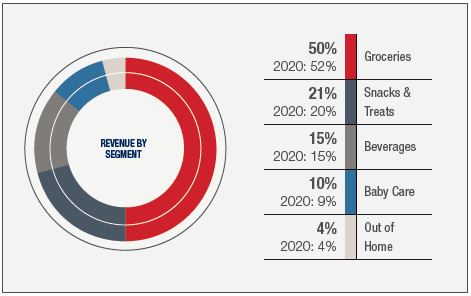
The Consumer Brands portfolio delivered overall revenue growth of 4%, comprising price inflation of 7% and a 3% reduction in total volumes. The flat revenue performance in Groceries was offset by year-on-year top line growth in Snacks & Treats, Beverages, Baby Care and Out of Home. Price increases and significantly improved factory performances were the primary reasons for operating income increasing 20% to R1,1 billion.
Excluding the impact of the product recall, Groceries’ sales were negatively impacted by a competitive trading environment, low seasonal demand in the first half and unusually quiet trade over Easter. Full-year revenue was unchanged at R5,5 billion. This was underpinned by price inflation of 8%, offset by a similar percentage decline in total volumes. Consistent factory performance and expense management discipline resulted in operating income increasing 12% to R397 million despite experiencing significant increases in certain raw materials and packaging costs.
* Excludes product recall and civil unrest
As previously reported, Tiger Brands’ claim under the contract with the third-party supplier, arising from the canned vegetable product recall, is in the process of being assessed. In October 2021, we issued formal correspondence to the third-party supplier setting out the scope of our claim. The supplier has since referred the claim to its insurers who have appointed a loss adjuster to assess the claim. The process is at its early stages and we will continue to engage with the supplier to find a speedy resolution to the matter.
Production volumes within Snacks & Treats were adversely impacted by Covid-19-related absenteeism as well as the civil unrest in the second half. These factors resulted in supply chain complexities with regards to lost production as well as raw and packaging material shortages. In addition, adjusted lockdown measures implemented in July 2021 resulted in lower demand in respect of impulse purchases. This, as well as subdued shopper engagement relating to seasonal events such as Easter, led to slower revenue growth in the second half. Nonetheless, revenue for the year increased by 7% to R2,3 billion, underpinned by price inflation of 8% and an overall volume decline of 1%. Operating income increased strongly by 37% to R234 million, driven by higher realisations together with the impact of ongoing cost improvement initiatives.
Supported by a strong second half performance from the ready-to-drink category as well as concentrates (Oros), year-on-year revenue in Beverages increased by 6% to R1,7 billion. Operating income increased by 9% to R261 million, benefiting from a favourable product mix as well as improved factory efficiencies and sound cost management.
Baby delivered a strong performance, driven by a recovery in volumes across most segments. Revenue increased by 12% to R1,1 billion with equal price and volume growth. Operating income increased by 29% to R143 million, benefiting from a favourable product mix, waste reduction and lower distribution costs.