
At the heart of Tiger Brands is the passion to produce quality, branded products that resonate with our consumers. This means we work hard to understand their diverse and changing needs to serve them better.

We have a hundred years’ experience in producing quality, branded products that resonate with consumers. Many of our brands hold number one or number two positions in market share and equity in their respective categories and have celebrated many external awards for being South Africa’s most loved brands.
Our Billion Rand Brands have stayed relevant through our ability to renovate and innovate. By monitoring consumer tastes and trends, and investing in product and process research and development, we maintain our leadership position.
The year under review is no exception. We have focused innovation and renovation on meeting the needs of consumers. This includes the launch of a larger Albany Xtra loaf, Tinkies mini value pack, Purity Junior pouches, Jungle Cereal Bars and Doom value pack. We have innovated by adding two new flavours to our Roses Cordial range (ginger and blueberry), and demonstrated our ability to compete in categories that we see value in by launching KOO pilchards.


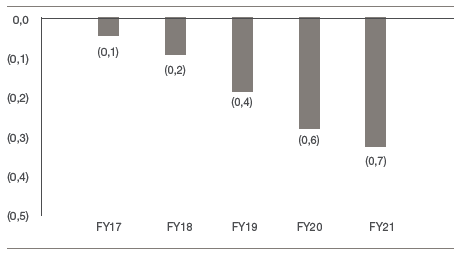
We have a strong, ungeared balance sheet and the business consistently generates attractive cash flows. In 2021 cash generated from operations increased 34% to R4,0 billion while we ended the year with a strong net cash position of R2,2 billion (FY20: R1,8 billion). This sound capital structure provides us with the ability to drive growth through investment in the existing business, brands and innovation, as well as returning cash to shareholders.
It also allows us flexibility to be able to invest in potential acquisitions, while our ability to convert earnings into cash means we are able to self-fund many initiatives, including the recently launched Venture Capital Fund. The launch of the fund led to the receipt of over 500 expressions of interest. We are in the final stages of making an offer for a business, which is closely aligned to our health and nutrition strategy, while a further nine opportunities are being assessed.
NET DEBT TO EBITDA (X)
Cash has exceeded debt since FY17
For more information, see CFO report.

Last year, we revised our operating model with the aim of providing the individual business units with the benefits of Tiger’s scale, but with sufficient autonomy, accountability and flexibility so that this benefit is not eroded by the inertia of command and control from the centre. In addition, we have embarked on a future-fit campaign, a project that aims to make the group more agile through cost containment and factory efficiencies. With cumulative cost savings in excess of R900 million over the last two years (R474 million in 2020 and R498 million in 2021), these initiatives are well-established to gain momentum.
In addition, we have made significant improvements in material usage variances, reducing waste, improving factory performances and ensuring procurement savings. Factories operating optimally will restore competitiveness and improve service levels.
CLEAR ACCOUNTABILITY MATRIX DRIVES CONSISTENT COST MANAGEMENT IN LINE WITH GUIDANCE (R’million)
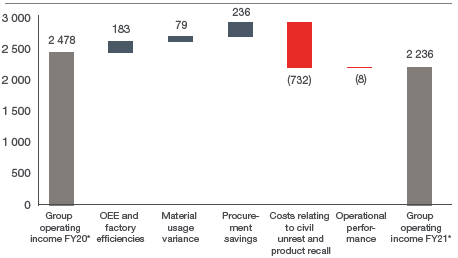
* Group operating income from continuing operations before impairments and non-operational items.
We have concluded a review of our technology requirements to ensure we are future-fit with investment planned to expand our technology and digital capabilities.

Tiger Brands’ management has seen some significant changes to its executive management and the board over the last few years. With Noel Doyle taking the helm as CEO – after 11 years as CFO and in other areas across the group – this created an opportunity to bring in some fresh thinking into the CFO position with the appointment of Deepa Sita in October 2020, combining the stability of institutional memory with the energy of new perspective.
The board has benefited from newly appointed members with strong global and FMCG expertise. Together with a new chairman, Geraldine Fraser-Moleketi, this has helped deepen a culture of execution and accountability at the highest level.
“I believe that we have a highly engaged board, that brings differing individual strengths and that is robust in ensuring accountability of the management team.”
Geraldine Fraser-Moleketi, Chairman
For more information, see the governance section.

We recognise the significant increase in investor interest and engagement on environmental, social and governance (ESG) issues. Tiger Brands has made significant progress in delivering on its sustainable future strategy, and on its commitments in each of its three strategic focus areas: health and nutrition; enhanced livelihoods; and environmental stewardship. Tiger Brands has launched several new healthy and affordable products and improved its labelling to accommodate more nutrition information. Significant further strides have been taken in promoting economic inclusion and food security through the company’s enterprise and supplier development fund, preferential procurement activities, and ongoing investments in socio-economic development. In addressing some of the more immediate food security challenges in poor communities, the Tiger Brands Foundation has continued to make a meaningful impact on the nutritional needs of learners, students and vulnerable families across the country. We continue to explore opportunities to design inclusive circular economy initiatives with our current focus on minimisation. Our key initiatives focus on reducing waste-to-landfill, recycling packaging material, reducing food waste and loss, and diverting food waste and loss towards new value-creation opportunities.
We recognise that we have a significant responsibility to continue addressing our material ESG impacts and continue to fully integrate this responsibility across the organisation.
For more information on sustainability see our sustainability report.

For more information, see build a growth pipeline.

