

Our operating environmentDownload pdf version
Changing dynamics in our operating environment shape our ability to create value and deliver on our purpose. We have identified five core trends that have a material bearing on our business model and strategy. Our updated strategic priorities have positioned the company to respond effectively to the risks and opportunities emerging in association with each of these trends.
WEAK MACRO-ECONOMIC FUNDAMENTALS
We track and review changes in the macro-economic environment, as we would benefit from a strong economy and healthy consumer demand.
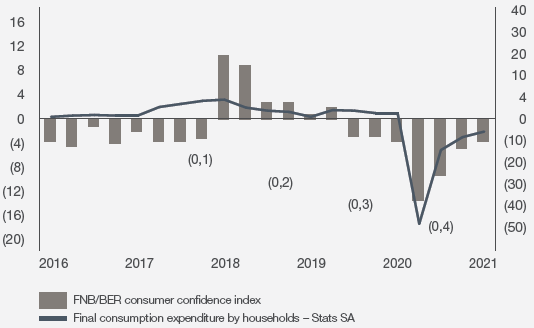
The tough macro-economic environment has resulted in reduced demand for discretionary and premium products, shifting demand to value offerings, and increasing competition. Volumes and margins are threatened, and cost recovery ahead of inflation remains a challenge. The impact of these developments was exacerbated by the civil unrest and looting in South Africa, as well as operational challenges that include employee unrest across several operations.
On a positive note, the government has released economic stimulus capital, further opened the door to independent power producers, and allowed the private sector to participate in improving rail and port infrastructure.
For consumers, the renewal of the social relief of distress grant until March 2022 will help bolster consumer confidence for low-income households.
| CONSUMER CONFIDENCE VS HOUSEHOLD EXPENDITURE (quarterly change year-on-year) |
 |

OUR STRATEGIC RESPONSE

- To meet the growing needs of the value-conscious consumer, we are driving our relevance in the value segment through innovation and renovation to meet value-specific consumer needs, highlighting the benefits of our current brands through marketing best practice and delivering commercially viable opportunities to manufacture private label products to our benefit
- We have introduced a more systemic approach to delivering cost saving and efficiencies across the business, changing the governance structures, improving accountabilities, strengthening our central revenue management capability within each of our business units, and improving our stock-keeping unit (SKU) rationalisation; these various initiatives have contributed to R498 million in savings this year
- We are driving long-term cost savings and improved productivity across our supply chain, investing in world-class manufacturing operations, improving our procurement capabilities, and approving an ambitious logistics transformation programme to be executed over the next three years
- We have further strengthened our activities to boost economic opportunities and improve the livelihoods of thousands of people across our value chain, including through a deliberate focus on supporting black/black-women farmers and owned enterprises.
AN INCREASINGLY COMPETITIVE MARKET
We are inspired to meet the shifting needs of consumers, and beat our competitors, by harnessing our capabilities to bring innovative new products to market with speed and agility.
The maturing food retail environment in South Africa remains particularly competitive, both among food producers and within distribution channels. New producers are establishing strong premium brands and successful niche products, challenging traditional market leaders, and placing significant pressure on industry margins. While supermarkets remain the leading distribution channel in packaged food, the channel is seeing strong competition from mixed and wholesale retailers, independents, and emerging informal players. Food retail generally has diversified, with increasing online engagement and digital sales. Retailers have hardened their procurement practices, and in many instances built successful private labels on core staples and key niche products. As convenience and value have become key drivers of consumer choice, and informal players capture consumers closer to home, a shift to alternative pack formats has enabled market expansion and affordable price points. Heightened promotional activity has undercut margins, runs the risk of damage to price perception, and inspired competition and differentiation towards richer value propositions that threaten brand dominance.
Innovation and speed-to-market is increasingly necessary to meet consumer trends and gain market share. The pressure on food safety governance and management has mounted, as has the need and benefit of adopting digital technologies and new ways of working to drive smarter, more efficient operations. While digitalisation brings valuable performance benefits, it also brings cyber security risks. These various dynamics reflect the complexity of the market and the relentless intensity of competition. In this context we are challenged to reinvent our historic brand advantage, and to ensure the sophistication of our operations, but are inspired to build our agility and capability for innovation.
OUR STRATEGIC RESPONSE
- We have enhanced our research and analytics, strengthened our monitoring of customer and brand strategies and performance, and identified opportunities to optimise our product portfolio and respond to the growth in private label
- We have invested in strengthening innovation, focusing on fewer and larger innovation projects – on value, nutrition and convenience – as well as building our "Big Brand" image and consumer intimacy and loyalty
- We are developing product offerings and distribution strategies to expand our reach and target faster growth in the emerging informal market (general trade)
- We have strengthened our customer marketing teams, invested in category management resources and tools to enhance in-store execution, and established key account forums and joint business plans with major customers. We are introducing legally compliant, fair and equitable trading terms that are performance and behavioural-based.
CHANGING CONSUMER EXPECTATIONS
We continuously adapt to the changing needs of consumers who demand connectivity, convenience, quality, affordability, taste, health and sustainability.
Shifting patterns of consumer behaviour are leading to significant changes in the food system, driven by increasing urbanisation, digital connectivity and mobility, the rising number of single households, and changing personal priorities. Dietary shifts reflect these changing global patterns and economic aspirations, with growing public health concerns offset by the consistent uptake of processed products, and convenience foods, snacks and beverages. In the emerging post-Covid-19 environment, consumers across income-groups are typically shopping less frequently, across fewer categories, and at fewer retailers, for bigger baskets. E-commerce channels have become markedly more important for middle and higher-income groups. The practice of home cooking, stocking pantries, and extending product life has increased broadly, along with momentum towards more health-conscious purchasing.
Middle and high-income consumers are increasingly sensitive to the social and environmental practices of retailers, brands and products. The profile of goods favoured has shifted for each income-group, with consumers needing to spend more for the same, driving growth in value for food businesses but lower growth in volumes. The overriding rise in the price-consciousness of consumers has increased demand for value and affordability. The increase in health-consciousness has increased product scrutiny and an emerging social and environmental-awareness is prompting the search for added value. These multifaceted shifts in consumer needs present a significant opportunity for innovation.
OUR STRATEGIC RESPONSE
- Our consumer and market insights team tracks market and consumer behaviour and preferences to identify opportunities for product and process innovation and to optimise our product portfolio
- We have appointed an innovation director who is reworking our innovation practices and methodologies to drive a step-change in innovation performance, with innovation opportunities currently being realised in areas such as snackification, value and health and wellness
- Given recent and anticipated growth in the e-commerce channel, fuelled in part by the pandemic, we are working to raise our online presence and become the preferred supplier to priority e-commerce partners.
PRESSURE TO IMPROVE ESG PERFORMANCE
We acknowledge the growing interest from investors and stakeholders on our ESG performance and recognise the importance of building an ethical and sustainable business practice.
Increasing consumer and investor activism on ESG issues, and emerging regulatory interventions, reflect a growing concern to address the negative nutritional, health and environmental outcomes of the food system, placing greater pressure for industry action, transparency and accountability. Globally, the food system has been identified as “the single strongest lever to optimise human health and environmental sustainability*”. Locally, South Africa has profound food-related health challenges, characterised by high levels of obesity, lifestyle-induced non-communicable disease (NCD), and persistent hunger and malnutrition.
The SDGs provide a benchmark for clear targets and an increasing number of global industry initiatives demand collective action. Enhanced regulatory and voluntary interventions have introduced new marketing, health and environment-related control mechanisms, regulations and taxes. An increased threat of litigation threatens resources and reputation. Higher-income consumers are more willing to trade-off on price for health and sustainability, with increasing demand for brands-with-purpose, sustainable and local products, plant-based proteins, ethical marketing and front-of-pack nutrition labels. These shifts challenge some traditional business approaches and encourage the adoption of purpose-led innovation. We are increasingly pressured to align with global agreements and voluntary initiatives, proactively address environmental impacts, accelerate social transformation and prioritise value creation that aligns with public health interests.
* EAT/Lancet Commission (2019) Food Planet Health
OUR STRATEGIC RESPONSE
- We have made further progress this year on our commitment to enabling consumers to improve their health and wellbeing, refreshing our Eat Well Live Well programme, updating our nutritional standards to align with globally recognised guidelines, and taking deliberate steps to prioritise health and nutrition in our innovation pipeline
- We have continued to invest significantly in driving quality and food safety across the company to ensure that we have robust management systems, qualified people and a strong quality culture, further strengthening our audit and assessment processes, achieving external certification for all our manufacturing facilities against globally recognised food safety standards, and made valuable progress in securing certification for our warehouses
- We are striving to reduce our environmental impact through innovative solutions, including optimising energy and water usage, developing innovative products and packaging, leveraging our brand and marketing, and implementing circular economy initiatives that stimulate economic opportunities
- We are continuing in our efforts to improve the livelihoods of thousands of people across our value chain, using our procurement practices and our investment in supplier and enterprise development, to stimulate economic opportunities, including through a specific focus on supporting black/black-women farmers and owned enterprises.

PERSISTENT IMPACTS OF THE COVID-19 PANDEMIC
We have responded effectively to the prolonged impacts of a persistent pandemic by re-allocating capital and capacity to protect our people and business operations.
The Covid-19 pandemic had a material impact on all business across the food producer sector, despite much of the sector being classified as an essential service. The pandemic has increased complexity in the operating environment and amplified existing macro-economic challenges, placing further pressure on consumer spending and driving changes in consumer needs and expectations. It has impacted local and global supply chains, increased the costs of production, contributed to production setbacks, and presented new challenges in terms of employee engagement and wellbeing. The rise of new Covid-19 variants, the slow vaccination roll-out in South Africa, and a potentially widening gap between the recovery of developed and emerging markets, means that the Covid-19 pandemic will continue to impact the economy and directly shape our plans and prospects for the next few years.
OUR STRATEGIC RESPONSE
- During the stringent lockdowns we worked with suppliers, logistics and customers to limit disruptions in essential food supplies, supplemented by effective communication to address concerns around food security
- We have prioritised the safety and wellbeing of employees, requiring remote working where possible, and introducing health screening and testing for staff at essential service sites, accompanied by numerous other measures to ensure employee wellbeing
- Although global raw material availability may impact supply levels in some categories, we are generally well-placed to meet demand and increase production capacity on key products if needed.