

Remuneration and performanceDownload pdf version
“ During the period under Mark Bowman Chairman Remuneration committee |
SECTION 1: BACKGROUND STATEMENT STATEMENT FROM THE CHAIRMAN OF THE REMUNERATION COMMITTEEDear stakeholder On behalf of the remuneration committee (the committee), I am pleased to present the 2021 remuneration report which, in compliance with best practice reporting as recommended by King IV™, highlights:
During the period under review, the Tiger Brands’ executive leadership team has effectively led the ramp up of the execution of five strategic priorities to enhance the company’s ability to proactively navigate the prevailing market conditions:
|

As can be expected, the execution of our business priorities and business results were once-again significantly impacted by the Covid-19 pandemic, the social unrest in South Africa in July 2021 and the recall of selected KOO products due to defective cans which warranted a review and re-prioritisation in some instances of our focus areas at our various operations and categories.
During the period under review, enhancements were made to the remuneration strategy to improve alignment of critical business KPIs to measure and reward performance against our strategy. As such, the remuneration committee approved the implementation of a revised short-term incentive (STI) scorecard that drives the achievement of key performance indicators as well as maintains a balance between the focus on financial, strategic and sustainability measures. The STI group and business unit weightings were also revised to increase focus on delivery of results at the category team level. Further amendments were also made to the group and business unit scorecards, thereby improving line of sight for employees in the frontline of our business.
These changes to the STI structure further align to our reward framework, which follows a total reward approach, consisting of guaranteed pay and variable pay, a range of market relevant benefits and professional growth opportunities that recognise individual and team performance. This holistic approach enables us to attract, motivate and retain talented high-performing people (see further details below).
SHAREHOLDER VOTING OUTCOMES
In line with our commitment to remunerate our people in a fair and equitable manner, we maintain strong relationships with stakeholders and strive towards high standards of disclosure of our remuneration approach to ensure that there is a clear understanding of our remuneration policy and the practices that have been implemented.
The non-binding advisory votes by shareholders at the 2021 and 2020 annual general meetings (AGM) are summarised as follows:
| % vote in favour | February 2021 |
February 2020 |
| Remuneration policy | 89,20% | 76,55% |
|---|---|---|
| Remuneration implementation | 82,24% | 78,71% |
| Non-executive directors’ fees | 99,97% | 99,01% |
SHAREHOLDER ENGAGEMENT
The committee is committed to shareholder engagement and will take the following steps if 25% or more of total votes exercised by shareholders at the upcoming AGM are against the remuneration policy or implementation report:
- Tiger Brands will seek to actively engage with dissenting shareholders by inviting them to one-on-one meetings and, where necessary, will issue a SENS announcement requesting shareholders to appropriately engage on their specific concerns
- Tiger Brands will consider the shareholder concerns and report on the outcome of the engagements and measures taken in its next integrated annual report.
REMUNERATION COMMITTEE OBJECTIVES AND ACTIVITIES FOR FY21
In FY21 the committee undertook the following activities:
- Approved the salary increase mandate for employees on total remuneration packages (TRP) Vesting is time-based according to the following pattern:
- Approved the remuneration for executive directors and executive committee members
- Approved the STI and long-term incentive (LTI) performance conditions, targets and weightings in respect of FY22
- Recommended for approval to the board the non-executive directors’ fee increases
- Approved the implementation of measures to address identified pay inequities
- Approved an amendment to the minimum shareholding policy allowing the committee to apply discretion on the implementation of the minimum shareholding requirement where economic environment challenges may result in difficulty in achieving the minimum shareholding
- Notwithstanding the achievement of the key performance indicators of the group short-term incentive scheme, the remuneration committee used its discretion to make the decision not to award the executive leadership team short-term incentives for FY21, due to the significant impact of the KOO cans’ recall on shareholder value.
FOCUS AREAS FOR FY22
The committee is committed to remaining up to date with the latest remuneration market trends and best practice, business needs, as well as our responsibilities to Tiger Brands’ people, shareholders and communities to ensure that our remuneration practices enable and support the delivery of the business strategy.
Key focus areas will include:
- Embedding the STI integrated scorecard and LTI scheme to align our people with business objectives, shareholder interests and ignite winning performance
- Continuous review of our approach to monitor and address identified pay inequities
- Continue to review our reward mechanisms and practices
with a view to introducing innovative reward strategies to:
- Ignite winning performance
- Attract, retain and motivate key talent, core and leadership capabilities.
EXTERNAL ADVICE PROVIDED TO THE COMMITTEE IN FY21
In reviewing our remuneration offering to ensure that it is competitive, fair, transparent, and responsible, we enlisted the services of PwC South Africa to assist us with design, market practice and survey data. The committee is satisfied that PwC South Africa is independent.
VOTING AT AGM
As required by King IV™, the remuneration policy and implementation report which follow, will be tabled for separate non-binding advisory votes by shareholders at the upcoming AGM in February 2022. As required by the Companies Act, non-executive directors’ fees for the coming year will be put to shareholders by way of a special resolution. We encourage all shareholders to provide feedback on their position on the various voting requirements. We are committed to engaging with shareholders as required to discuss issues of concern.
On behalf of the committee, I am confident that our remuneration policy has achieved the desired outcomes for FY21 and is aligned with the company’s strategic goals.
Mark Bowman
Chairman – Remuneration committee
11 November 2021
SECTION 2: OVERVIEW OF REMUNERATION POLICY
REMUNERATION GOVERNANCE
The membership of the Tiger Brands remuneration committee consists of a minimum of three non-executive directors, the majority of whom are independent. The CEO is a permanent invitee to all meetings and other executives may attend the meetings by invitation.
The CEO and nominated invitees are not present when matters relating to their own remuneration are discussed. The Group company secretary is the secretary of the committee.
The committee meets four times each year and, where necessary, additional meetings may be held.
As documented in the remuneration committee terms of reference the duties and responsibilities of the committee are:
- Remuneration governance
- Executive and senior management remuneration and performance
- Non-executive director remuneration.
The terms of reference are reviewed annually.
FAIR AND RESPONSIBLE REMUNERATION
Tiger Brands is committed to a total reward offering built on a strong foundation of fair and responsible pay that is linked to our remuneration philosophy of pay for performance.
TIGER BRANDS’ REMUNERATION STRATEGY
The remuneration strategy is aligned to the Tiger Brands’ people strategy, which is geared to enable the execution of the business strategy and accelerate business performance. The people strategy comprises three pillars: talent, leadership and great place to work underpinned by the foundation of execution excellence.
Our remuneration principles have been designed to support the execution of the people strategy and are premised on our belief that great people and great brands are at the core of our success. Our reward framework is holistic, encompassing the monetary elements of reward, as well as non-financial aspects such as recognition, development, the work environment and culture.

The following are the key objectives of our remuneration policy:
- Strengthen our ability to competitively attract and retain talent to enable the execution of our strategy
- Align Tiger Brands’ annual and long-term performance to the delivery of the strategy
- Align Tiger Brands’ people performance with shareholder interests
- Motivate and stimulate high performance across Tiger Brands through competitive STIs and LTIs
- Cement the foundation for fair and responsible pay that has already been built
- Ensure that reward mechanisms are simple and provide line of sight to all employees.
We have summarised below the various remuneration elements (guaranteed package, short-term incentive and long-term incentive) that Tiger Brands offers at different levels of employment.
GUARANTEED PACKAGE (EXCLUDING BARGAINING UNIT EMPLOYEES)
Description
Guaranteed package (GP) offered to people on a TRP comprises base pay, allowances, retirement and medical benefits. It is reviewed annually based on personal performance (KPIs linked to individual performance agreements (IPA) for each TRP employee which is agreed to at the commencement of every year), business performance (linked to budget), behaviours aligned with the company values and market competitiveness (national and sector benchmarks).
Benchmarks
Benchmarking for executive directors is based on a peer group of companies and is reviewed on an annual basis. The peer group is determined using the closeness metric formula, based on:
- Total assets
- Turnover
- Market capitalisation.
Companies included in the peer group comprise:
| Factor | Executive directors | Rest of exco, senior management and below | |||
| Survey type | Bespoke survey Public data of South African companies listed on the JSE, based on the closeness metric is used to determine an appropriate peer group |
Remchannel survey | |||
|---|---|---|---|---|---|
| Comparator group* | Aspen Pharmacare Limited AVI Limited Clicks Group Limited Distell Group Limited |
Imperial Holdings Limited Massmart Holdings Limited Mr Price Group Limited Pick n Pay Stores Limited |
RCL Foods Limited The Spar Group Limited Woolworths Holdings Limited |
National and consumer goods circles | |
* In FY20 the comparator group for executive directors and non-executive directors’ remuneration benchmarking was merged.
| Anchor point |
Tiger Brands has anchored its current pay position at the 65th percentile of the national market. We aspire to achieve a normal distribution around the anchor point based on individual performance, talent/potential, experience and in certain instances, tenure. It is important to note that guaranteed packages are not automatically adjusted to the anchor point. The performance-based increases granted in the organisation (including those for executive directors and executive committee members) are managed within the overall salary increase budget and the pay progression model as discussed below. |
|
|---|---|---|
| Benefits | Benefits include retirement fund contributions, funeral cover, permanent health insurance, death-in-service cover, medical aid contributions and travel allowances (where applicable). |
SHORT-TERM INCENTIVE
Description and link to strategy
The operating model for Tiger Brands enables us to maximise the potential of our people in line with our business goals. To ensure that our reward approach is aligned with our operating model, we have revised and simplified the STI scheme to align the contributions of all our people to a “One Team Tiger” bottom line, thereby creating greater potential for reward across the board. The STI scheme is summarised below.
The primary intention of the STI is to improve business performance by focusing participants’ attention on annual key financial, strategic, functional and personal performance objectives (KPIs based on a balanced scorecard), which are aligned with the long-term business strategy for sustainable value creation. This drives high performance by explicitly creating line of sight in linking group, business unit and individual performance.
- All permanent employees on a guaranteed package in Paterson grades CU and above, are eligible to participate
- The STI is paid annually in cash to qualifying people who are employed by the organisation on the payment date
- The on-target percentage (as a percentage of guaranteed package) is benchmarked against the South African market to ensure we are aligned with market practice. It is based on affordability and the STI payment is based on achieving the defined objectives
- The STI outcomes are determined based on a multiple
of the on-target percentage of guaranteed package, which
comprises three performance factors:
- A group performance factor focused on group financial and non-financial metrics
- A business unit performance factor focused on business unit financial and non-financial metrics
- An individual performance factor focused on individual performance objectives and allows for differentiation in rewarding high performers.
Payment of an STI is subject to the overriding condition that the group/business unit meets or exceeds the agreed entry threshold in respect of its earnings before interest and tax (EBIT).
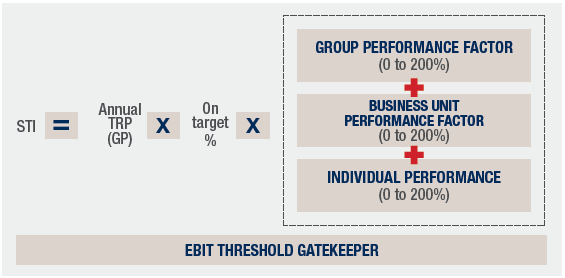
Predetermined weightings will be applied to each of the performance factors. In respect of the individual performance factor, participants will be rated on a rating scale ranging from 1 (poor performer) to 5 (exceptional performer).
Target and maximum
In FY22 the following ranges of STI awards will apply to the various categories of people covered by this report:
| On-target percentage of guaranteed package % |
Maximum of on-target percentage % |
||
| CEO, CFO and executive directors | 60 | 200 | |
| Executive committee members | 60 | 200 | |
| Other participants (Paterson grades CU to E band) | 8,5 to 50 | 200 |
Group and business unit performance factors
The underlying values and weightings for each KPI are set and approved by the remuneration committee in advance of each year to determine parameters for the STI in the form of a balanced scorecard. Below is the group STI scorecard for FY22 that will be applied to the CEO, CFO, executive directors, executive committee members and other participants.
| Strategic objective | Strategic objective weighting |
Key performance indicator |
Key performance indicator weighting |
Threshold score = 50% |
On-target score = 100% |
Stretch score = 200% |
|
| Growth*, ** | Sales volume growth | 10% | 92% | 100% | 108% | ||
| 65% | Brand health | 7,5% | 98% | 100% | 105% | ||
| Innovation | 7,5% | 92% | 100% | 108% | |||
| EBIT | 40% | 95% | 100% | 105% | |||
| Efficiency*, ** | Improvement in Overall Equipment Effectiveness year-on-year |
||||||
| 10% | Overall Equipment | 5% | 80% | 100% | 120% | ||
| Effectiveness (Factor in Waste) | Material Usage Variance (R’m) | ||||||
| 5% | 85% | 100% | 103% | ||||
| People and sustainability* | Reduction in complaints (consumer call line) year-on-year |
||||||
| Quality | 10% | 10% | 12% | 15% | |||
| 25% | Reduction in lost-time injuries year-on-year | ||||||
| Safety (LTI) | 10% | 46% | 50% | 54% | |||
| Leadership positions filled internally | 5% | 40% | 50% | 60% | |||
| * | The actual targets have not been provided as they are linked to budget and considered commercially sensitive information. |
| ** | For the key performance indicators within the growth and efficiency strategic objectives, the targeted percentages for “threshold”, “on-target” and “stretch”, as set out above, represent the targeted percentage achievement of the underlying budgeted amounts. |
The group, business unit and individual performance weightings applicable to the various employee categories are detailed below:
| Employee category | Group | Business unit |
Individual | |
| CEO, CFO and executive directors | 80% | 0% | 20% | |
| Executive committee members | 80% | 0% | 20% | |
| Other participants (Paterson grades CU to E band) | 0% to 40% | 40% to 80% | 20% |
LTI
Description
We have aligned our LTI to our reward approach and operating model, taking into consideration the following principles:
- Strengthen our ability to competitively attract and retain talent to enable the execution of our business strategy
- Align Tiger Brands’ management’s performance to our long-term strategy and, in particular, to unleashing the power of our people objective
- Employees in Paterson grade D and above may be eligible to participate in the annual awards of the LTI.
The table below provides further details regarding the performance and restricted shares awarded under the LTI plan (LTIP):
| Performance shares | Restricted shares | |||||
| Instrument | Employee category | Performance shares multiple |
Employee category | Restricted shares multiple |
||
| Award mechanism | CEO | 81,3% | CEO | – | ||
| CFO | 81,3% | CFO | – | |||
| Executive committee members | 61,0% | Executive committee members | – | |||
| Senior management and below | 10,6% to 27,7% | Senior management and below | 14,5% to 22,9% | |||
| Performance multiplier |
|
|||||
| Calculation of award quantum |
|
|
||||
| Vesting |
|
|
||||
| Performance conditions applicable to performance shares |
HEPS growth (weighted at 50%):
The HEPS calculation is performed on an annual compound basis over the three-year vesting period. Linear vesting to apply between threshold and stretch. ROIC – (weighted at 50%):
The measurement will be the average ROIC over the three-year vesting period. Linear vesting to apply between threshold and stretch. |
|||||
| Share price |
|
|||||
Historical LTI information
Eligible employees still participate in the following LTI instruments, the allocation of which had been discontinued in prior financial years:
- Restricted shares issued as bonus-matching shares (full value shares with a three-year vesting period, no performance criteria)
- Share appreciation rights (SARs).
Below is a description of the above share instruments.
Share appreciation rights
The last grant of SARs was made on 5 June 2019. The vesting and performance conditions of the SARs are set out hereunder.
The allocations of SARs were subject to performance vesting criteria. Apart from a 5% vesting in FY19 of the third tranche of SARs allocated in FY14, all the tranches of SARs allocated in subsequent financial years that would have vested in FY19 and thereafter have been forfeited due to performance criteria not having been met. This trend was identified in FY19 as an area of concern to the company as the mechanism was ineffective in providing key people with a vested interest in the company.
In mitigation of this risk, the allocation of SARs was discontinued and, as set out above the company commenced with the award of performance shares, (i.e. full value shares that are subject to performance conditions), and the grant of restricted shares with effect from FY20.
Vesting
Vesting is time-based according to the following pattern:
| Year from allocation date | |||||||
| 0 | 1 | 2 | 3 | 4 | 5 | ||
| Vesting | 1/3 | 1/3 | 1/3 | ||||
Performance metrics
The allocations of SARs during the 2019 financial year are subject to the performance criteria as set out in the table below:
| Metric | Measurement | Weight | Metric | ||||||||||
| HEPS growth (real) | Compound annual growth | 50% | Full vesting: HEPS = > CPI + rate of growth in GDP (measured on an annual compound basis over the applicable period) Pro rata vesting on a linear scale: HEPS growth > CPI but below CPI + GDP rate. No vesting if HEPS < = CPI | ||||||||||
| ROIC | Average ROIC measured over three, four and five years for each one-third tranche | 50% |
|
||||||||||
HEPS: Headline earnings per share.
ROIC: Return on invested capital (after tax).
For SARs allocated in December 2016, September 2017 and December 2017, the performance vesting condition is as follows:
| Metric | Weight | 0% vesting |
Maximum 100% vesting |
|
| HEPS | 100% | CPI and below | CPI +GDP |
Pro rata vesting on a linear scale of HEPS growth > CPI but below CPI + GDP rate. Further vesting condition: Average annual return on capital over the relevant performance period must exceed the company’s weighted average cost of capital (WACC).
Bonus-matching shares
The practice of granting restricted shares in the form of “bonus-matching shares” (which were linked directly to the achievement of an STI in the previous financial year) was discontinued as from FY19 (with the last grant of bonusmatching shares made on 6 December 2018). All previous grants of bonus-matching shares will continue to vest in accordance with the rules of the LTIP.
Vesting takes place on the third anniversary of the date of grant. No performance conditions are applicable.
BEE shares
The following two schemes were established as part of the company’s black empowerment strategy:
- Tiger Brands Black Managers Trust (BMT I)
- Established in 2005 to attract and retain diverse talent
- Rights allocated – Tiger Brands shares. Rights are settled after making the required capital contributions to BMT I. For all rights allocated on or before 31 July 2010, settlement may take place at any time after the initial lock-in period, i.e. from 1 January 2015. For all rights allocated after 31 July 2010, the lock-in date varies depending on the date of allocation. Periodically, new allocations are made to new joiners and top-up allocations are made to existing participants promoted to higher grades out of shares that may become available as a consequence of forfeitures.
- Thusani Trust
- Established in 2005 as part of the company’s BEE phase I empowerment initiative. The trust’s resources were enhanced in 2009 under the company’s BEE phase II transaction
- The trust provides bursaries for tertiary education to dependants of permanently employed black people who might not otherwise be able to afford this cost.
Dilution
The maximum aggregate number of shares that may be acquired by participants under the LTIP and any other share plan may not exceed 5,5 million shares, and for any one participant 550 000 shares. In determining these limits, shares acquired through the JSE and transferred to participants are not considered. At 30 September 2021, the aggregate number of shares that may be acquired by participants under the various schemes was 2 634 230 (2020: 2 728 933), which represents approximately 1,4% of the number of issued ordinary shares. This is in line with JSE regulations.
Minimum shareholding policy
We have a minimum shareholding policy, where senior executives are expected to build up their personal shareholding in the company over a specific period. In the case of the CEO, the target is 200% of guaranteed package while the target for executive directors and members of the executive committee is 100% of guaranteed package. Senior executives who were in service when the policy was adopted in 2016 have six years to build up their shareholding from date of adoption. Senior executives appointed after adoption have six years to build their shareholding from date of appointment. They may use any vesting LTIs or their own resources to acquire these shares.
Exemption from compliance with the minimum shareholding requirements
In the case of the minimum shareholding requirement not being met, the board retains the overriding discretion to:
- Vary the minimum shareholding level or extend the determination date for an individual executive or the executives as a whole. This will only be allowed to apply in exceptional circumstances considered as “business unusual”
- Determine that an executive has complied with the policy even if the number of shares held by an executive does not meet the minimum shareholding requirements. Such an exemption will only be allowed in exceptional circumstances where compliance will result in severe financial difficulty for an executive or prevent an executive from complying with an order of a court of law.
MALUS AND CLAWBACK
A malus and clawback policy is in place with the intention to minimise risk.
With respect to malus, if the remuneration committee, in consultation with the board and/or any committee of the board, believes that a trigger event has occurred, it has full discretion to reduce, in part or whole, unvested variable remuneration (i.e. STIs and LTIs) before the end of the vesting or payment period. In the case of clawback, it is the responsibility of the remuneration committee, in consultation with the board and/or any committee of the board, to implement clawback for the whole or portion of vested variable remuneration in the event of a trigger event occurring over a period of three years from the date on which payment was made of such vested variable remuneration. Trigger events include, but are not limited to:
- Material misstatement of financial results
- Misconduct, incompetence, fraud and dishonesty
- Negligence or material breach of obligations to the company
- Deliberate harm to the company’s reputation
- Material failure of risk management.
ILLUSTRATING POTENTIAL REMUNERATION OUTCOMES
The variable pay arrangements described above have various potential outcomes. These outcomes could be from zero (minimum) to the expected level of performance outcomes (target) to the maximum potential variable pay outcomes (maximum). In the illustrations presented below, it should be noted that:
- STI represents the cash component of short-term performance
- LTI represents the total award of performance vesting shares.
Total remuneration potential for members of executive management for the year ended 30 September 2021
| CHIEF EXECUTIVE OFFICER (R’000) |
CHIEF FINANCIAL OFFICER (R’000) |
|
 |
 |
|
| MEMBERS OF THE EXECUTIVE COMMITTEE (average) (R’000) |
||
 |
EXECUTIVE SERVICE CONTRACTS
Senior executives are employed full-time under standard agreements, with a notice period of three months. We strive to bind all senior executives by a restraint-of-trade agreement. To the extent that executives have access to proprietary business insights and intellectual property, Tiger Brands will enforce the agreement should they join a competitor. The restraint comprises a three-month notice period or three months’ special leave (paid as a three-month lump sum (based on guaranteed package) on termination).
SIGN-ON AND SPECIFIC RETENTION PAYMENTS
In exceptional circumstances (mainly for the recruitment and retention of critical and/or scarce talent), Tiger Brands will award a sign-on/retention payment which will be subject to the following conditions:
- Employees remaining in the service of Tiger Brands as a permanent employee for an uninterrupted period of 24 months from date of the payment. Should the employee or Tiger Brands decide to terminate the employment relationship for any reason, excluding those listed below, before the expiration of 24 months, the employee will be required to repay Tiger Brands the full gross amount. There will be no pro rata refunds. Should Tiger Brands terminate the employment relationship because of operational reasons (for example, retrenchment or redundancy) or ill health, or if termination occurs as a result of death, the employee will not be required to repay Tiger Brands.
Payments on termination of employment
| Remuneration policy component | Voluntary termination (i.e. resignation) | Involuntary termination (retrenchment, retirement, death) | ||
| GP | Paid up to last day of service | Paid up to last day of service including notice period, where applicable. | ||
| Medical aid | Benefit continues to last day of service | Benefit continues up to last day of service. Employees who qualify for post-retirement medical aid funding will continue to receive the employer contribution with effect from their normal retirement date. | ||
| Retirement and risk plans | Employer contributions paid until last day of service. Employee is entitled to the value of the investment, but all risk benefits cease on termination of service. | |||
| Other benefits | Not applicable | Severance package in respect of retrenchments – one or two weeks for every completed year of service in terms of the relevant rules. | ||
| STIs | No pro rata bonus paid | Pro rata STI payment (based on extent of achieving specified financial and strategic targets for the period and a personal performance agreement being in place at the date of exit). | ||
| LTIs | All unvested awards will be forfeited. Unexercised vested awards must be exercised not later than the last day of service, failing which they will lapse | Depending on the nature of the instrument and reasons for termination, a participant may retain all units or a pro rata portion. Accelerated vesting and settlement of retained units may apply in certain circumstances. | ||
EXTERNAL BOARD APPOINTMENTS
Under a formal policy, an executive is limited to one substantive outside directorship. The chairman of the Tiger Brands’ board, chairman of the nominations committee, and chairman of the remuneration committee are required to authorise these appointments based on a recommendation from the CEO. Other than in respect of their appointment to the boards of associate companies, directors’ fees under this policy may be retained by the individual. Other than associate companies, Tiger Brands currently has no executive members serving as non-executive directors on the main board or subcommittees of listed or public external companies.
Non-executive directors
Fees and approval process
Non-executive directors are paid an annual retainer that reflects their overall contribution and input to the company, and not just for attendance at board and committee meetings. Fees are reviewed annually, and increases are implemented in March after approval at the relevant AGM.
Benchmarking is conducted on an annual basis to benchmark these fees against South African companies listed on the JSE, based on market capitalisation, turnover and total assets. As these are similar metrics to that of the benchmark group for executive directors it was decided that from FY20, in line with King IV™ and in terms of the current requirements of the organisation, a single comparator group be adopted for the non-executive directors and executive directors’ remuneration benchmarking. The revised comparator group is detailed above.
Targeted remuneration for the 12-month period ending 28 February 2022 was based on the 65th percentile of the peer group, which is aligned with our internal anchor point. Non-resident non-executive directors are paid a premium in comparison to resident directors, which is below the market median. The chairman does not receive any additional remuneration for participating in committees of the board. Non-executive directors who perform services outside the scope of their ordinary duties will not receive additional remuneration. Shareholder approval will be sought for increasing non-executive directors’ fees, including fees paid for attending special board meetings. Details of proposed non-executive directors’ fees effective from 1 March 2022 appear in the notice of AGM of shareholders to be held on 22 February 2022. Details of non-executive directors’ fees paid in the review period appear below.
Voting statement
This remuneration policy is subject to a non-binding advisory vote by shareholders at the upcoming AGM.
SECTION 3: IMPLEMENTATION REPORT
In this section of the remuneration report we explain the implementation of our remuneration policy, providing details of the remuneration paid to our executive directors and members of the executive committee for the financial year ended 30 September 2021.
SALARY ADJUSTMENTS
In 2020 the remuneration committee approved a 0% annual increase December 2020. The only exceptions to this were the negotiated increases for bargaining unit employees and specific increases to reward high performance, retain critical skills and address the remuneration objective of fair and responsible pay in the CL and below employee population during the financial year.
2021 GP
The following increases to GPs were implemented in the reporting period for executive directors. New amounts were effective as indicated below:
| 1 Dec 2020 to 30 Nov 2021 |
1 Dec 2019 to 30 Nov 2020 |
% increase |
||
| Executive directors | ||||
| NP Doyle | 10 000 000 | 10 000 000 | 0%* |
| 1 May 2021 to 30 Nov 2021 |
1 Oct 2020 to 30 April 2021 |
% increase |
||
| DS Sita | 6 000 000 | 5 500 000 | 9,09%** |
| * | No increases were awarded in 2020. |
| ** | Appointed 1 October 2020, increase of 9,09% was agreed to at the time of sign-on subject to meeting certain performance criteria. |
2021 STI
As indicated in the policy section, the STI for executive directors is based on the combination of a group performance factor and individual performance component.
EXECUTIVE DIRECTORS
The group performance factor for executive directors is weighted according to the table below. Results for FY21 were as follows:
| Strategic objective weighting |
Key performance indicator |
Key performance indicator weighting |
Threshold score = 50% |
Target score = 100% |
Stretch score = 200% |
Achievement | ||||
| Strategic objective |
Actual result |
Weighted result |
||||||||
| Growth | 60% | Sales volume growth | 10% | 87% | 100% | 109% | Not achieved | 0,00% | ||
| Brand health | 10% | 98% | 100% | 105% | Threshold | 5,26% | ||||
| EBIT | 40% | 95% | 100% | 108% | Target | 50,95% | ||||
| Efficiency | 20% | Net working capital | 10% | 93% | 100% | 108% | Threshold | 5,09% | ||
| Overall Equipment Effectiveness (Factor in Waste) | 5% | Improvement in Overall Equipment Effectiveness year-on-year | ||||||||
| 83% | 100% | 125% | Target | 9,20% | ||||||
| 5% | Material Usage Variance (R’m) | |||||||||
| 92% | 100% | 112% | Threshold | 4,33% | ||||||
| People and sustainability | 20% | Quality | 10% | Reduction in complaints (consumer call line) year-on-year | ||||||
| 10% | 12% | 15% | Stretch | 20,00% | ||||||
| Safety (LTIFR) | 5% | Reduction in lost-time injuries year-on-year | ||||||||
| 10% | 15% | 20% | Target | 7,50% | ||||||
| EE – ACI opportunity utilisation |
5% | 70% | 80% | 90% | Target | 7,34% | ||||
The targeted percentages for threshold, target and stretch as set out above per KPI represent the targeted percentage achievement of the underlying budgeted amounts.
Linear vesting will apply if the actual result falls between threshold and target or between target and stretch.
- Despite achievement of the key performance indicators of the STI, as shown in the table above, the executive team were not awarded short-term incentives for FY21 due to the significant impact of the KOO cans recall and impact thereof on KPIs.
- The FY21 individual performance factor is the aggregated result of assessing the KPIs for the relevant executive, as follows:
Executive directors
Executive directors’ individual KPIs are aligned to the group KPIs. FY21 group KPIs and their achievement are listed above. The actual individual performance factor for executive directors is weighted according to the same table above. The results for FY21 were as follows:
| NP Doyle | DS Sita | |||||||||||
| KPIs | Not met |
Partially met |
Met | Exceeded | % achievement of target |
Not met |
Partially met |
Met | Exceeded | % achievement of target |
||
| Group KPIs |  |
|
||||||||||
|---|---|---|---|---|---|---|---|---|---|---|---|---|
| Name | GP* | On-target % |
Actual group performance factor % |
Actual personal performance factor % |
2021 STI (Rand)*** |
2020 STI (Rand) |
||||
| NP Doyle | 10 000 000 | x | 60% | x | 109,67% | + | 100% | – | – | |
| DS Sita** | 6 000 000 | x | 60% | x | 109,67% | + | 100% | – | – |
| * | Annual guaranteed package in rand as at 30 September 2021. |
| ** | Appointed 1 October 2020. |
| *** | Executive directors were not awarded STIs in FY21. |
2021 LTIs
In FY21, we awarded performance shares to executive directors, executive committee members, senior management and middle management. Grants of specific retention shares were made to selected senior management and key people whose contribution has been identified as being critical to achieving our business strategy.
LTI awards made during the year to executive directors are set out below:
LTI AWARDS TO EXECUTIVE DIRECTORS FOR FY21
| Performance shares | |||||||
| Name | LTI personal performance multiplier** |
GP | Award % | Number | Face value |
Expected value |
|
| NP Doyle | 150% | 10 000 000 | 81,3% | 59 930 | 12 195 755 | 15 000 779 | |
| DS Sita* | n/a | 5 500 000 | n/a | 9 700 | 1 973 950 | 2 427 959 | |
| DS Sita | 100% | 5 500 000 | 81,3% | 21 980 | 4 472 930 | 5 501 704 | |
| ** | The personal performance multiplier is used to modify the standard quantum of performance shares and restricted shares, based on an individual’s personal sustained performance and potential. This is a discretionary percentage ranging from 0% to 200%. |
| Allocated on 4 December 2020 at VWAP of R203,50. | |
| * | Sign-on allocation. |
TIGER BRANDS BLACK MANAGERS TRUST SCHEME AWARDS TO EXECUTIVE DIRECTORS FOR FY21
With effect from 31 January 2021, DS Sita was allocated 7 000 Tiger Brands shares, 5 950 Adcock Ingram shares and 1 811 Oceana shares in terms of the Tiger Brands Black Managers Trust scheme.
LTI AWARDS VESTING OR WITH A PERFORMANCE PERIOD ENDED IN 2021
The outcome for awards due to vest in FY21, and whose performance conditions ended by 30 September 2021, are shown below. This applies to all eligible participants.
| LTI measures | Performance condition result | ||
| LTI allocation | Real HEPS growth | % vesting | |
| Company-matching shares granted in FY18 | N/A | 100% (time-based vesting) | |
| Deferred bonus shares granted in FY18 | N/A | 100% (time-based vesting) | |
| Bonus-matching shares granted in FY18 | N/A | 100% (time-based vesting) | |
| SARs granted in FY16 – third tranche |  |
– | |
| SARs granted in FY17 – second tranche | |
– | |
| SARs granted in FY18 – first tranche | |
– |

CURRENT MINIMUM SHAREHOLDING SUMMARY
| Name | Date of engagement |
GP* | Number of shares held |
Original value of shares held |
Current value of shares held** |
Current value as % of GP |
Target % of GP |
Years remaining to meet target |
|
| NP Doyle | 1 July 2012 | 10 000 000 | 12 775 | 4 199 926 | 2 322 495 | 23% | 200% | 1 | |
|---|---|---|---|---|---|---|---|---|---|
| CXO1 | 5 December 2016 | 3 955 997 | 7 373 | 1 638 700 | 1 340 411 | 34% | 100% | 1 |
| * | GP as at 30 September 2021. |
| ** | Value determined with reference to the VWAP of the Tiger Brands share for the 10 trading days ended 30 September 2021. |
PAYMENTS FOR TERMINATION OF OFFICE
No additional payments were made for executives terminating office.
COMPLIANCE WITH REMUNERATION POLICY
There were no deviations from the remuneration policy in the financial year.
SINGLE TOTAL FIGURE OF REMUNERATION
The following tables disclose total remuneration received and receivable by executive directors and executive management for the period 1 October 2020 to 30 September 2021:
Executive directors
| NP Doyle | DS Sita* | LC Mac Dougall** | |||||||||
| Remuneration element | FY21 (R’000) |
FY20 (R’000)*** |
% | FY21 (R’000) |
FY20 (R’000) |
% | FY21 (R’000) |
FY20 (R’000) |
% | ||
| Basic salary | 8 591 | 6 996 | 4 958 | – | – | – | 3 094 | – | |||
|---|---|---|---|---|---|---|---|---|---|---|---|
| Retirement funding | 1 409 | 1 270 | 335 | – | – | – | 109 | – | |||
| Other benefits | – | – | 228 | – | – | – | 55 | – | |||
| Guaranteed package | 10 000 | 8 266 | 5 519 | – | – | 3 258 | – | ||||
| Short-term incentive | – | – | – | – | – | – | – | – | |||
| Cash remuneration | 10 000 | 8 266 | 5 519 | – | – | – | 3 258 | – | |||
| SARs | – | – | – | – | – | – | – | ||||
| Bonus matching shares | – | 315 | – | – | – | – | 128 | – | |||
| Deferred bonus shares and | |||||||||||
| company matching shares | – | 421 | – | – | – | – | 259 | – | |||
| Cash sign-on bonus | – | – | 1 818**** | – | – | – | – | – | |||
| Total remuneration | 10 000 | 9 002 | 11,1%*** | 7 337 | – | – | – | 3 645 | – | ||
| * | Appointed 1 October 2020. |
| ** | Retired 31 January 2020. |
| *** | In FY20 the executive committee forfeited 30% of their salaries for three months toward Covid-19 relief efforts. |
| **** | Subject to a two-year work-back provision. Expensed over two years. |
Members of executive committee
| Key | FY21 (R’000) |
FY20 (R’000)* |
| CXO1 | 3 956 | 3 710 |
|---|---|---|
| CXO2 | 1 793 | 3 841 |
| CXO3 | 4 985 | 5 193 |
| CXO4 | 3 044 | 5 017 |
| CXO5 | 4 565 | 4 056 |
| CXO6 | 5 513 | 5 776 |
| CXO7 | 5 347 | 3 297 |
| CXO8 | 4 221 | 3 770 |
| CXO9 | – | 1 738 |
| CXO10 | – | 5 274 |
| CXO11 | 6 500 | 5 347 |
| CXO12 | – | 2 660 |
| CXO13 | 4 820 | – |
| CXO14 | 3 433 | – |
| Total | 48 177 | 49 679 |
Notes:
CXO2 retrenched 31 December 2020.
CXO9 resigned 31 January 2020.
CXO10 resigned 31 August 2020.
CXO11 fixed-term contract.
CXO12 acted for the period February 2020 to September 2020.
CXO13 appointed 1 May 2021.
CXO14 appointed 15 November 2020.
* In FY20 the executive committee forfeited 30% of their salaries for three months toward Covid-19 relief efforts.
NUMBER AND VALUE OF LTI SHARE AWARDS
Disclosure of the quantum and value of awards for the CEO and CFO outstanding at the beginning and end of the reporting period, as well as new awards made in the period, are provided in the tables below, with the cash value of awards settled during the reporting period indicated in the value-based tables.
| Name and awards | Award date | Vesting date | Grant price (ZAR) |
Opening number |
Granted during the year |
Forfeited during the year |
Performance condition achieved |
|
| NP Doyle | ||||||||
|---|---|---|---|---|---|---|---|---|
| FY21 Performance shares | 04/12/2020 | 04/12/2023 | – | – | 59 930* | – | – | |
| FY20 Performance shares | 07/09/2020 | 07/09/2023 | – | 65 880 | – | – | – | |
| FY19 SARs | 06/12/2018 | 06/12/2021 | 254,79 | 18 895 | – | – | – | |
| 06/12/2022 | 254,79 | 18 896 | – | – | – | |||
| 06/12/2023 | 254,79 | 18 897 | – | – | – | |||
| FY18 SARs | 11/12/2017 | 11/12/2020 | 385,29 | 16 432 | – | 16 432 | – | |
| 11/12/2021 | 385,29 | 16 433 | – | – | – | |||
| 11/12/2022 | 385,29 | 16 433 | – | – | – | |||
| FY17 SARs | 07/12/2016 | 07/12/2020 |
368,11 |
12 112 |
– |
12 112 | – | |
| 07/12/2021 | 368,11 | 12 112 | – | – | – | |||
| FY16 SARs | 09/02/2016 | 09/02/2021 | 271,19 | 8 201 | – | 8 201 | – | |
| FY15 SARs | 04/02/2015 | 04/02/2018 | 358,22 | 1 117 | – | 1 117 | – | |
| Total | 205 408 | 59 930 | 37 862 | – |
| Name and awards | Settled during the year |
Closing number |
Face value at award (ZAR) |
Cash received (ZAR) |
Value of shares acquired (ZAR) |
Closing fair value vesting (ZAR) |
|
| NP Doyle | |||||||
|---|---|---|---|---|---|---|---|
| FY21 Performance shares | – | 59 930 | 12 195 755 | – | – | 10 457 785 | |
| FY20 Performance shares | – | 65 880 | 11 741 792 | – | – | 11 560 622 | |
| FY19 SARs | – | 18 895 | 4 814 257 | – | – | 216 159 | |
| – | 18 896 | 4 814 512 | – | – | 291 754 | ||
| – | 18 897 | 4 814 767 | – | – | 331 831 | ||
| FY18 SARs | – | – | – | – | – | – | |
| – | 16 433 | 6 331 471 | – | – | 3 944 | ||
| – | 16 433 | 6 331 471 | – | – | 35 167 | ||
| FY17 SARs | – | – | – | – | – | – | |
| – | 12 112 | 4 458 548 | – | – | 363 | ||
| FY16 SARs | – | – | – | – | – | – | |
| FY15 SARs | – | – | – | – | – | – | |
| Total | – | 227 476 | 55 502 572 | – | – | 22 897 626 |
| Name and awards | Award date | Vesting date | Grant price (ZAR) |
Opening number |
Granted during the year |
Forfeited during the year |
Performance condition achieved |
|
| DS Sita | ||||||||
|---|---|---|---|---|---|---|---|---|
| 2021 Performance shares | 04/12/2020 | 04/12/2023 | – | – | 31 680* | – | – | |
| Total | – | 31 680 | – | – |
| Name and awards | Settled during the year |
Closing number |
Face value at award (ZAR) |
Cash received (ZAR) |
Value of shares acquired (ZAR) |
Closing fair value vesting (ZAR) |
|
| DS Sita | |||||||
|---|---|---|---|---|---|---|---|
| 2021 Performance shares | – | 31 680 | 6 446 880 | – | – | 5 528 160 | |
| Total | – | 31 680 | 6 446 880 | – | – | 5 528 160 |
* Allocated on 4 December 2020 at a VWAP of R203,50.
INTERESTS OF EXECUTIVE DIRECTORS IN BBBEE SCHEMES
DS Sita was awarded shares in terms of the Black Managers Trust Scheme for the year ended 30 September 2021.
| Name and awards | Award date | Vesting date | Opening number | Granted during the year |
Forfeited during the year |
Settled during the year |
|
| Tiger Brands share allocation | 31/01/2021 | 31/01/2024 | – | 2 333 | – | – | |
|---|---|---|---|---|---|---|---|
| 31/01/2025 | – | 2 333 | – | – | |||
| 31/01/2026 | – | 2 334 | – | – | |||
| Adcock Ingram share allocation*** | 31/01/2021 | 31/01/2024 | – | 1 983 | – | – | |
| 31/01/2025 | – | 1 983 | – | – | |||
| 31/01/2026 | – | 1 984 | – | – | |||
| Oceana share allocation*** | 31/01/2021 | 31/01/2024 | – | 603 | – | – | |
| 31/01/2025 | – | 604 | – | – | |||
| 31/01/2026 | – | 604 | – | – | |||
| Total | – | 14 761 | – | – |
| Name and awards | Closing number |
Face value at award (ZAR)* |
Cash received (ZAR) |
Value of shares acquired (ZAR) |
Closing fair value vesting (ZAR)** |
|
| Tiger Brands share allocation | 2 333 | 334 995 | – | – | 317 871 | |
|---|---|---|---|---|---|---|
| 2 333 | 334 995 | – | – | 317 871 | ||
| 2 334 | 335 139 | – | – | 318 008 | ||
| Adcock Ingram share allocation*** | 1 983 | 63 278 | – | – | 65 538 | |
| 1 983 | 63 278 | – | – | 65 538 | ||
| 1 984 | 63 309 | – | – | 65 571 | ||
| Oceana share allocation*** | 603 | 30 554 | – | – | 31 127 | |
| 604 | 30 605 | – | – | 31 178 | ||
| 604 | 30 605 | – | – | 31 178 | ||
| Total | 14 761 | 1 286 758 | – | – | 1 243 881 |
| * | Calculated with reference to the market value of an allocated share (less the amount of the capital contribution) as at the date of the award. |
| ** | Calculated with reference to the market value of an allocated share (less the amount of the capital contribution) as at year end (30 September 2021). |
| *** | In addition to the award of the Tiger Brands shares, the executive was also awarded Adcock Ingram and Oceana shares (as a consequence of the unbundling by Tiger Brands of its interests in Adcock Ingram and Oceana, the Tiger Brands Black Managers Trust, as Tiger Brands shareholder, also became a shareholder of shares in Adcock Ingram and Oceana). Participants in the Trust are, consequently, also awarded shares in these two companies when awarded Tiger Brands shares. |
NON-EXECUTIVE DIRECTORS’ REMUNERATION FY21
The non-executive directors’ remuneration paid for the year ended 30 September 2021 is disclosed below, excluding VAT in rand:
| Committee | MO Ajukwu | MJ Bowman | I Burton | MP Fandeso | CH Fernandez | GJ Fraser- Moleketi |
GA Klintworth | |
| Notes | 1 | 2 | ||||||
|---|---|---|---|---|---|---|---|---|
| Board fees | 1 000 500 | 435 000 | 326 250 | 435 000 | 1 667 197 | 1 000 500 | ||
| Audit committee fees | 97 162 | 307 233 | ||||||
| Investment committee fees | 27 432 | 18 288 | ||||||
| Remuneration committee, nomination and governance committee fees | 245 897 | |||||||
| Social, ethics and transformation committee fees | 238 930 | |||||||
| Risk and sustainability committee fees | 354 255 | 191 033 | ||||||
| Extraordinary fees in respect of special board meeting | 105 740 | 45 974 | 45 974 | 45 974 | 105 740 | |||
| Ad hoc work/meetings | 48 581 | |||||||
| Total FY21 | 1 460 495 | 754 303 | 441 700 | 1 027 821 | 1 713 171 | 1 345 170 | ||
| Total FY20 | 1 279 854 | 649 724 | 108 750 | 309 970 | 936 414 | 108 750 | 1 173 764 |
| Committee | M Makanjee | TE Mashilwane | KDK Mokhele | MP Nyama | M Sello | OM Weber | DG Wilson | |
| Notes | 3 | 4 | ||||||
|---|---|---|---|---|---|---|---|---|
| Board fees | 435 000 | 435 000 | 519 482 | 217 500 | 435 000 | 1 000 500 | 435 000 | |
| Audit committee fees | 86 217 | 48 581 | 194 325 | |||||
| Investment committee fees | 29 718 | 68 354 | 29 718 | |||||
| Remuneration committee, nomination and governance committee fees | 114 844 | 114 844 | ||||||
| Social, ethics and transformation committee fees | 202 915 | 77 912 | 51 941 | 103 883 | ||||
| Risk and sustainability committee fees | 38 506 | 77 012 | 226 545 | 265 691 | ||||
| Extraordinary fees in respect of special board meeting | 45 974 | 45 974 | 45 974 | 105 740 | 45 974 | |||
| Ad hoc work/meetings | 48 581 | 48 581 | ||||||
| Total FY21 | 798 733 | 713 327 | 519 482 | 346 453 | 908 565 | 1 440 285 | 868 442 | |
| Total FY20 | 759 675 | 889 821 | 1 877 102 | 649 842 | 475 544 | 250 125 | 695 384 |
1 I Burton resigned 24 June 2021.
2 MP Fandeso resigned 28 February 2020.
3 KDK Mokhele retired 31 December 2020.
4 MP Nyama retired 17 February 2021.
NON-EXECUTIVE DIRECTORS’ REMUNERATION FY22
The following table reflects the proposed changes in the non-executive directors’ fees from 1 March 2022, excluding VAT, subject to the approval of shareholders at the AGM on 22 February 2022:
| Forum | Capacity | Current rate effective March 2021 |
Proposed rate resident board members – effective March 2022 |
Proposed fees to be paid to non-resident board members – effective March 2022 |
|
| Main board | Chairman | 2 077 929 | 2 161 000 | – | |
|---|---|---|---|---|---|
| Member | 435 000 | 452 500 | 1 040 750 | ||
| Audit | Chairman | 344 869 | 358 500 | – | |
| Member | 194 325 | 202 100 | – | ||
| Remuneration and nominations | Chairman | 245 897 | 255 700 | – | |
| Member | 114 844 | 119 400 | – | ||
| Risk and sustainability | Chairman | 302 061 | 314 000 | – | |
| Member | 154 024 | 160 200 | 368 460 | ||
| Social, ethics and transformation | Chairman | 202 915 | 211 000 | – | |
| Member | 103 883 | 110 000 | 253 000 | ||
| Hourly fees* | 4 572 | 4 754 | 10 934 | ||
| Extraordinary meetings** | 22 987 | 23 906 | 54 984 |
| * | Hourly fees are for the sole purpose of the calculation of fees for the investment committee meetings which are held on an ad hoc basis. |
| ** | Payment of fees for extraordinary meetings are at the discretion of the chairman of the board and chairman of the remuneration committee. |
NON-BINDING ADVISORY VOTE
This implementation report is subject to a non-binding advisory vote by shareholders at the AGM on 22 February 2022.