The Tiger Brands’ board has ultimate responsibility for overseeing the group’s risk management
and assurance arrangements and is assisted by the risk and sustainability committee in the
fulfilment of its fiduciary duties.
Senior management, across the divisions and business units,
are responsible for leading the management of risks in their
respective areas, while oversight at divisional level rests with
the relevant executive committees. Although divisional and
business unit risk registers are formally reviewed quarterly,
risks are managed continuously. The risk and sustainability
committee meets three times per year to provide group-level
oversight.
We are committed to maintaining an integrated process
of risk and assurance management that is rooted in
generally accepted frameworks and good practices,
including ISO 31000:2018 and the King IV™. Collectively the
risk registers provide a comprehensive and well-considered
view of the potential risks facing the group, its divisions and
business units. We thoroughly interrogate the various
mitigating strategies to ensure proactive responses to all
risks. This year, Tiger Brands did not engage in activities
that exposed it to undue, unexpected or unusual risks.
We have an integrated combined assurance
process to provide comfort to stakeholders that
our risks and opportunities are appropriately
managed. This process coordinates assurance
activities from various providers to ensure an
optimal assurance result.
These processes are embedded through our risk-aware
culture, in which every employee, contractor and consultant
contributes to the effective identification and management
of all risks, including compliance and IT risks. Our culture
supports the continual strengthening of our risk management
and assurance processes to achieve the targeted maturity
level as set by the board, which is informed by independent
assessments of the effectiveness of our risk management
arrangements.
RISK APPETITE AND TOLERANCE
Risk appetite refers to the level of risk that Tiger Brands’
management is prepared to absorb before mitigating actions
are implemented; risk tolerance refers to the company’s
strategic capacity to accept or absorb the risk. The risk and
sustainability committee determines the risk appetite and
tolerance. The board reviews and approves this annually,
ensuring that the company effectively identifies, manages and
reports on risk across all operations and all territories. The
underlying reporting structure starts at site level and rolls up
into the relevant business unit and division, culminating in risk
reporting at group level.
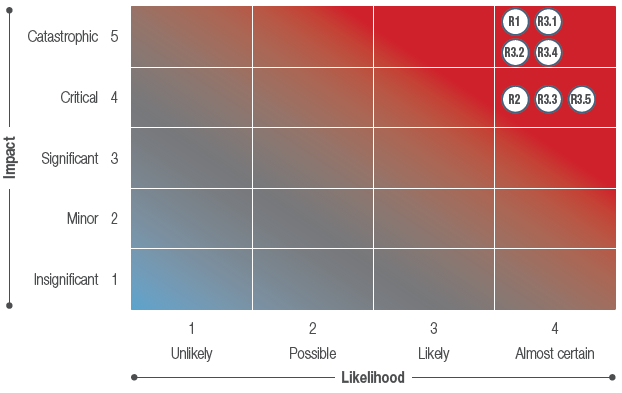
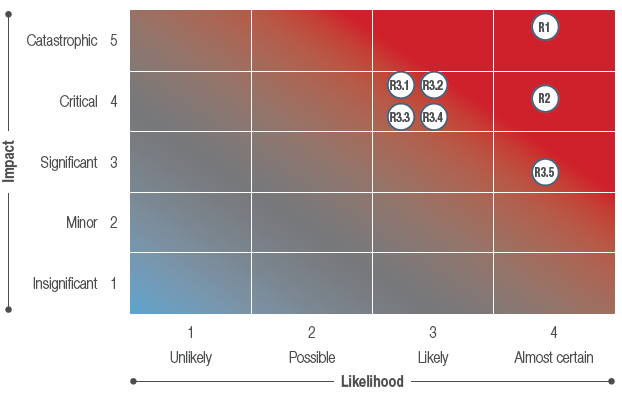
Each risk is evaluated in terms of its likelihood and impact,
both on an inherent basis (before controls) and a residual basis
(after controls). The group risk profile is reviewed quarterly and
may be revised after considering changes to the local and
regional macro-economic environment, recent political and
legislative developments, socio-economic challenges, and
technological advancements. Through our combined
assurance model, the risk and sustainability committee
evaluates and approves the level of assurance provided
for all the group risks.
OUR TOP RISKS
The heat maps overleaf reflect those risks that exceed our
residual tolerance level and that are thus identified as having
the most material implications for Tiger Brands and its
employees. Each risk is presented from an inherent and
residual perspective, based on key tolerance levels.
INHERENT RISK MAP
Albany route-to-market
Inability to respond to changes in market dynamics and competition
Negative impact of Covid-19
Food quality and safety
RESIDUAL RISK MAP
Changing consumer preferences
Information and cyber security
Data and information risk
The following table briefly reviews the implications, mitigation measures and the year-on-year trend in the risk rating, for each of our top risks.
MEET THE NEEDS
OF THE CONSUMER
OPTIMISE OUR
SUPPLY CHAIN
BE OBSESSED ABOUT COST
SAVINGS AND EFFICIENCIES
BUILD A GROWTH
PIPELINE
IGNITE
OUR PEOPLE
1. Albany route-to-market
Risk trend /2020 ranking (1)
CONTEXT AND VALUE IMPACT
This remains our top risk; we have zero
appetite for loss of life, which is the primary
driver for the overall risk rating. Increasing
levels of violent crime against drivers in the
bakery route-to-market can result in:
Employee and service provider loss of life
Distribution disruptions
Reputational and brand damage
Potential loss of market share.
MITIGATING ACTIONS
All delivery routes are risk assessed and tailored response measures developed
Embedding implementation, adherence and compliance to all security-related policies
Security assessment reports have been compiled for all facilities to address security-related improvement opportunities
We are looking to address issues around CCTV installations, security system
upgrades, maintenance of current security systems, and service level agreements on
monitoring security practices, and we are piloting cashless digital payment systems.
2.
Inability to respond to changes in market
dynamics and competition
Risk trend /2020 ranking (10)
CONTEXT AND VALUE IMPACT
Changing market dynamics, customer
consolidation and intensifying competition are
changing in response to constrained consumer
spending, and the rise of smaller niche players,
private label, and cheap imports. This poses an
increasing challenge to our market
performance, threatening:
Loss of customers and market share
Retailer dominance, with customers
becoming competitors
Erosion of brand equity and profit margins.
MITIGATING ACTIONS
Key account forums and joint business plans established with major customers
Enhanced research and analytics, with monitoring of customer and brand
strategies and performance
Investing in strengthening our innovation, focusing on fewer and larger innovation
projects – on value, nutrition and convenience – as well as building our Big Brand
image and consumer intimacy and loyalty
Containing cost pushes in the supply chain to ensure that products remain
competitively priced
Strengthened customer marketing teams and invested in category management
resources and tools to enhance in-store execution
Commercial analytics tool used to optimise promotions
Standardised legally compliant, fair and equitable trading terms.
3.1
Covid-19 impacts
Risk trend /2020 ranking (2)
CONTEXT AND VALUE IMPACT
The high rate of Covid-19 infections and the response measures
implemented by government and business, increased market uncertainty
and challenged risk management through the following:
Economic shutdown and reduced growth
Production setbacks and declining stock levels
Increased operational costs and revenue loss
Employee unease, absenteeism, job loss and loss of life
Declines in customer experience and brand reputation.
MITIGATING ACTIONS
Operations managed responsibly with the health
and safety of employees a top priority
Global raw material availability may impact finished
product supply levels in some categories. We are well
placed in the short to medium term and confident we
can meet demand, increasing production capacity on
key food products if needed.
3.2
Food quality and safety
Risk trend /2020 ranking (5)
CONTEXT AND VALUE IMPACT
Challenges with food safety can have significant
implications in terms of:
Loss of life
Reputational and brand damage
Loss of market share
Disruptions to production
Expensive product recall
Potential litigation.
MITIGATING ACTIONS
Revised good manufacturing practice (GMP) standards and food safety system
certification standard (FSSC 22000) implemented across the group, supported
by standardised quality self-assessments for all our manufacturing sites, training
of quality teams and a robust supplier quality management process
Manufacturing, group legal and regulatory compliance functions collaborate
to ensure products comply with regulatory standards and meet consumer
preferences.
Entrenched partnership with Stellenbosch University to remain at the forefront of scientific trends, through the Centre for Food Safety
Adoption of European Hygienic Engineering and Design Guidelines (EHEDG) in terms of manufacturing hygiene standards
Additional efforts to close gaps, reduce surprises, eliminate new liabilities and foster a "quality" culture.
3.3
Changing consumer preferences
Risk trend /2020 ranking (new)
CONTEXT AND VALUE IMPACT
The challenging macro-economic environment and
changing market dynamics have led to a change
in consumer behaviour and preferences including
uptake of e-commerce, increased focus on health
and wellness, "greener" food, local products and
brands, and changing consumer taste
Weakened consumer demand on the back of low
economic growth negatively impacting volumes
and heightened consumer focus on shopping on
promotion, negatively impacts profitability
Risk of inadequate market intelligence, consumer
insight, misaligned price management responses;
insufficient investment in innovation; and lack of
flexibility due to facility constraints.
MITIGATING ACTIONS
Consumer and market insights team that is tracking market and consumer
behaviour and preferences through a variety of methodologies to guide and
inform business decision making
Innovation director appointed who is reworking our innovation practices
and methodologies to drive a step change in innovation performance
Innovation opportunities being realised in areas such as snackification,
value, and health and wellness
Currently rolling out revenue growth management practices across our
business units to be smarter with our pricing practices
Research study completed to enhance our understanding of consumers’
consumption patterns and inform our innovation and communication
activities
Launched the Venture Capital Fund to access and invest in external
innovation.
3.4
Information and cyber security
Risk trend /2020 ranking (7)
CONTEXT AND VALUE IMPACT
Increasing interconnectivity, globalisation and
“commercialisation” of cyber crime are driving greater
frequency and severity of cyber incidents, including
data breaches:
This can compromise the confidentiality, integrity
and availability of information and technology
resources, lead to disclosure of commercially
sensitive information, intellectual property and/or
disruption to operations
In addition to non-compliance risks, the release
of any personal information also has negative
reputational and brand implications.
MITIGATING ACTIONS
IT policies have been established to support the group’s approach to
managing information security
The cyber security landscape is monitored with a view to implementing
the latest security practices and revising existing controls to safeguard
the group against cyber crime and maintaining cyber resilience
Various initiatives underway including multifactor authentication, identity
and access governance, privileged access management, Information
Technology and Operations Technology (IT/OT) convergence, data
masking in our databases, and initiating a full review of all mimecast rule
sets to obtain the right balance between tight security and usability
Various external security specialist providers utilised to further enhance
our security posture.
3.5
Data and information risk
Risk trend /2020 ranking (8)
CONTEXT AND VALUE IMPACT
Suboptimal information management could
lead to inconsistent data quality,
compromising decisions and contributing to
privacy/identity management and information
security risks
Increased regulation is placing additional
demand on system capabilities and IT teams
and presents implications in terms of
compliance and potential non-compliance
costs.
MITIGATING ACTIONS
Security testing is considered for all applicable projects with the aim
of strengthening our technology control environment for data security.
Implementation of enterprise-wide data and information strategy is in progress
The following policies govern the development of new solutions on an ongoing
basis: information security and cyber resilience policy, information privacy policy,
and acceptable usage policy
A data management specialist is being contracted to assist in the formulation and
strengthening of our capabilities in this area, working jointly with the IT and legal
team to drive the required architecture and governance aspects across the group.
TIGER BRANDS LIMITED
(Tiger Brands or the company)
(Incorporated in the Republic of South Africa)
Share code: TBS
ISIN: ZAE000071080
INDEPENDENT NON-EXECUTIVE DIRECTORS
GJ Fraser-Moleketi (chairman)
MO Ajukwu
MJ Bowman
CH Fernandez
GA Klintworth
M Makanjee
TE Mashilwane
M Sello
OM Weber
DG Wilson
This report contains forward-looking statements that, unless otherwise indicated, reflect the company’s expectations at
the time of finalising the report. Actual results may differ materially from these expectations if known and unknown risks or
uncertainties affect the business, or if estimates or assumptions prove inaccurate. Tiger Brands cannot guarantee that any
forward-looking statement will materialise and, accordingly, readers are cautioned not to place undue reliance on these
statements. The company assumes no obligation to update or revise any forward-looking statements, even if new information
becomes available as a result of future events or for any other reason, save as required by legislation or regulation.