
INTEGRATED ANNUAL REPORT 2024
for the year ended 30 September 2024
for the year ended 30 September 2024
Recognising the rapid growth rates in the general trade segment, we are looking to boost the competitive presence of our brands across the general trade segment by delivering an effective route-to-market and shopper marketing solution. We are continuing to identify and realise opportunities in the e-commerce space, deliver precision execution, and strengthen our relationships with customers across all channels.
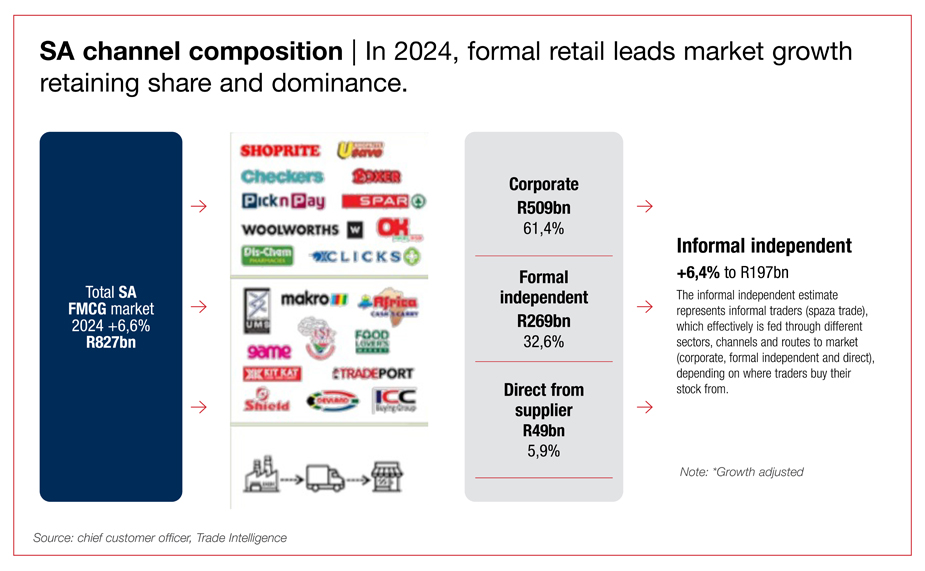
Although the formal retail channel remains the largest contributor to the South African FMCG sector – at roughly 61% of the estimated R827 billion market. In recent years, there has been strong growth in the market share of wholesalers and distributors (general trade), including among informal independent traders such as spaza shops and superettes. At the same time, there has been a growing blurring across traditional channels, with wholesalers moving into the retail space, and large retailers venturing into wholesale and small, low-cost convenience stores, including in more remote rural areas.
With households in the general trade channel representing around 61% of total shoppers, and with the channel delivering around 8,9% CAGR growth, this is a critical target market for Tiger Brands. Aided by the acceleration of fintech – that is formalising ordering and payment platforms and facilitating the provision of value-added services in spaza shops – the general trade channel is becoming increasingly modernised, well organised and more convenient, with longer trading hours and more extensive geographic reach. Shoppers typically visit spaza stores up to four times more than traditional supermarkets, providing a significant opportunity to expose shoppers to our products and brands.
Given this growth potential, we are looking to accelerate the presence of our brands across the general trade channel through a three-pronged strategy.
These strategic commitments are underpinned by our activities aimed at strengthening the capabilities of our sales force, optimising our routes to market, and leveraging digital transformation opportunities to automate our sales processes, improve customer data accuracy, and equip our sales team with the necessary digital tools and training. Collectively these various activities have contributed to a reduction in the cost to serve and a positive operating income, helping to create an estimated 300 local jobs.
Grocery e-commerce continues to grow rapidly, becoming one of the largest categories in the broader e-commerce channel, and offering significant opportunities for brand penetration. This year, we have continued to drive various initiatives to raise our online presence and become the preferred supplier to prioritised digital commerce partners, making further progress in our targeted areas:
We have delivered strong performance this year, delivering 54% growth in Bricks & Clicks and 26% growth in Pureplay.
Recognising that stores differ significantly in terms of their trading space, and their shopper and mission profiles, it is critical that we develop highly tailored channel strategies informed by a detailed understanding of different shopper profiles. We are working with retailers – who are increasingly using data analytics and AI to leverage basket data – to deepen our understanding of shopper behaviour and preferences, and to inform our shopper activation and store execution plans. By continuing to improve our shopper-centric segmentation of trade channels, this is enabling us to develop more focused consumer messaging and engagement, more tailored pricing and promotions, and more appropriate price and pack architecture, as well as delivering valuable cost savings.
To ensure cost efficient and effective execution across our serviced channels, and to meet our "cost to serve" and execution targets, we have continued to roll out our Perfect Outlet standards and our strategic initiatives relating to operational effectiveness and cost efficiency. Using a modern trade dynamic resource model, we have optimised resourcing to ensure that the right people are in the right store at the right time, including increasing weekend coverage to respond to higher trading levels. We have expanded out Perfect Outlet programme to cover new channels and customers, and we have grown the reach to cover 1 500 stores. Using increasingly sophisticated retailer data, we are improving our predictive analytics models to identify execution opportunities, sharing these more effectively through a digital dashboard that is assisting to improve resourcing and strengthen delivery of our Perfect Outlet standards.
In our most recent trade perceptions survey, Tiger Brands was ranked in the top five in terms of the quality of our customer engagement against leading FMCG manufacturers. Informed by the survey feedback, we have identified various opportunities to address the identified challenges and further improve customers' perception of their relationship with Tiger Brands. To ensure more strategic alignment with our customers, we are intensifying the customer forums across all our key customers, and we are continuing to work with them to ensure greater alignment between our category strategies and customers' strategies to maximise growth through mutually beneficial win-win opportunities. In line with our new federated operating model, we have strengthened delegation of authority to customer management teams, and we are working with our retail partners to leverage retail media to co-create category solutions for mutual benefit. To improve supply chain management, we are undertaking joint forecasting to drive improved factory efficiencies and ensure optimised service levels.
We have continued to leverage our revenue management practices to improve profitability and optimise our customer portfolio by ensuring that our product prices, placement and availability are properly aligned within each customer segment. This is based on an informed understanding of customers' perception of product value, and on a detailed review of price indexing, discount curves and brand health. Through improved data analytics at an SKU and customer level, and improved simulation tools of product price elasticities, we have strengthened our ability to identify opportunities to eliminate margin dilution in specific product categories and to target volume growth. We continue to work on simplifying our trading terms and provide clearer performance metrics aimed at incentivising strong customer performance aligned with our strategic growth drivers.