
INTEGRATED ANNUAL REPORT 2023
For the year ended 30 September 2023
For the year ended 30 September 2023
Tiger Brands’ results for the 12 months ended 30 September 2023 reflect the challenging trading environment marked by high food inflation, cost-conscious consumers continuing to trade out of premium products, rand depreciation and unreliable electricity supply.

Despite double-digit inflation across the portfolio, the impact on group volumes was minimal. Total revenue increased by 10% to R37,4 billion, driven by price inflation of 11%, favourable foreign exchange gains of 1%, and marginal overall volume declines of 2%. Volume growth in Exports was offset by volume declines in the Domestic Business, primarily attributable to Milling and Baking, Groceries and Baby, as well as the Deciduous Fruit business due to the timing of shipments. These volume declines were partially offset by good volume growth in Rice, Beverages, Home and Personal Care, Tiger Brands Food Service Solutions, as well as Chococam.
Cost-containment initiatives and supply chain efficiencies continued to make a positive contribution to the results at R525 million, R65 million higher than the R460 million previously guided. Despite this, the ongoing challenges of fully recovering higher input costs persisted in the second half, resulting in the overall gross margin declining to 27,7% from the 30,3% reported in the prior year. Group operating income was impacted by non-recurring items related to insurance proceeds of R137 million (2022: R190 million) and retrenchment costs in the current year of R95 million (2022: reversal of R8 million). Group operating income decreased by 9% to R3,1 billion.
Income from associates increased by 46% to R697 million, driven by a good underlying performance from Carozzi. Earnings from National Foods were favourably impacted by R120 million due to a change in functional currency from Zimbabwean dollars (ZWD) to United States dollars (USD) as a consequence of listing on the Victoria Falls Stock Exchange (VFEX) in January 2022.
Net financing costs for the year amounted to R238 million compared to R75 million last year. The increase was due to higher interest rates, the impact on opening cash balances of the R1,5 billion share buy-back, which commenced in June 2022 and concluded in August 2022, and higher average levels of working capital investment despite progress being made in managing these levels down in the second half.
The group’s effective tax rate before fair value losses, non-operational items and income from associates declined slightly to 29,0% from 29,4% last year.
EPS decreased by 2% to 1 725 cents (2022: 1 762 cents). HEPS increased marginally by 2% to 1 735 cents (2022: 1 702 cents). The variation in EPS when compared to HEPS is due to the non-recurrence of certain capital profit items accounted for in EPS in FY22, which were excluded from HEPS.
This year, our strategies in our Exports division paid off, while the Domestic Business reflected the tough operating environment, with mixed performances across our local divisions.
In Grains, revenue benefited from price increases across all segments and a strong volume performance in rice and bread. While bread volumes and market shares increased in line with the intended strategy, price realisations and profit margins were negatively impacted by adverse channel mix as volumes in the general trade declined. The bakery business was also impacted by the significant incremental cost of loadshedding versus prior year (R69 million in FY23 vs. R18 million in FY22) and higher conversion costs due to higher wages and utilities. Our sorghum-based Breakfast and Beverages business delivered a muted performance, impacted by supply challenges and lower demand. Although our Jungle business delivered solid profit growth, adverse product mix, higher raw material and distribution costs, and sub-optimal factory performances in the Rice and Pasta segments adversely impacted overall profitability.
| (R’million) | FY23 | FY22 |
|---|---|---|
| Total revenue | 37 388 | 34 029 |
| Cost of sales | (27 048) | (23 713) |
| Gross profit | 10 340 | 10 3161 |
| Gross profit % | 27,7% | 30,3% |
| Sales, marketing and distribution expenses | (5 671) | (5 257) |
| Other operating expenses | (1 719) | (1 847) |
| Operating income before sundry income | 2 950 | 3 2122 |
| Sundry income | 168 | 219 |
| Operating income before impairments and non-operational items | 3 118 | 3 431 |
| Operating income % | 8,3% | 10,0% |
| Impairments and fair value losses | (43) | (16) |
| Operating income before non-operational items | 3 075 | 3 415 |
| Non-operational items | 33 | 28 |
| Profit including non-operational items | 3 108 | 3 443 |
| Net finance costs | (238) | (75)3 |
| Foreign exchange profit/(loss) | (34) | 46 |
| Investment income | 18 | 23 |
| Income from associated companies | 697 | 4784 |
| Profit before taxation | 3 551 | 3 915 |
| Taxation | (817) | (1 020) |
| Profit for the year | 2 734 | 2 895 |
| EPS from operations | 1 725 | 1 762 |
| HEPS from operations | 1 735 | 1 702 |
1. Decline in gross margin attributable to higher input costs and under-recoveries
2. Cost-containment initiatives and supply chain efficiencies amounted to R525 million, ahead of R460 million target
Operating income impacted by:
3. Higher financing costs driven by higher average debt levels and interest rates as well as higher working capital requirements
4. Income from associates benefited from good underlying performance at Carozzi and change in functional currency reporting at National Foods
Within Consumer Brands, all segments delivered top-line growth, with a particularly strong performance from Snacks and Treats, Beverages and Tiger Brands Food Service Solutions. Lower profitability is reflective of the ongoing challenges of fully recovering from higher input costs, particularly from agricultural inputs, as well as the fact that certain categories reflected the difficult consumer environment with absolute category volume contraction.
Home and Personal Care’s performance was driven by a solid recovery in both segments. Revenue in Personal Care was up 24%, with higher volumes in skincare brands, Ingram’s and Skin Clinic. Operating income benefited from strong volume growth, price increases, and lower inflation on key ingredients. Home Care’s top-line performance was supported by a better pest season, while improved factory efficiencies, cost containment initiatives, and favourable mix resulted in higher operating income.
Exports and International delivered a pleasing performance, driven primarily by a step change in the Rest of Africa business, with Exports reporting a marked improvement across all key metrics, namely volumes, revenue and profitability. Exports and International increased revenue by 14% to R4,9 billion while profits were up 71% to R601 million, benefiting from improved profitability, especially within Exports and Deciduous Fruit, as well as an improvement in the quality of the debtor’s book. The sale process for Deciduous Fruit (Langeberg & Ashton Foods) was re-opened earlier in the year, with the final stage of a due diligence process currently underway. The business will continue in its current form to allow the process to be completed.
Chococam’s operating environment was characterised by high input costs, unreliable electricity supply and increased regulation pertaining to imports. Nevertheless, revenue increased by 30% to R1,4 billion, comprising price inflation and solid volume growth, driven by a strong performance from the spreads segment while pricing stability and optimal packaging solutions resulted in market share gains. Operating income benefited from sound cost control. The overall performance was further boosted by rand weakness on translation.
Further details are provided in the operational review.
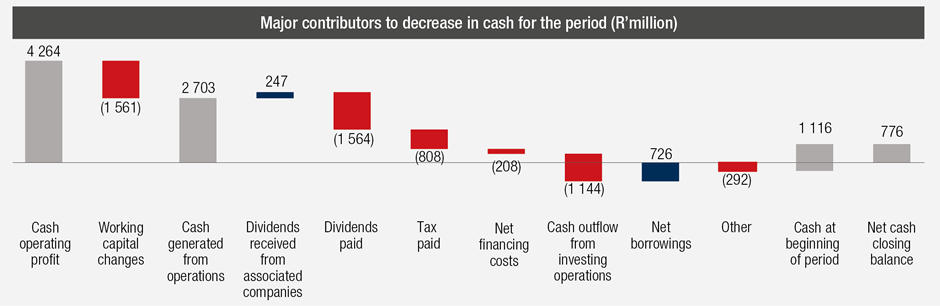
Cash operating profit relative to the prior year was unchanged at R4,3 billion. The benefit of lower inventory outflows on working capital was offset by a decline in trade and other payables, which is in line with the company’s strategy of securing raw materials, packaging, and ingredients in response to a volatile and unreliable global and local inbound supply chain. This resulted in cash generated from operations increasing marginally to R2,7 billion. Capital expenditure for the period amounted to R1,2 billion (2022: R1,0 billion). The group ended the period in a net debt position of R923 million (2022: net cash R143 million).
The company declared a final ordinary dividend of 671 cents per share for the year ended 30 September 2023, in line with the company’s dividend policy of 1,75x cover based on HEPS. Together with the interim dividend of 320 cents per share, this brings the total dividend for the year to 991 cents per share. Shareholders are referred to the dividend declaration in the AFS for further details.
As previously reported, pre-trial preparations by the parties to get the matter ready for trial are ongoing. As part of the overall endeavour to expedite the resolution of the matter, Tiger Brands’ legal team and the plaintiffs’ attorneys jointly approached the National Institute of Communicable Diseases (NICD) for access to their records, which are vital to a determination of the action. Tiger Brands is yet to receive a response from the NICD.
The last three years at Tiger Brands have been challenging as well as rewarding. During my tenure, we have made significant investments in technology and digital capabilities, which will help drive operational efficiencies, increase automation, improve customer and consumer data and analytics, and drive revenue management initiatives. We have resourced up in critical functions such as logistics and procurement, the benefits of which will emerge in the medium to long term. In addition, we have pursued cost-saving opportunities with rigour, and laid the foundation that will benefit the group going forward.
Finally, the year under review marks the successful transition and on-boarding of Deloitte & Touche as the company’s newly appointed independent auditors.
I wish to thank Noel, my colleagues on the executive committee, the audit committee, and the board for their support and guidance throughout my time at Tiger Brands. I am particularly grateful to the finance team for their dedication, unwavering commitment and support. Finally, thank you to our shareholders for their investment and meaningful engagement.
Tiger Brands has what is needed to deliver on its full potential and to restore the business to its rightful position. I wish Tjaart and the executive team the very best and I will watch with keen interest from afar.
Deepa Sita
Chief financial officer
30 November 2023
