
INTEGRATED ANNUAL REPORT 2023
For the year ended 30 September 2023
For the year ended 30 September 2023

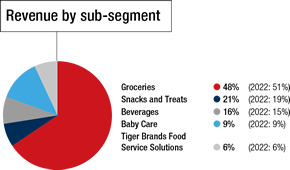
Groceries' revenue was largely unchanged at R6,4 billion, with price inflation of 8% offset by lower volumes of 7%. The muted top-line performance reflects the lower category demand that was evident in the first half, continuing into the second half, with market volumes contracting by 5% over the year. In addition to the adverse category dynamics, raw material shortages in the first half, exacerbated by the low supply of eggs in the second half due to avian influenza, resulted in factory under-recoveries. Operating income declined by 49% to R308 million. Improving profitability is a primary focus area for FY24, with cost reduction being a critical focus area. Good progress has been made in this regard, with the factory restructuring completed and initiatives underway to reduce warehousing and distribution costs. Moreover, the relocation of the peanut butter plant has progressed well, with the startup of the new site on track for the first quarter of FY24.
The Snacks and Treats division recorded revenue growth of 16% to R2,8 billion, supported by price inflation of 6% and overall volume growth of 10% achieved primarily by the sugar segment. The category remains in volume decline as consumers limit basket spend to necessities. Despite this, Snacks and Treats achieved value and volume growth ahead of the market over the 12-month period. Operating income, however, was adversely impacted by the reconfiguration of the plant to improve safety protocols as well as raw material shortages. This resulted in significant under-recoveries and lost sales. Operating income declined by 13% to R229 million.
Beverages' revenue increased by 17% to R2,2 billion, supported by volume growth of 12% and price inflation of 5%. Volume growth was achieved across all dilutable brands benefiting from optimal pricing and effective promotional activity. This was offset in part by a less-than-favourable volume performance from sports drinks (Energade), which faces strong competitor activity and new listings. Despite significant increases in the cost of key ingredients and packaging items, operating income for the full year increased 27% to R340 million. This was due to the successful execution of the pricing strategy in the dilutable segment, focused continuous improvement initiatives, price pack architecture, and revenue growth management.
The Baby segment performance reflects the continued affordability challenges across the category as consumers opt out of baby-specific offerings and into general meal and wellbeing solutions for the whole family. Revenue was marginally up at R1,1 billion, driven by price inflation of 5%, offset by volume declines of 4%. Volumes are reflective of lower demand across key segments, particularly jars, while pouches continue to gain share in a declining market. Operating income declined by 9% to R134 million, with the benefit of improved factory efficiencies being more than offset by lower volumes and an unfavourable product mix.
Tiger Brands Food Service Solutions delivered a strong set of full-year results. Revenue grew by 25% to R835 million, with volumes increasing by 15% and price inflation of 10%. Operating income increased 12% to R152 million, benefiting from improved efficiencies in distribution. The business successfully executed accelerating growth in key channels while improving the product and margin mix, supported by strong customer relationships, cross-category collaboration and agile solutions.
Revenue
R13,3 billion
2022: R12,4 billion
8%
Operating income
R1,2 billion
2022: R1,4 billion
18%
Operating margin
8,7%
2022: 11,1%
240bps