
INTEGRATED ANNUAL REPORT 2023
For the year ended 30 September 2023
For the year ended 30 September 2023
Section 1: Background statement
On behalf of the remuneration committee (the committee), I am pleased to present the 2023 remuneration report which, in compliance with best practice reporting as recommended by the King IV™ Report on Corporate Governance for South Africa, highlights:
During the period under review, the Tiger Brands executive leadership team have led the execution of our five strategic priorities to drive business performance, growth and innovation while proactively navigating very challenging market conditions. The six strategic priorities continued to focus the organisation on:
| 1. | Meeting the needs of the consumer |
| 2. | Building a growth pipeline |
| 3. | Be obsessed about cost-savings and efficiencies |
| 4. | Optimising our supply chain |
| 5. | Igniting our people |
| 6. | Investing in a sustainable future |
Operating in a pressurised consumer market, in the context of persistently elevated food inflation, high interest rates, low economic growth, and high cost of living, the company experienced pressure on sales volumes in the domestic business and overall group margins. As a result, the company did not achieve the threshold group EBIT target required to release funding for the group portion of the short-term incentive (STI). As our remuneration philosophy is clear on the principle of pay for performance, Tiger Brands executives (CEO, CFO and Exco) will receive no STI in FY23.
The third and last tranche of share appreciation rights (SARs) that vested in FY23 did not achieve the minimum performance conditions for both the HEPS and ROIC targets. As a result, this tranche of SARs lapsed. The performance vesting shares (PVS) awarded in December 2020 will vest on 3 December 2023. For the period covering this award, the HEPS stretch target was exceeded, resulting in a 200% vesting rate of this portion (50% of award). The ROIC threshold target was achieved, resulting in a 25,49% vesting of this component. As a result, the overall vesting of the December 2020 PVS award is at 112,7%.
The one-off retention payments and share grants made to executive committee members (as detailed in the FY22 report) to stabilise and retain key talent succeeded in retaining the services of 88% of recipients to ensure the continued focus on business performance in the context of challenging economic conditions. The resignation of the CFO, Deepa Sita, to pursue a new opportunity in Australia was announced during the year. Consequently, Deepa's retention share awards under this initiative shall be forfeited as the vesting date is December 2024.
As announced in October 2023, the board and Noel Doyle jointly agreed that he steps down as CEO. The terms of the separation were mutually agreed upon, the principles of which are disclosed below. The incoming CEO, Tjaart Kruger, commenced service in November 2023. His compensation details are disclosed below.
During the period under review, further enhancements were made to the remuneration strategy to improve alignment of critical business key performance indicators (KPIs) to measure and reward performance against our strategy. As such, the remuneration committee approved the implementation of a revised short-term incentive (STI) scorecard that enables the achievement of key performance indicators as well as maintains a balance between the focus on financial, strategic and sustainability measures.
As reported in FY22, ESG-associated targets to drive and measure our performance were implemented. To this end, the remuneration committee approved an ESG key performance indicator (KPI) and associated targets for inclusion in the FY23 short-term incentive scheme scorecard (see below: FY24 group and business unit performance factors, and executive directors performance scorecard FY23).
The committee also approved an upward revision of on-target and stretch conditions in respect of the long-term incentive plan (see table below: LTI performance conditions).
The remuneration committee maintains strong relationships with shareholders and strives towards high standards of disclosure of our remuneration approach to ensure that there is a clear understanding of our remuneration policy and the practices that have been adopted.
The non-binding advisory votes by shareholders for the past four years are summarised as follows:
| % vote in favour | February 2023 |
February 2022 |
February 2021 |
February 2020 |
|---|---|---|---|---|
| Remuneration policy | 73,70% | 91,55% | 89,20% | 76,55% |
| Remuneration implementation | 53,81% | 96,94% | 82,24% | 78,71% |
Neither remuneration policy nor the implementation report achieved the requisite threshold of 75% non-binding advisory approval. Tiger Brands is committed to continuous and robust shareholder engagement. To this end, key shareholders were engaged prior to the annual general meeting as well as in response to the voting outcomes. The outcomes of these engagements are addressed in the following section.
The remuneration committee chairman, the chief human resources officer (CHRO) and investor relations conducted a series of engagements with key shareholders, with the feedback summarised below:
1. |
General feedback Most shareholders were complimentary on how the Tiger Brands' remuneration policy has been simplified, improved and aligned more explicitly with shareholder interests over the last three years. They were also appreciative on how the disclosure in the remuneration report had become progressively more transparent. |
2. |
Retention grants to executive team (excluding CEO) Although the majority of shareholders indicated support for the retention payments, citing their understanding of the fine balance between retaining skill and aligning management reward with shareholder returns, there were reservations expressed around the usage of a) cash payments, and b) restricted shares, the vesting criterion of which is only time with no performance vesting criteria. The shareholders also requested full disclosure of retention payments in the remuneration report. The retention payments were fully disclosed in the FY22 remuneration report. |
3. |
ESG metrics Most shareholders indicated that they rely on companies to indicate which metrics are most relevant to creating long term, sustainable value but mentioned carbon emissions, energy efficiencies and water as relevant in the context of companies operating in South Africa. Tiger Brands has a comprehensive ESG strategy (see the sustainability report). In addition to existing KPIs for efficiency, quality and safety, reduction in carbon emissions was integrated into the short-term incentive (STI) scorecard in FY23. |
4. |
Minimum shareholding requirement targets Consistent feedback from all shareholders was that the minimum shareholding requirement (MSR) targets are on the lower side, with best practice being 300% for the CEO, 200% for the CFO, and 100% for the rest of the executive committee. In addition, they recommended that Tiger Brands considers putting mechanisms in place to enable executives to meet MSR requirements within the set period. The remuneration policy has been benchmarked against market practice and reviewed accordingly to make the mechanisms that enable executives to meet the MSR requirements more explicit. |
5. |
Retrospective disclosure of business performance targets used to determine short-term incentives An area of improvement for the majority of shareholders is the disclosure of retrospective business performance targets used to determine short-term incentives. The remuneration committee has considered this feedback and made a decision to continue to align the disclosure policies with industry standards so as to proactively manage the risk of disclosing information that could jeopardise Tiger Brands' competitive position in the market. |
The remuneration committee is committed to shareholder engagement and takes the following steps, if 25% or more of total votes exercised by shareholders at the AGM are against the remuneration policy or implementation report:
In FY23, the committee executed its duties in line with the approved annual work plan, which included the following activities:
The focus areas are deliberately designed to ensure the committee remains abreast of the latest remuneration market trends and best practice, business needs, as well as our responsibilities to Tiger Brands' people, shareholders, and communities to ensure that our remuneration practices enable and support the delivery of the business strategy.
Key focus areas in FY24 will include:
We enlist the services of PwC South Africa for purposes of independent benchmarking, incentive scheme market practice, remuneration trends and survey data. KPMG is engaged for the purposes of auditing STI payments and to assist with the review of the single figure of the remuneration table. The committee is satisfied that PwC South Africa and KPMG are independent and remain objective in providing the services.
As required by the King IV Code on Corporate Governance, the remuneration policy and implementation report that follow will be tabled for separate, non-binding advisory votes by shareholders at the upcoming AGM in February 2024. As required by the Companies Act, non-executive directors' fees for the coming year will be put to shareholders by way of a special resolution. We are committed to engaging with shareholders as required to discuss issues of concern and, therefore, encourage shareholders to provide feedback.
On behalf of the committee, I am satisfied that the remuneration policy is appropriate, and I am confident that our remuneration policy has achieved the desired outcomes for FY23 and is aligned with the company's strategic goals and shareholder interests. The remuneration disclosures presented in this report have been made in compliance with the remuneration policy as approved by shareholders. No known deviations from the remuneration policy have been made in the current financial year.
As I take over the chairmanship of the remuneration committee, I would like to thank Don Wilson for his service as chairman of this committee for the last three years and wish him well with his new role as chairman of the audit committee.
Lucia Swartz
Chairman: remuneration committee
30 November 2023
Section 2: Overview of remuneration policy
The membership of the Tiger Brands remuneration committee consists of a minimum of three non-executive directors, the majority of who are independent. The CEO is a permanent invitee to all meetings and other executives attend the meetings by invitation.
The CEO and nominated invitees are not present when matters relating to their own remuneration are discussed. The group company secretary is the secretary of the committee.
The committee meets four times a year and, where necessary, additional meetings may be held.
The role of the committee is to provide independent and objective assistance to the board in ensuring that Tiger Brands remunerates fairly, responsibly, and transparently to promote the achievement of strategic objectives and positive performance outcomes in the short, medium and long term.
As documented in the remuneration committee terms of reference, the duties and responsibilities of the committee are:
The terms of reference are reviewed annually.
Tiger Brands is committed to a total reward offering built on a strong foundation of fair and responsible pay that is linked to our remuneration philosophy of pay for performance. Salaries are benchmarked against the REMchannel® salary survey once a year to ensure that remuneration decisions are fair and in line with market practice. We also follow a job-grading methodology that is consistent and provides a fair and accurate job grade, which allows for proper salary benchmarking.
Our pay progression model strives to fairly reward employees based on performance and market positioning. It enables us to actively manage outlier compensation in a fair and responsible manner, and to ensure that differentials that exist are justifiable.
Unjustifiable pay differentials are addressed during the annual reward review process, where we assess and adjust the salaries of unjustifiably underpaid employees in line with the prevailing mandate. This salary adjustment is generally capped at a predetermined percentage to limit exorbitant increases. Specific focus is given to African, Coloured, female, and employees in roles that are classified as scarce and critical skills.
In addition, we follow a systemic approach in day-to-day decision-making by ensuring individual pay and salary ranges are matched to similar roles in the market, and frameworks that guide decision-makers to ensure that new appointments, promotions, and other pay review opportunities are executed in accordance with our set standards and parameters. At every compensation review opportunity, we consider, report and interrogate pay differentials seen through various lenses, including gender and race. At every compensation decision point, we ensure that these differentials, where they are unjustified, are addressed with a view to continuously narrow such gaps. After each company-wide pay review, these outcomes and trends are reported to the board for approval before implementation. As a result, income differentials have closed significantly since 2018 when we started to apply dedicated and structured efforts. To maintain the focus on fair and responsible pay, Tiger Brands will perform regular analyses of compensation differentials and close gaps accordingly.
The company's remuneration strategy is aligned to the Tiger Brands' people strategy, which is geared to enable the execution of the business strategy and accelerate business performance.
Our remuneration principles have been designed to support the execution of the people strategy and are premised on our belief that great people and great brands are at the core of our success. Our reward framework is holistic, encompassing the financial elements of reward as well as non-financial aspects such as recognition, development, the work environment, culture and meaningful work.
 |
The following are the key objectives of our remuneration policy:
Below we have summarised the various remuneration elements (guaranteed package, short-term incentive, and long-term incentive) that Tiger Brands offers at different levels of employment:
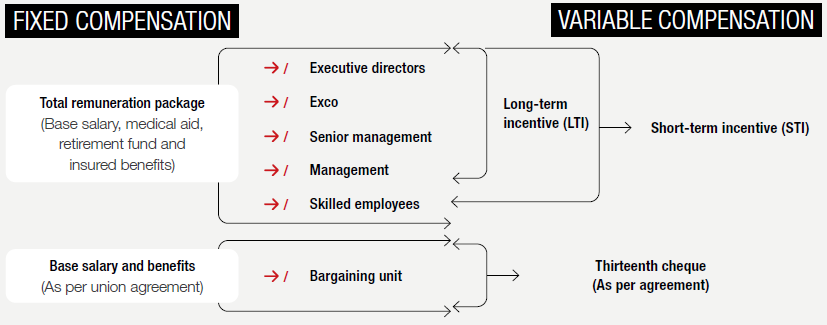 |
Guaranteed package (GP) offered to people on a total remuneration package basis (TRP) comprises base pay, allowances, retirement and medical benefits. It is reviewed annually based on personal performance (KPIs linked to individual performance agreements (IPA) for each TRP employee, which is agreed to at the commencement of every year), business performance (linked to budget), behaviours aligned with company values, and market competitiveness (national and sector benchmarks).
Benchmarking for executive directors is based on a comparator group of companies and is reviewed on a bi-annual basis. The comparator group is determined using the closeness metric formula, which measures how similar a candidate company is to Tiger Brands, and is based on:
Companies included in the comparator group comprise:
| Factor | Executive directors | Rest of Exco, senior management, and below |
|||
| Survey type |
Bespoke survey Public data of South African companies listed on the JSE, based on the closeness metric used to determine an appropriate comparator group |
REMchannel® survey: National and consumer goods circles | |||
| JSE-listed comparator group* |
|
RCL Foods Limited Oceana Group Limited Woolworths Holdings Limited Barloworld Limited Libstar Holdings Limited |
|||
| * From FY22, the same comparator group is issued for executive directors' and non-executive directors' remuneration benchmarking | |||||
| Anchor point | Tiger Brands has anchored its current pay position at the 65th percentile of the national market. We aspire to achieve a normal distribution around the anchor point based on individual performance, talent, potential, experience and scarcity and criticality of skills. The performance-based increases granted in the organisation (including those for executive directors and executive committee members) are managed within the overall salary increase budget. | ||||
| Benefits | Benefits include retirement fund contributions, funeral cover, permanent health insurance, death-in-service cover, medical aid contributions and travel allowances (where applicable). | ||||
The primary intention of the STI is to improve business performance by focusing participants' attention on annual key financial, strategic, functional and personal performance objectives (KPIs based on a balanced scorecard), which are aligned with the long-term business strategy for sustainable value creation. This drives high performance by explicitly creating line of sight in linking group, business unit and individual performance.
Payment of an STI is subject to the overriding condition that the group and business unit meet or exceed the agreed entry threshold in respect of its earnings before interest and tax (EBIT).
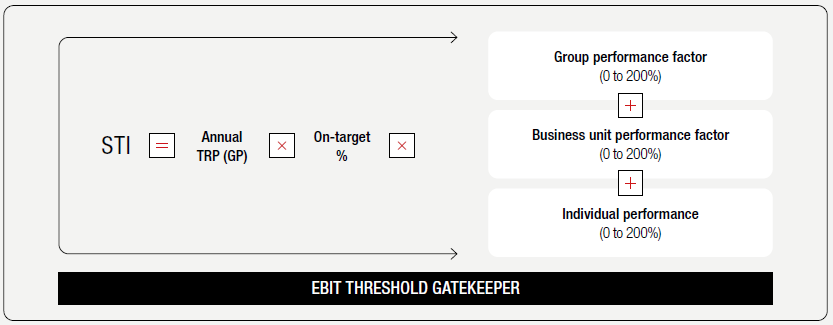 |
Predetermined weightings are applied to each of the performance factors, ranging from 50% (threshold performance) to 200% (stretch performance). In respect of the individual performance factor, participants will be rated on a rating scale ranging from 1 (poor performer) to 5 (exceptional performer).
In FY24, the following ranges of STI awards will apply to the various categories of people covered by this report:
| On-target percentage of guaranteed package (%) |
Maximum percentage of guaranteed package (based on the achievement of stretch performance) (%) |
|
| CEO, CFO and executive directors | 60 | 120 |
| Executive committee members | 60 | 120 |
| Senior management (EU MDs) | 50 | 100 |
| Senior management (EU) | 40 | 80 |
| Senior management (EL) | 35 | 70 |
| Qualified and experienced specialists and mid-management (DU) | 17,5 | 35 |
| Qualified and experienced specialists and mid-management (DL) | 12,5 | 25 |
| Technical, skilled and supervisory employees (CU band) | 8,5 | 17 |
The underlying values and weightings for each KPI are set and approved by the remuneration committee in advance of each year to determine parameters for the STI in the form of a balanced scorecard. The STI scorecard for 2024 is simplified so as to ensure sharper focus on key outcomes. Below is the group STI scorecard for FY24 that will be applied to the CEO, CFO, executive directors, executive committee members, and other participants:
| Strategic objective | Strategic objective weighting |
Key performance indicator | Key performance indicator weighting |
Threshold score = 50% |
On-target score = 100% |
Stretch score = 200% |
| Performance and growth | 80% | Brand equity | 5% | 89% | 100% | 111% |
| EBIT (absolute) | 25% | 95% | 100% | 105% | ||
| EBIT (margin) | 20% | 96% | 100% | 108% | ||
| Gross margin | 20% | 98% | 100% | 105% | ||
| Working capital management | 10% | Cash conversion rate (cash generated from operations as a % of EBITDA) |
||||
| 86% | 100% | 143% | ||||
| Enablers: People and sustainability | 20% | Quality and food safety | 5% | Reduction in complaints year-on-year | ||
| 83% | 100% | 117% | ||||
| Safety (LTI manufacturing) | 5% | 94% | 100% | 107% | ||
| Carbon emissions | 5% | 80% | 100% | 140% | ||
| Talent pipeline | 5% | % internal leadership appointments | ||||
| 75% | 100% | 125% | ||||
| * The actual targets have not been provided as they are linked to budget and considered to be commercially sensitive information ** The targeted percentages for “threshold”, “on-target” and “stretch” as set out above per key performance indicator represent the targeted percentage achievement of the underlying budgeted amounts |
The group, business unit and individual performance weightings applicable to the various employee categories are detailed below:
| Employee category | Group | Business unit |
Individual |
| CEO, CFO and executive directors | 80% | 0% | 20% |
| Executive committee members | 80% | 0% | 20% |
| Other participants (Paterson grades CU to E band) | 0% to 40% | 40% to 80% | 20% |
The LTI is aligned to our reward approach and operating model, taking into consideration the following principles:
Employees in Paterson grade D and above may be eligible to participate in the annual awards of the long-term incentive.
The table below provides further detail regarding the performance and restricted shares awarded under the long-term incentive plan:
| Instrument | Performance shares | Restricted shares | ||||
| Employee category | Performance shares award multiple as a % of guaranteed pay |
Employee category | Restricted shares award multiple as a % of guaranteed pay |
|||
| Award mechanism | CEO | 81,3% | CEO | – | ||
| CFO | 81,3% | CFO | – | |||
| Executive committee members | 61,0% | Executive committee members | – | |||
| Senior management and below | 10,6% to 27,7% | Senior management and below | 8,2% to 22,9% | |||
| Performance multiplier |
|
|||||
| Calculation of award quantum |
|
|
||||
| Vesting |
|
|
||||
| Performance conditions applicable to performance shares |
HEPS growth (weighted at 50%):
The HEPS calculation is performed on an annual compound basis over the three-year vesting period. Linear vesting to apply between threshold and stretch. ROIC (weighted at 50%):
The measurement will be the average ROIC over the three-year vesting period. Linear vesting to apply between threshold and stretch. Definition of ROIC: Operating income from total operations before impairments and non-operational items (reduced by the group's average tax rate) plus the after-tax share of income from associates as a percentage of average invested capital. Invested capital comprises the book value of total equity (which is inclusive of non-controlling interests), plus long-term and short-term borrowings (including the liability arising from IFRS 16), less the value of cash on hand and cash equivalents. Invested capital is also increased by the re-instatement of any write-offs/impairments (both historically as well in the current period) that are included in non-operational income of any intangible assets, fixed assets, and associates. The average invested capital is determined by calculating the simple average of the aforesaid balances, based on their values at the beginning and end of the relevant financial year. |
|||||
| Share price |
|
|||||
| (1) | +4% for all allocations before December 2023 |
| (2) | +2% for all allocations before December 2023 |
Eligible employees who have been awarded SARs prior to its discontinuation in FY19 continue to participate in the SARs. No new SARs awarded since FY19.
The following two schemes were established as part of the company's black empowerment strategy:
In compliance with the JSE Listings Requirements, the LTIP contains limits setting out the aggregate maximum number of shares that may be settled to all participants as well as the aggregate maximum number of shares to be settled to any one participant. The LTIP rules provide that these limits are not applicable where shares acquired on the JSE are used to settle LTIP awards. Tiger's practice is to purchase shares in the market and the LTIP therefore does not result in any dilution to shareholders.
On 30 September 2023, the aggregate number of shares that may be acquired by participants under the various schemes, and which will be purchased in the market, was 2 200 673 (2022: 2 557 731).
We have a minimum shareholding policy, where senior executives are expected to build up their personal shareholding in the company over a specific period. In the case of the CEO, the target is 200% of guaranteed package, while the target for executive directors and members of the Exco is 100% of guaranteed package. Senior executives who were in service when the policy was adopted in 2016 have six years to build up their shareholding from date of adoption. Senior executives appointed after adoption have six years to build their shareholding from date of appointment. They may use any vesting LTIs or their own resources to acquire these shares.
In order to accelerate the progress towards achieving minimum shareholding, this policy was amended to compel a commitment of a minimum of 30% (thirty percent) of executives' vested long-term incentives towards their shareholding pre-tax or post-tax, or such portion required to reach the minimum shareholding, should they be less than 30% below the requirement.
In the case of the minimum shareholding requirement not being met, the board retains the overriding discretion to:
The preventative aim of this policy is to remove the incentive for an executive to intentionally manipulate financial results or financial position or organisational information with the intention of financially benefiting from variable remuneration. These provisions align the interests of executives with the long-term interests of the organisation as well as shareholders, and to ensure that irresponsible behaviour is not rewarded.
With respect to malus, if the remuneration committee, in consultation with the board and/or any committee of the board, believes that a trigger event has occurred, it has full discretion to reduce, in part or whole, unvested variable remuneration (i.e. STIs and LTIs) before the end of the vesting or payment period. In the case of clawback, the remuneration committee, in consultation with the board and/or any committee of the board, may implement clawback for the whole or portion of vested variable remuneration in the event of a trigger event occurring over a period of three years from the date on which payment was made of such vested variable remuneration. Trigger events include, but are not limited to:
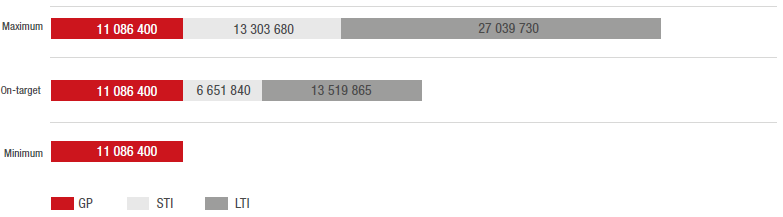
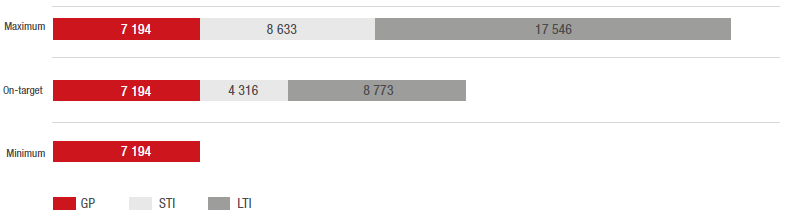
The variable pay arrangements described above have various potential outcomes. These outcomes could be from zero (minimum) to the expected level of performance outcomes (target) to the maximum potential variable pay outcomes (maximum).
In the illustrations presented alongside, it should be noted that:
CEO (R'000)
The depiction below mirrors the potential remuneration of the outgoing CEO, expressed in annual terms.
CFO (R'000)
Members of the executive committee (average) (R'000)
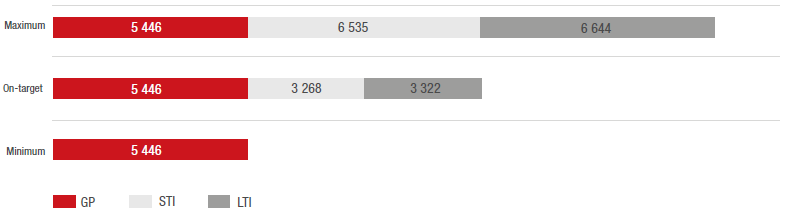
Senior executives are employed full-time under standard agreements, with a notice period of three months and retirement age of 63. We bind all senior executives by a restraint-of-trade agreement to protect Tiger Brands' interests (including trade secrets, confidential information and customer connections), and to prevent economic prejudice to Tiger Brands, including loss of clients and goodwill. To the extent that executives have access to proprietary business insights and intellectual property, Tiger Brands will enforce the agreement should they join a competitor. The restraint comprises a three-month notice period or three months' special leave (paid as a three-month lump sum based on guaranteed package on termination).
In exceptional circumstances (mainly for the recruitment and retention of critical and/or scarce talent), Tiger Brands will award a sign-on/retention payment that will be subject to the following conditions:
| Remuneration policy component |
Voluntary termination (i.e. resignation) |
Involuntary termination (retrenchment, retirement, death) |
| Guaranteed package | Paid up to last day of service | Paid up to last day of service including notice period, where applicable. |
| Medical aid | Benefit continues to last day of service | Benefit continues up to last day of service. Employees who qualify for post-retirement medical aid funding will continue to receive the employer contribution with effect from their normal retirement date. |
| Retirement and risk plans | Employer contributions paid until last day of service. Employee is entitled to the value of the investment, but all risk benefits cease on termination of service. | |
| Other benefits | Not applicable | Severance package in respect of retrenchments – one or two weeks for every completed year of service in terms of the relevant rules. |
| Short-term incentives | No pro rata bonus paid | Pro rata STI payment (based on extent of achieving specified financial and strategic targets for the period and a personal performance agreement being in place at the date of exit). |
| Long-term incentives | All unvested awards lapse | Depending on the nature of the instrument and reasons for termination, a participant may retain all units or a pro rata portion. Accelerated vesting and settlement of retained units may apply in certain circumstances. |
Under a formal policy, an executive is limited to one substantive outside directorship. The chairman of the Tiger Brands' board, chairman of the nominations committee and chairman of the remuneration committee are required to authorise these appointments based on a recommendation from the CEO. Other than in respect of their appointment to the boards of associate companies, directors' fees under this policy may be retained by the individual. Other than associate companies, Deepa Sita serves on the board of Datatec Limited.
Fees and approval process
Non-executive directors are paid an annual retainer that reflects their overall contribution and input to the company, and not just for attendance at board and committee meetings. Fees are reviewed annually, and increases are implemented in March after approval at the relevant AGM.
Benchmarking is conducted on an annual basis to benchmark these fees against South African companies listed on the JSE based on market capitalisation, turnover and total assets. As these are similar metrics to that of the benchmark group for executive directors, it was decided that, from FY20, in line with King IV™ and in terms of the current requirements of the organisation, a single comparator group be adopted for the non-executive directors' and executive directors' remuneration benchmarking. The revised comparator group is detailed above.
Targeted remuneration for the 12-month period ending 28 February 2023 was based on the 65th percentile of the comparator group, which is aligned with our internal anchor point. Non-resident, non-executive directors are paid a premium in comparison to resident directors. The chairman does not receive any additional remuneration for participating in committees of the board. Non-executive directors who perform services outside the scope of their ordinary duties will not receive additional remuneration. Shareholder approval will be sought for increasing non-executive directors' fees, including fees paid for attending special board meetings. Details of proposed non-executive directors' fees effective from 1 March 2023 appear in the notice of AGM of shareholders to be held on Thursday, 22 February 2024. Details of non-executive directors' fees paid in the review period appear below.
Voting statement
This remuneration policy is subject to a non-binding advisory vote by shareholders at the upcoming AGM.
Section 3: Implementation report
In this section of the remuneration report, we explain the implementation of our remuneration policy, providing details of the remuneration paid to our executive directors and members of the executive committee for the financial year ended 30 September 2023.
In 2022, the remuneration committee approved a 6,5% annual increase effective December 2022. This excludes the negotiated increases for bargaining unit employees and targeted increases to reward exceptional performance, retain critical skills and execute day-to-day internal mobility practices such as promotions, transfers and other deployments during the financial year.
The following increases to guaranteed packages were implemented in the reporting period for executive directors. New amounts were effective as indicated below. Deepa Sita's increase at the time reflected acknowledgement of performance, criticality of role and skills and market position.
| 1 Dec 2022 to 30 Nov 2023 |
1 Dec 2021 to 30 Nov 2022 |
% increase | |
| Executive directors | |||
| NP Doyle | R11 086 400 | R10 400 000 | 6,6% |
| DS Sita | R7 194 000 | R6 600 000 | 9,0% |
The board and Noel Doyle entered into a mutual separation agreement, which facilitated his amicable exit. His exit is subject to various conditions, including restraint-of-trade conditions for a period of six (6) months after his formal termination, which is March 2024.
The financial aspects of the mutual separation agreement include a severance payment equal to two weeks per year's service, three months' contractual notice pay, a payment in lieu of restraint of trade equal to six months, and annual leave accrued at termination date. The financial details of the separation payments will be fully disclosed in the FY24 remuneration report.
Outstanding long-term incentives shall be treated in terms of the rules of the scheme. Unvested share awards shall be reduced pro rata in relation to Noel's service period relative to the award period, and shares shall vest according to the existing structure. There shall be no accelerated vesting.
The incoming CEO's total reward offer is in line with the market, and in accordance with Tiger Brands' policy and practices. Because Tjaart Kruger is engaged on a fixed-term basis, some elements of his compensation were specifically agreed upon to avoid conflict with current policies and regulations, and to drive business outcomes required by the board in relation to the period of service.
| Element | Multiple | On-target amount |
| Salary | N/A | R11 000 000 |
| STI | On-target 60%; max 120% | R6 600 000 |
| End-of-term conditional award (allocation value = 100% of guaranteed package) | On-target 100%; max 200% | R22 550 000 (Face value over the 26-month term) |
The conditional award is a vehicle that aligns with shareholder interests, in terms of which conditional rights to shares in Tiger Brands Limited are awarded to Tjaart Kruger. This award is different to performance vesting shares awarded to executive management, given that the measurement period is equal to the length of the contract (two years), as opposed to the three-year vesting criterion for performance vesting shares. This is a focused and bespoke plan aligned with the strategic objective of fixing the fundamentals and creating value for shareholders. The award will vest at the end of the contract period (31 December 2025) subject to the achievement of performance outcomes as set out in the table below over the contract period and will be settled using shares purchased in the market by the company. A one-year lock-in period will apply from the date of issue until 31 December 2026. In addition, Tjaart has agreed to purchase Tiger Brands shares with his own funds, in the open market, by the end of March 2024.
| Performance condition | Weighting | Threshold (25% vesting) |
Target (100% vesting) |
Stretch (200% vesting) |
| Operating margin | 40% | 90% of target | 100% | 119% of target |
| ROIC | 40% | WACC + 1% | WACC + 3% | WACC + 5% |
| Cash flow (cash conversion) | 20% | 86% of target | 100% | 143% of target |
As indicated in the policy section, the STI for executive directors is based on the combination of a group performance factor and individual performance component.
The group performance factor (80% overall weighting) for executive directors is weighted according to the table below. Results for FY23 were as follows:
| Achievement | ||||||||
| Strategic objective |
Strategic objective weighting |
Key performance indicator |
Key performance indicator weighting |
Threshold score = 50% |
Target score = 100% |
Stretch score = 200% |
Actual result |
Weighted result |
| Growth | 57,5% | Sales volume growth | 5% | 92% | 100% | 150% | <0% | 0% |
| Brand health | 7,5% | 96% | 100% | 104% | 93% | 0% | ||
| Innovation | 5% | Net sales delivery | 74% | 0% | ||||
| 90% | 100% | 120% | ||||||
| Pipeline value | 57% | 0% | ||||||
| 93% | 100% | 114% | ||||||
| EBIT | 40% | 96% | 100% | 107% | 90% | 0% | ||
| Efficiency | 10% | Overall equipment effectiveness (factor in waste) | 5% | 78% | 100% | 144% | 71% | 0% |
| Continuous improvement | 5% | 89% | 100% | 122% | 117% | 5,4% | ||
| People and sustainability | 32,5% | Quality | 10% | Reduction in complaints year-on-year | 121% | 17,5% | ||
| 86% | 100% | 129% | ||||||
| Safety (LTIFR) | 10% | Reduction in lost-time injuries year-on-year | 116% | 2,0% | ||||
| 96% | 100% | 113% | ||||||
| Carbon emissions | 5% | 67% | 100% | 150% | 2% | 0% | ||
| Talent pipeline | 7,5% | Time to fill | 113% | 5,6% | ||||
| 82% | 100% | 129% | ||||||
| Vacancy fill % | 110% | 7,1% | ||||||
| 89% | 100% | 111% | ||||||
| Final group performance factor | 59% | |||||||
| EBIT disqualifier | 0% | |||||||
Due to the non-achievement of the group EBIT threshold, the EBIT disqualifier is triggered, and therefore disqualifies the group portion of the STI weighting.
The individual performance factor (20% overall weighting) for executive directors is weighted according to the table below. The results for FY23 were as follows:
| NP DOYLE | DS SITA | ||||||||
| Key performance indicators |
Not met |
Partially met |
Met Exceeded | % achievement of target |
Not met |
Partially met |
Met Exceeded | % achievement of target |
|
| Partially met |  |
|
|||||||
Met |
 |
Partially met |
|
Not met |
 |
| Name | GP# | On-target % | Actual group performance factor % x weighting (80%)## |
Actual personal performance factor % x weighting (20%) ### |
2023 STI (rand) |
2022 STI (rand) |
|||
|---|---|---|---|---|---|---|---|---|---|
| NP Doyle | 11 086 400 | x | 60% | x | 0 | + | 0 | 0 | 6 219 647 |
| DS Sita | 7 194 000 | x | 60% | x | 0 | + | 0 | 0 | 4 184 683 |
# Annual guaranteed package in rand as at 30 September 2023
## Actual group performance factor determined as 0% x 80% = 0%
### Based on the non-achievement of group EBIT minimum target, the executives are disqualified from STI, hence the personal performance factor is considered 0 for calculation purposes
In FY23, performance shares were awarded to executive directors, executive committee members, senior management, and middle management.
Long-term incentive awards made during the year to executive directors are set out below:
Long-term incentive awards to executive directors for FY23
| Performance shares | ||||||
| Name | LTI personal performance multiplier* |
GP | Award % | Number | Face value# | Expected value |
| NP Doyle | 150% | 11 086 400 | 81,3% | 64 530 | 13 520 326 | 16 630 000 |
| DS Sita | 150% | 7 194 000 | 81,3% | 41 880 | 8 774 698 | 10 792 879 |
* The personal performance multiplier is used to modify the standard quantum of performance shares and restricted shares based on an individual’s personal sustained performance and potential. This is a percentage ranging from 0% to 150%
# Allocated on 15 December 2022 at VWAP of R209,52
The outcome for awards due to vest in FY23, and whose performance conditions ended by 30 September 2022, are shown below. This applies to all eligible participants.
Performance value shares granted in FY20
| Targets | Weighting | Threshold (25% vesting) |
Target (100% vesting) |
Stretch (200% vesting) |
Actual achievement |
Performance outcome % vesting |
| Headline earnings per share (HEPS) | 50% | CPI + GDP | CPI + GDP + 2% | CPI + GDP + 4% | |
0% |
| Return on invested capital (ROIC) | 50% | WACC + 1% | WACC + 2% | WACC + 5% | |
0% |
| Total | 0% |
Met |
|
Partially met |
|
Not met |
|
Share appreciation rights granted in FY18 – third tranche
| Targets | Weighting | Minimum target |
Actual achievement |
Performance outcome % vesting |
| Headline earnings per share (HEPS)* | 100% | 12 296,70 cents | |
0% |
| Total | 0% | 0% |
* Cumulative HEPS over the five-year vesting period
Met |
|
Partially met |
|
Not met |
|
Share appreciation rights granted in FY19 – second tranche
| Targets | Weighting | Minimum target |
Actual achievement |
Performance outcome % vesting |
| Headline earnings per share (HEPS)* | 100% | 7 056,80 cents | |
0% |
| Return on invested capital (ROIC) | 50% | 13,76% | |
0% |
| Total | 0% |
* Cumulative HEPS over the five-year vesting period
Met |
|
Partially met |
|
Not met |
|
Current minimum shareholding summary
| Name | Date of engagement |
GP* | Number of shares held |
Original value of shares held |
Current value of shares held** |
Original value as % of GP |
Target % of GP |
Years remaining to meet target |
| NP Doyle | 1 July 2012 | R11 086 400 | 22 775 | R5 769 933 | R3 494 824 | 52% | 200% | 0 |
| CXO1 | 5 December 2016 | R4 361 094 | 7 373 | R1 638 700 | R1 131 387 | 38% | 100% | 2 |
* GP as at 30 September 2023
** Value calculated with reference to the closing price of a Tiger Brands share as at 30 September 2023, i.e. R153,45
No additional payments were made for executives terminating office, save for the payments to be made in FY24 disclosed in relation to Noel Doyle here in this report.
There were no deviations from the remuneration policy in the financial year.
The following tables disclose total remuneration received and receivable by executive directors and executive management for the period 1 October 2022 to 30 September 2023.
| NP DOYLE | DS SITA | ||||||
| Remuneration element | FY23 (R’000) |
FY22 (R’000) |
% | FY23 (R’000) |
FY22 (R’000) |
% | |
|---|---|---|---|---|---|---|---|
| Basic salary | 9 427 | 8 878 | 6,2 | 6 527 | 5 938 | 9,9 | |
| Retirement funding | 1 545 | 1 455 | 6,2 | 330 | 330 | – | |
| Other benefits | – | – | – | 251 | 245 | 2,4 | |
| Guaranteed package | 10 972 | 10 333 | 6,2 | 7 108 | 6 513 | 9,6 | |
| Short-term incentive | – | 6 219 | <0 | – | 4 184 | <0 | |
| FY21 long-term performance shares* | 10 364 | – | n/a | 5 479 | – | n/a | |
| Total remuneration | 21 336 | 16 552 | 28,9 | 12 587 | 10 697 | 17,7 | |
* The FY21 performance shares awarded on 4 December 2020 will vest on 4 December 2023. The shares will vest at a multiple of 112,7%. The above values are indicative and based on the Tiger Brands closing share price on 29 September 2023 (R153,54)
| Key | FY23 (R’000) |
FY22 (R’000) |
|---|---|---|
| CXO1 | 6 371# | 8 605* |
| CXO2 | 5 486# | 6 581* |
| CXO3 | 10 371# | 11 551* |
| CXO4 | 6 650 | 12 671* |
| CXO6 | 9 685# | 13 774* |
| CXO8 | 6 865# | 10 770* |
| CXO11 | 4 577** | |
| CXO14 | 5 092 | |
| CXO15 | 6 728 | 7 399* |
| Total | 61 825 | 71 351 |
Notes:
CXO14 appointed 1 December 2022
CXO11 appointed 1 January 2023
* Includes retention payments made in December 2021 of R24,1 million as well as FY22 STI payable in December 2022 of R36,1 million
** Includes sign-on bonus
# Includes the FY21 performance shares awarded on 4 December 2020 that will vest on 4 December 2023, totalling R11,9 million
Disclosure of the quantum and value of awards for the CEO and CFO outstanding at the beginning and end of the reporting period, as well as new awards made in the period, are provided in the tables above, with the cash value of awards settled during the reporting period indicated in the value-based tables below.
| Name and awards | Award date | Vesting date | Grant price (ZAR) |
Opening number |
Granted during the year |
Forfeited during the year |
Performance condition achieved |
Settled during the year |
Closing number |
Face value at award (ZAR) |
Cash received (ZAR) |
Value of shares acquired (ZAR) |
Closing fair value vesting (ZAR)* |
| NP Doyle | |||||||||||||
| FY20 performance shares | 07/09/2020 | 07/09/2023 | – | 65 880 | – | 65 880 | – | – | – | – | – | – | – |
| FY21 performance shares | 04/12/2020 | 04/12/2023 | – | 59 930 | – | – | – | – | 59 930 | 12 195 755 | – | – | 9 053 625 |
| FY22 performance shares | 15/12/2021 | 15/12/2024 | – | 69 700 | – | – | – | – | 69 700 | 12 683 309 | – | – | 9 996 374 |
| FY23 performance shares | 19/12/2022 | 19/12/2025 | – | – | 64 530 | – | – | – | 64 530 | 13 520 326 | 8 787 050 | ||
| FY18 SARs | 11/12/2017 | 11/12/2022 | 385,29 | 16 433 | – | 16 433 | – | – | – | – | – | – | – |
| FY19 SARs | 06/12/2018 | 06/12/2022 | 254,79 | 18 896 | – | 18 896 | – | – | – | – | – | – | – |
| FY19 SARs | 06/12/2018 | 06/12/2023 | 254,79 | 18 897 | – | – | – | – | 18 897 | 4 814 767 | – | – | 17 952 |
| Total | 249 736 | 64 530 | 101 209 | – | – | 213 057 | 43 214 157 | – | – | 27 855 001 |
| Name and awards | Award date | Vesting date | Grant price (ZAR) |
Opening number |
Granted during the year |
Forfeited during the year |
Performance condition achieved |
Settled during the year |
Closing number |
Face value at award (ZAR) |
Cash received (ZAR) |
Value of shares acquired (ZAR) |
Closing fair value vesting (ZAR) |
| DS Sita | |||||||||||||
| FY21 performance shares | 04/12/2020 | 04/12/2023 | – | 31 680 | – | – | – | – | 31 680 | 6 446 880 | – | – | 4 785 898 |
| FY22 performance shares | 15/12/2021 | 15/12/2024 | – | 9 220 | – | – | – | – | 9 220 | 1 677 763 | – | – | 1 322 332 |
| FY23 performance shares | 19/12/2022 | 19/12/2025 | – | – | 41 880 | – | – | – | 41 880 | 8 774 698 | – | – | 5 702 800 |
| FY22 restricted shares | 15/12/2021 | 15/12/2024 | – | 72 540 | – | – | – | – | 72 540 | 13 200 104 | 10 403 687 | ||
| Total | 113 440 | 41 880 | – | – | – | 155 320 | 30 099 445 | – | – | 22 214 717 |
DS Sita was awarded shares in terms of the Black Managers Trust Scheme for the year ended 30 September 2021:
| Name and awards | Award date | Vesting date | Opening number |
Granted during the year |
Forfeited during the year |
Settled during the year |
Closing number |
Face value at award* (ZAR) |
Cash received (ZAR) |
Value of shares acquired (ZAR) |
Closing fair value vesting** ZAR |
| DS Sita | |||||||||||
| Tiger Brands share allocation | 31/01/2021 | 31/01/2024 | – | 2 333 | – | – | 2 333 | 334 995 | – | – | 263 932 |
| 31/01/2025 | – | 2 333 | – | – | 2 333 | 334 995 | – | – | 263 932 | ||
| 31/01/2026 | – | 2 334 | – | – | 2 334 | 335 139 | – | – | 264 045 | ||
| Adcock Ingram share allocation*** | 31/01/2021 | 31/01/2024 | – | 1 983 | – | – | 1 983 | 63 278 | – | – | 92 031 |
| 31/01/2025 | – | 1 983 | – | – | 1 983 | 63 278 | – | – | 92 031 | ||
| 31/01/2026 | – | 1 984 | – | – | 1 984 | 63 309 | – | – | 92 077 | ||
| Oceana share allocation*** | 31/01/2021 | 31/01/2024 | – | 603 | – | – | 603 | 30 554 | – | – | 38 411 |
| 31/01/2025 | – | 604 | – | – | 604 | 30 605 | – | – | 38 475 | ||
| 31/01/2026 | – | 604 | – | – | 604 | 30 605 | – | – | 38 475 | ||
| Total | – | 14 761 | – | – | 14 761 | 1 286 758 | – | – | 1 183 409 |
| * | Calculated with reference to the market value of an allocated share (less the amount of the capital contribution) as at the date of the award |
| ** | Calculated with reference to the market value of an allocated share (less the amount of the capital contribution) as at year end (30 September 2023) |
| *** | In addition to the award of the Tiger Brands shares, the executive was also awarded Adcock Ingram and Oceana shares (as a consequence of the unbundling by Tiger Brands of its interests in Adcock Ingram and Oceana, the Tiger Brands Black Managers Trust – as Tiger Brands shareholder – also became a shareholder of shares in Adcock Ingram and Oceana). Participants in the trust are, consequently, also awarded shares in these two companies when awarded Tiger Brands shares |
The non-executive directors' remuneration paid (excluding VAT) for the year ended 30 September 2022 is disclosed below:
| Committee | MO Ajukwu | FNJ Braeken | MJ Bowman | CH Fernandez | GJ Fraser- Moleketi |
GA Klintworth |
| Notes | 4 | 5 | 1 | |||
| Board fees | R1 071 973 | R1 071 973 | R466 075 | R2 225 830 | R1 071 973 | |
| Audit committee fees | R478 775 | R369 255 | ||||
| Remuneration committee, nomination and governance committee fees | ||||||
| Social, ethics and transformation committee fees | R260 590 | R260 590 | ||||
| Risk and sustainability committee fees | R379 514 | R379 514 | R165 006 | R379 514 | ||
| Investment committee fees | R86 269 | R49 393 | ||||
| Extraordinary fees in respect of special board meeting | R113 267 | R113 267 | R49 246 | R49 246 | R113 267 | |
| Total FY23 | R1 825 344 | R2 129 798 | R1 098 975 | R2 275 076 | R1 825 344 | |
| Total FY22 | R1 563 468 | R992 006 | R340 448 | R990 714 | R2 143 370 | R1 505 804 |
Notes:
1. CH Fernandez resigned 10 October 2023
2. S Sithole appointed 1 April 2023
3. LA Swartz appointed 1 June 2022
4. FNJ Braeken appointed 1 April 2022
5. MJ Bowman retired 16 February 2022
6. M Makanjee retired 31 December 2021
| Committee | M Makanjee |
TE Mashilwane |
M Sello | S Sithole | LA Swartz | OM Weber | DG Wilson |
| Notes | 6 | 2 | 3 | ||||
| Board fees | R562 018 | R466 075 | R239 825 | R466 075 | R1 071 973 | R466 075 | |
| Audit committee fees | R208 163 | R208 163 | |||||
| Remuneration committee, nomination and governance committee fees | R122 982 | R63 282 | R122 982 | R282 859 | R263 371 | ||
| Social, ethics and transformation committee fees | R217 330 | R113 300 | |||||
| Risk and sustainability committee fees | R323 420 | R379 514 | |||||
| Investment committee fees | R44 639 | R17 637 | R113 604 | R44 639 | |||
| Extraordinary fees in respect of special board meeting | R49 246 | R49 246 | R25 340 | R49 246 | R113 267 | R49 246 | |
| Total FY23 | R996 215 | R1 160 204 | R346 084 | R638 303 | R1 961 216 | R1 031 494 | |
| Total FY22 | R188 190 | R732 962 | R1 080 840 | R142 975 | R1 628 110 | R874 546 |
Notes:
1. CH Fernandez resigned 10 October 2023
2. S Sithole appointed 1 April 2023
3. LA Swartz appointed 1 June 2022
4. FNJ Braeken appointed 1 April 2022
5. MJ Bowman retired 16 February 2022
6. M Makanjee retired 31 December 2021