Over the past year, we have made significant progress in executing our turnaround strategy and restoring investor confidence in Tiger Brands. Our strategic focus areas this year have been clear: embed our federated operating model, make the business more efficient and competitive in a challenging operating environment, and ensure that we meet consumer expectations in terms of affordability and product quality.
We have taken meaningful steps this year to strengthen our operating model, simplify our product portfolio and instil a culture of empowerment and accountability across our divisions. In many respects “Team Tiger” is roaring again: our execution is sharper, our operating model leaner, our decision-making quicker and our factories and routes-to-market are simplified.
Although the pace and quality of our turnaround seems to have surprised some in the market, we still have a strong runway of planned initiatives in place that will ensure we continue to deliver growth and sustainable profitability. This runway includes innovations around product value tiering, value engineering product formulations and packaging, and realising valuable additional opportunities for factory efficiencies and logistics optimisation across our operations. There is plenty still to do, but the foundations are securely in place.
STRONG FINANCIAL RESULTS
This year, total revenue was up by 2.7% to R34.4 billion, off the back of encouraging 3.5% volume growth and price deflation of 0.8%. This underlying volume growth, reversing years of volume decline, reflects effective execution of our deliberate volume recovery initiatives.
As a result of our sustained focus on cost leadership, we saw a strengthening in gross margins to 31.3%, up from 29.1% last year. Group operating income (before impairments and non-operational items) was up by 35.0% to R3.8 billion. Earnings per share (EPS) for total operations increased by 29.7% to 2 482 cents per share, while headline earnings per share (HEPS) for total operations increased to 2 056 cents per share.
COMPETING IN A CHALLENGING OPERATING ENVIRONMENT
Globally, the processed food sector has faced heightened pressure as increasingly value-conscious consumers demand healthier, more nutritious and ethically sourced products, and as regulators across markets introduce stricter expectations relating to food quality, labelling and supply chain management. These challenges have been compounded by continuing geopolitical and policy uncertainty, as well as variable weather patterns, all of which have impacted global supply chains.
In our primary market in South Africa, high levels of unemployment and consumer debt levels, together with subdued economic growth, are placing immense pressure on consumers. Competition across the food sector has intensified, with retailers and manufacturers fighting hard for market share. In food retail, there are those who continue to set the pace with strong performance, while other players are reasserting themselves with renewed vigour. This increased competitive intensity is good both for the consumer and for the food sector as a whole, pushing all of us in the sector to be more efficient and effective in meeting consumer demand.
Faced with constrained disposable income and increasing food insecurity, South Africa’s lower-income consumers have the particularly acute challenges of balancing affordability with access to quality nutrition. Following the effective roll-out of our operating model and turnaround strategy, Tiger Brands is now much better placed – leaner, more focused and closer to our markets – to meet these challenging consumer needs and to compete more effectively in this highly dynamic environment.
OPERATIONAL HIGHLIGHTS
We have seen tangible performance improvements this year across all our business units.
At the corporate centre, we have reduced our head office into a leaner headquarters and moved our corporate services into a more optimised building, with MDs and their teams moving closer to the operations to foster greater collaboration and consumer-centric innovation. We are also in the process of finalising the sale of our former head office building and plan to house our shared services functions in a new facility. Physically and structurally, Tiger is more federated, and faster and closer to the businesses and markets we serve. We have also successfully concluded the disposal of our Baby Wellbeing and Langeberg & Ashton Food divisions, and the sale of our stake in Empresas Carozzi. The Competition Commission has recommended approval of the Randfontein operations transaction (including maize meal under the Ace brand and a wheat mill) to the Competition Tribunal, with envisaged completion by the end of FY26. We are making progress in the disposal of our subsidiary in Cameroon, as well as in finding optimal solutions for our remaining non-core categories within the Beacon chocolate division and King Food sorghum business.
OUR CRITICAL ENABLERS
We are sustaining and accelerating our turnaround with targeted investment across our strategic enablers:
UPDATE ON THE LISTERIOSIS CASE
We have made further progress this year towards resolution of the class action lawsuit relating to the listeriosis incident that occurred in 2018. As communicated in the SENS issued on 12 May 2025, the company’s lead reinsurer, QBE Insurance Group Limited – having primary conduct of the defence of the class action against Tiger Brands – authorised the insurers’ attorneys to make settlement offers to specific individuals who suffered damage as a result of the listeriosis. We had advised at the time that an offer should be conveyed by the plaintiffs’ attorneys to qualifying claimants, and that the damages be settled for those claimants who accepted to be quantified. The offer was not accepted, but engagements between the legal representatives of the parties are continuing, with a view to finalising a roadmap for overall settlement of the class action.
I am pleased to report that interim relief payments for those with urgent needs that were authorised by the company’s insurers at the time, were made to or on behalf of the confirmed claimants or their custodians, subject to certain conditions. The insurers have also agreed to extend further interim payments to additional confirmed claimants with urgent medical needs who meet agreed criteria. Although not legally obligated to make interim payments at this stage of the class action, the decision to do so underscores the commitment of Tiger Brands and our insurers to achieving a just resolution of the listeriosis class action as soon as possible. As previously stated, Tiger Brands has adequate product liability insurance cover for a group of its size.
LOOKING AHEAD
In signalling a new chapter for Tiger Brands, we have recently launched a refreshed brand identity that reflects our underlying mission to bring affordable, quality foods and essentials to everyone. In delivering on our revised purpose – to cultivate and nourish lives, every day and every tomorrow – we are committed to being an active force that creates positive outcomes, partnering with farmers, businesses and customers to contribute to a healthier, more resilient Southern Africa.
We will retain a very disciplined capital allocation framework, with a sharp focus on realising attractive growth opportunities in core and adjacent categories. Of course, some risks remain. Globally we are faced with a particularly uncertain trade environment – with potential volatility in local currencies, commodity prices and supply chain availability – while locally, consumers are likely to remain under severe strain. Despite these challenges, we are confident Tiger Brands will continue to grow market share and deliver value, reflecting the benefits of our leaner, more focused business.
We recognise that there is still work to do – especially in further reducing costs and delivering more affordable products – but we are on the right path. Our turnaround is real and the foundations for long-term growth are in place, underpinned by a clear strategy, strong brands and teams that are energised and executing with confidence. We are not finished, but we are firmly back on the front foot.
In closing, I would like to thank the Tiger Brands board for their continued advice and support, my colleagues on the leadership team for their support and dedication, and to all Tiger Brands’ employees who are responding to the goals we have set ourselves: to make bold choices, execute with energy, and move the performance needle, doing it right, first time, every time.
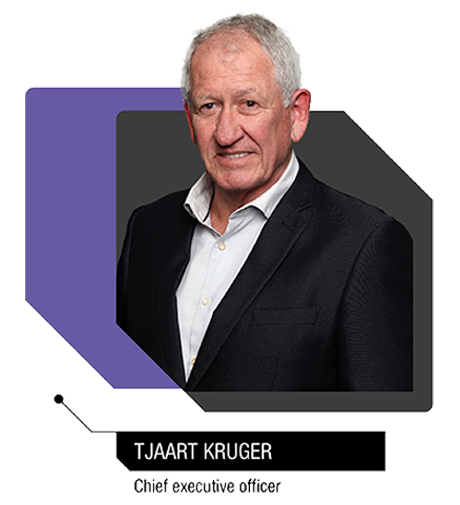
Tjaart Kruger
Chief executive officer
December 2025