GOVERNANCE
Our board of directors oversees governance and management, guiding ethical, sustainable practices that integrate environmental, social and governance-related impacts, risks and opportunities, aligned with our purpose to nourish and nurture more lives every day.
DIRECTION AND TONE
The Tiger Brands board provides overall ethical leadership and strategic direction in the best interests of the company, guided by regulatory and legislative requirements, codes of good practice and market benchmarks.
BOARD OVERSIGHT
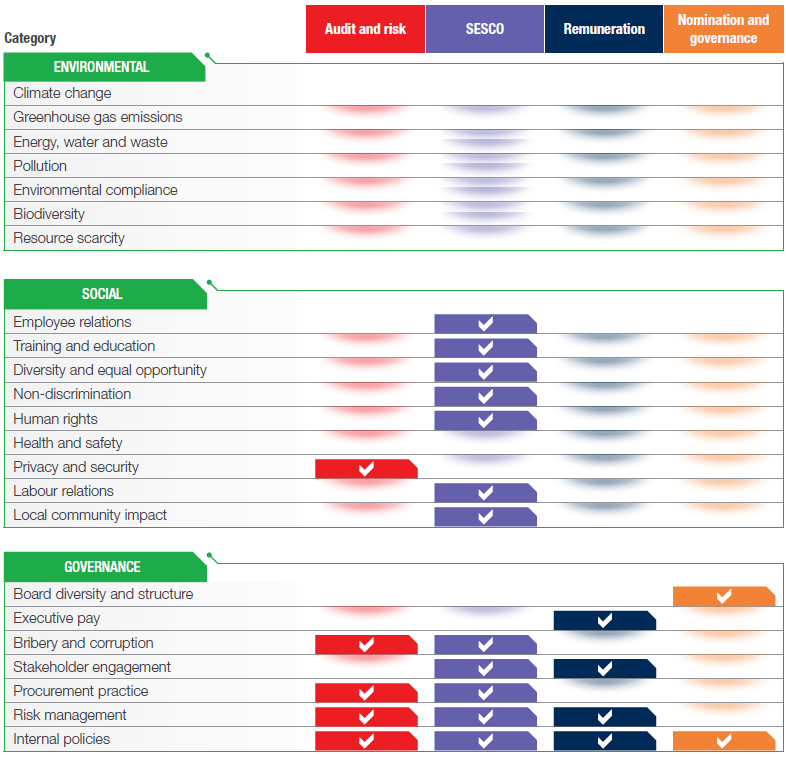
Responsibility for sustainability governance and management is delegated to specific board committees. The primary oversight role is held by the social, ethics and sustainability committee (SESCO). The nomination and governance committee (NAGC), remuneration committee (REMCO) and audit and risk committee (ARC) also contribute in specific areas.
Terms of reference
The board charter and terms of reference for board committees reflect their sustainability mandates. These documents consider the King IV Code on Corporate Governance, JSE Listings Requirements and the Companies Act. The terms of reference for the SESCO explicitly mention climate change in defining its mandate to monitor and review environmental impacts, risks and opportunities, and oversee ethical governance and responsible corporate management. The ARC terms of reference provide for the review of the sustainability disclosures for inclusion in the integrated report. All committee terms of reference are available at www.tigerbrands.com.
Sustainability-related roles of all board committees
Sustainability integration
The SESCO and the ARC each convene four times a year. During these meetings, the SESCO engages on Tiger Brands' sustainability performance and the management of material sustainability and climate-related impacts, while the ARC reviews related risks and opportunities. They provide guidance to the chief executive officer and the executive team and report to the board after each meeting. The SESCO's reports to the board include feedback on sustainability performance, management approach and key activities. Other committees also submit post-meeting reports to the board on their areas of responsibility. The annual work plans for the SESCO and the ARC ensure that relevant sustainability topics are discussed at meetings and reported to the board and for public disclosure.
More information on the composition, capabilities and committees of our board, as well as our corporate governance practices is available in the governance section of this report.
MANAGEMENT
Sustainability is of strategic importance across the business, with executive management driving its implementation. We are enhancing public disclosure and strengthening our management of sustainability impacts, risks and opportunities to support long-term resilience.
MANAGEMENT OVERSIGHT
The implementation of our sustainability strategy is driven by chief officers of our enabling functions and business unit managing directors, who are all members of our executive committee (Exco) and supported by senior managers with direct responsibility for specific sustainability-related activities. Our Exco facilitates the management of Tiger Brands' operational activities. They are directly responsible for overseeing the development and implementation of policies and strategy, and for driving progress against operational-level goals and targets, including those relating to sustainability and climate change. The Exco meets at least monthly and more often when necessary.
More information on the Exco is reported in this report.
MANAGEMENT PROCESSES
Policy framework
We have a robust policy framework that supports the governance and management of ethical business conduct and social and environmental impacts. Our policy framework aligns with all relevant legislation and supports our compliance activities. All policies are audited internally on a regular basis to ensure they adequately drive compliance with relevant legislation and routine management processes ensure that all policies are regularly updated.
Materiality process
Our independently facilitated annual materiality process helps identify and validate our most material sustainability issues, guiding strategy and disclosure while onboarding new members into the reporting process. This participatory approach involves a half-day workshop with executive and senior management teams, where we collectively assess our business model, dependencies, impacts, external environment and stakeholder interests – drawing on insights from investor and ESG ratings, internal risk assessments, stakeholder engagements and sector-relevant ESG trends. First introduced in 2019, this structured process is updated each year, with the most recent iteration conducted in April 2025 to inform this year's reporting cycle.
Risk management
Sustainability-related impacts and risks are managed through the application of our standard risk management structure, processes and methodologies. From this system we can extract climate and sustainability-related risks, analyses and assurances. We evaluate these risks over the short term (less than 12 months), medium term (one to three years) and long term (beyond three years).
More information on our risk management process is provided in this report.
We have formalised bottom up and top-down processes for identifying and monitoring sustainability and climate-related impacts and risks at operational and strategic levels.
We are in the early stages of integrating climate change into our risk management processes across operations, strategy, value chain and markets. Consequently, our most significant sustainability and climate-related issues are not yet fully aligned with our strategic planning horizons or capital allocation. Nonetheless, we are making incremental progress. In 2023, we began unpacking climate and sustainability-related risks through internal and external specialist engagements. In 2024, we completed a water risk assessment to identify key water-related risks for our operations and continue to monitor climate-driven disruptions in our supply chain.
ASSURANCE
We have adopted a combined assurance model with internal and external assurance processes for both financial and non-financial data, as detailed here. We are making progress with digitalising key management processes, with the aim of extending this to sustainability data management and reporting in the years ahead.