STATEMENT FROM THE CHAIRMAN OF THE REMUNERATION COMMITTEE
Dear stakeholder
On behalf of the remuneration committee (the committee), I am pleased to present the 2025 remuneration report which, in compliance with best practice reporting as recommended by the King IV Report on Corporate Governance for South Africa (King IV Code for Corporate Governance), highlights the key components of our remuneration policy, its alignment to the business strategy and priorities and the implementation of the policy for the year ending 30 September 2025 (FY25).
During the period under review, the group maintained strong performance momentum, further building on the foundation established in FY24 as the federated operating model was bedded down and the business turnaround strategy started to yield results. This was achieved through a relentless focus on the consumer, execution excellence and unlocking operational efficiencies, fuelled by Tiger Brands' talented people, values and winning behaviours. The Tiger Brands executive leadership team's focus on driving business performance, growth, innovation and executing at speed despite a volatile market have started to pay off. The strategic priorities that focused the organisation were:
These priorities are supported by the following key enablers:
OUR REMUNERATION OUTCOMES
In the 2025 financial year, Tiger Brands continued its turnaround that started in FY24 and exhibited resilient performance in a constrained consumer environment, achieving 2.7% revenue growth to R34.4 billion, with 3.5% volume growth in a 0.8% price deflation environment. Core operating profit expanded through disciplined cost management and efficiency gains. Strategic priorities centred on embedding the federated operating model implemented in FY24 to accelerate decision-making and consumer-centric innovation, coupled with portfolio reshaping via disposals of non-core assets, which unlocked capital for reinvestment and bolstered net debt reduction. Business units are supported by enabling functions who are responsible for shaping group-wide standards, processes and guardrails that enable execution of the business strategy and growth agenda. The shared services centres execute finance and people transactional activities, leveraging technology and digital solutions to realise economies of scale.
The company did exceed the target group EBIT target, and as such, made a provision for payment to be made in terms of the short-term incentive (STI) scheme.
As acknowledgment of the exceptional effort by leaders and key talent to produce a remarkable turnaround in the operational performance of Tiger Brands, and in particular the successful implementation of strategies that resulted in portfolio optimisation, sustained growth and significant shareholder value creation, the remuneration committee made the decision to award a discretionary bonus amount of R17.4 million to be distributed to key talent and exceptional performers. Discretionary awards to the CEO and CFO are detailed here.
The performance value shares (PVS) awarded in December 2022 will vest on 19 December 2025. For these awards, the HEPS performance was below threshold, resulting in a 0% vesting rate of this portion (50% of award). The achievement against the ROIC component exceeded target, resulting in a 130.11% vesting rate of this portion (50% of award). As a result, the overall vesting of the December 2022 award is at 65.05%.
The conditional share award made to the CEO upon commencement of his contract will vest on 31 December 2025 at 110.8%. This outcome is relevant to the performance period 1 October 2023 to 30 September 2025. A one-year disposal restriction period will apply, where settled shares will be retained by the company's escrow agent until the release date of 31 December 2026.
POLICY ENHANCEMENTS
During the period under review, further enhancements were made to the remuneration strategy to improve alignment of business-critical key performance indicators (KPIs) to measure and reward performance against execution of the business strategy. As such, the remuneration committee approved the implementation of a revised short-term incentive (STI) scorecard that motivates the achievement of key performance indicators. The relative weighting of 80% for the financial component of the STI scorecard was maintained into 2025, with clearer definitions and refined metrics in the enabler components, for example a more holistic metric for environmental sustainability was approved. The committee believes an improved balance was struck between financial, strategic and sustainability measures.
In the 2024 remuneration report, we announced the implementation of a deferred bonus share plan, where senior management may elect to defer a portion of their earned STI into deferred bonus shares, which are matched by the company on a "one-for-one" basis. Participants demonstrated increased confidence in the company's expected longer-term performance, with almost half of participants electing to defer a portion of their earned STI under the conditions of the plan.
Performance-linked short-term incentive payments include all employees, except where wage agreements determine otherwise, as announced in the previous report, were executed in December 2024. This demonstrates Tiger Brands' commitment to a pay-for-performance remuneration philosophy that is fair, inclusive and which positively impacts employee earnings and also employee engagement.
Our environmental, social and governance (ESG) strategy continues to be executed across our operations, and associated targets to drive and measure the ESG performance have been established. To this end, the remuneration committee approved an amendment to the environmental sustainability key performance indicator. The new, more holistic and sustainable KPI measures reduction in water and electricity intensities (previously – reduction in carbon emissions). This reflects a broader commitment to resource efficiency, addressing the critical sustainability challenges of water scarcity and energy conservation. It also represents a more comprehensive, operational and scalable framework tailored to the resource-heavy nature of food production (see here: FY26 group and business unit performance factors, and here: Executive Directors, Performance Scorecard FY25).
The committee considered the company's position with regard to fair and responsible pay and resolved to review the remuneration policy from this perspective. The policy has been updated to reflect clarity in respect of the company's position regarding fair and responsible pay, including a position on paying a living wage.
The committee noted and considered the amendments to the Companies Act, announced by the president in July 2024. Once the remainder of the amendments come into effect, the company will report in accordance with the Act's provisions.
SHAREHOLDER VOTING OUTCOMES
The remuneration committee maintains strong relationships with shareholders and strives towards high standards of disclosure of our remuneration approach to ensure that there is a clear understanding of our remuneration policy and the practices that have been adopted.
The non-binding advisory votes by shareholders for the past four years are summarised as follows:
Voting history
| % vote in favour | February 2025 |
February 2024 |
February 2023 |
February 2022 |
||
| Remuneration policy (%) | 99.72 | 96.64 | 73.70 | 91.55 | ||
|---|---|---|---|---|---|---|
| Remuneration implementation (%) | 99.43 | 97.33 | 53.81 | 96.94 |
The remuneration policy and the implementation report achieved the requisite threshold of 75% non-binding advisory approval. In addition, the special resolution relating to non-resident non-executive director fees achieved the requisite voting outcome at 88.18% – the result of targeted engagement with shareholders based on objective benchmarking data and market practice that demonstrated Tiger Brands' prudence in this regard. The company is committed to continuous and robust shareholder engagement. To this end, key shareholders were engaged in response to voting outcomes. The outcomes of these engagements are addressed in the following section.
SHAREHOLDER ENGAGEMENT
The remuneration committee chairman, the chairman of the board, the lead independent non-executive director and investor relations conducted a series of engagements with key shareholders, and the feedback is summarised below:
The remuneration committee is committed to shareholder engagement and to take the following steps, if 25% or more of total votes exercised by shareholders at the AGM are against the remuneration policy or implementation report:
KEY FOCUS AREAS, OBJECTIVES AND ACTIONS FOR FY25
In FY25, the committee executed its duties in line with the approved annual work plan, which included the following activities:
KEY FUTURE FOCUS AREAS OF THE COMMITTEE FOR FY26
The focus areas are deliberately designed to ensure the committee remains abreast of the latest remuneration market trends and best practice, business needs, as well as our responsibilities to Tiger Brands' people, shareholders and communities to ensure that our remuneration practices enable and support the delivery of the business strategy.
Key focus areas in FY26 will include:
EXTERNAL ADVICE PROVIDED TO THE COMMITTEE IN FY25
We enlist the services of PwC South Africa for purposes of independent benchmarking, incentive scheme market practice, remuneration trends and survey data. As internal auditors, KPMG are engaged for the purposes of auditing of STI payments. As external auditors, Deloitte review and confirm incentive provisions and long-term incentive vesting calculations. The committee is satisfied that PwC, KPMG and Deloitte are independent and remain objective in providing the services.
VOTING AT AGM
As required by the King IV Code on Corporate Governance, the remuneration policy and implementation report that follow, will be tabled for separate non-binding advisory votes by shareholders at the upcoming AGM in February 2026. As required by the Companies Act, non-executive directors' fees for the coming year will be put to shareholders by way of a special resolution. We are committed to engaging with shareholders as required to discuss issues of concern and therefore, encourage shareholders to provide feedback.
ACHIEVEMENT OF POLICY OBJECTIVES
On behalf of the committee, I am satisfied that the remuneration policy is appropriate, and I am confident that our remuneration policy has achieved the desired outcomes for FY25 and is aligned with the company's strategic goals and shareholder interests. The remuneration disclosures presented in this report have been made in compliance with the remuneration policy as approved by shareholders. No known deviations from the remuneration policy have been made in the FY25 financial year.
Lucia Swartz
Chairman – remuneration committee
REMUNERATION GOVERNANCE
The membership of the Tiger Brands remuneration committee consists of a minimum of three non-executive directors, the majority of whom are independent. The CEO is a permanent invitee to all meetings and other executives attend the meetings by invitation when required.
The CEO and nominated invitees are not present when matters relating to their own remuneration are discussed. The group company secretary is the secretary of the committee.
The committee meets four times a year and, where necessary, additional meetings may be held.
The role of the committee is to provide independent and objective assistance to the board in ensuring that Tiger Brands remunerates fairly, responsibly and transparently to promote the achievement of strategic objectives and positive performance outcomes in the short, medium and long term.
As documented in the remuneration committee terms of reference the duties and responsibilities of the committee are:
The terms of reference are reviewed annually.
FAIR AND RESPONSIBLE REMUNERATION
Tiger Brands is committed to a total reward offering built on a strong foundation of fair and responsible pay that is linked to our remuneration philosophy of pay for performance. Salaries are benchmarked once a year against the REMchannel® salary survey to ensure that remuneration decisions are fair and in line with market practice. We also follow a job grading methodology that is consistent and provides a fair and accurate job grade, which allows for proper salary benchmarking.
Our pay progression model strives to fairly reward employees based on performance and market positioning. It enables us to actively manage outlier compensation in a fair and responsible manner and to ensure that differentials that exist are justifiable.
Unjustifiable pay differentials are addressed during the annual reward review process, where we assess and adjust the salaries of unjustifiably underpaid employees, in line with the prevailing mandate. This salary adjustment is generally capped at a predetermined percentage to limit exorbitant increases. Specific focus is given to African, coloured and female employees, as well as employees in roles that are classified as scarce and critical skills.
In addition, we follow a systematic approach in day-to-day decision-making by ensuring individual pay and pay scales are matched to similar roles in the market, and guidelines direct decision-makers to ensure that new appointments, promotions and other pay review opportunities are executed in accordance with our set standards and parameters. At every compensation review opportunity, we consider, report and interrogate pay differentials, seen through various lenses, including gender and race. At every compensation decision point, we ensure that these differentials, where they are unjustified, are addressed with a view to continuously narrow such gaps. After each company-wide pay review, these outcomes and trends are reported to the board for approval before implementation. To maintain the focus on fair and responsible pay, Tiger Brands will perform regular analyses of compensation differentials and close gaps accordingly.
In addition to adherence to minimum wage legislation, the company strives to pay a living wage to enable a dignified standard of living for all employees. To this end, the company will apply a consistent and standardised benchmarking methodology and analysis to assess differentials to an accepted living wage benchmark, monitor progress and inform internal planning. The company will develop targeted plans to address identified gaps, balancing a commitment to paying a living wage with the company's cost efficiency objectives.
TIGER BRANDS' REMUNERATION STRATEGY
The company's remuneration strategy is aligned to the Tiger Brands' people strategy, which is geared to enable the execution of the business strategy and accelerate business performance.
Our remuneration principles have been designed to support the execution of the people strategy and are premised on our belief that great people and superior brands are at the core of our success. Our reward framework is holistic, encompassing the financial elements of reward, as well as non-financial aspects such as recognition, development and career growth, employee value proposition, the work environment, culture and meaningful work.
REWARD FRAMEWORK

The following are the key objectives of our remuneration policy:
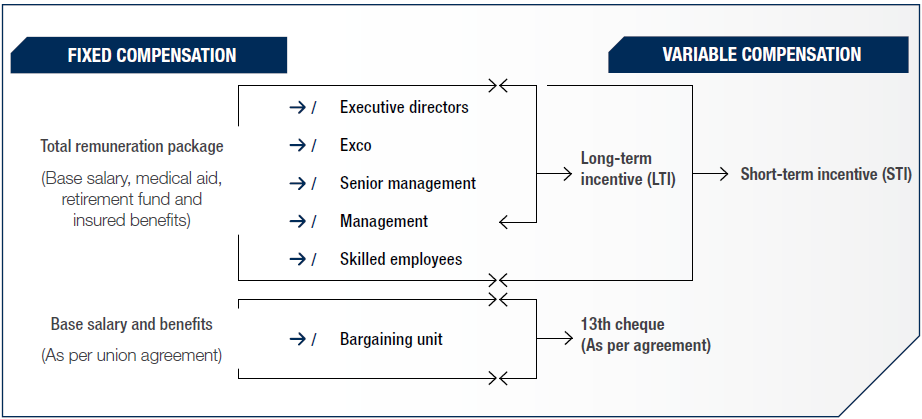
We have summarised below the various remuneration elements (guaranteed package, short-term incentive and long-term incentive) that Tiger Brands offers at different levels of employment:
Compensation mix
GUARANTEED PACKAGE (EXCLUDING BARGAINING UNIT EMPLOYEES)
Description
Guaranteed package (GP) offered to people on a total remuneration package basis (TRP) comprises base pay, allowances, retirement and medical benefits. It is reviewed annually based on personal performance against annually agreed KPIs in individual performance agreements (IPA), business performance, affordability, behaviours aligned with company values and market competitiveness (national and sector benchmarks).
Benchmarks
Benchmarking for executive directors is based on a comparator group of companies. The comparator group is determined using the closeness metric formula, which measures how similar a candidate company is to Tiger Brands and is based on:
Companies included in the comparator group comprise:
| Category | Survey type | Comparator group | |
| Executive directors | Bespoke survey Public data of South African companies listed on the JSE, based on the closeness metric, is used to determine an appropriate comparator group | JSE-listed comparator group* AVI Limited Barloworld Limited Clicks Group Limited Dischem Pharmacies Limited KAP Industrials Holdings Limited Libstar Holdings Limited Mr Price Group Limited Oceana Group Limited Pick n Pay Stores Limited RCL Foods Limited The Foschini Group Limited Woolworths Holdings Limited |
|
|---|---|---|---|
| Rest of Exco, senior management and below | REMchannel® survey | National and consumer goods circles | |
| Anchor point | Tiger Brands anchors its pay position competitively against the national market. We aspire to achieve a normal distribution around the anchor point based on individual performance, talent, potential, experience and in certain instances, tenure. We aim to pay employees that fully meet expectations in critical roles at or above the anchor point. The performance-based increases granted annually (including those for executive directors and executive committee members) are managed within the overall salary increase budget and the pay progression model as discussed below. | ||
| Benefits | Benefits include retirement fund contributions, funeral cover, permanent health insurance, death-in-service cover, medical aid contributions and travel allowances (where applicable). | ||
* The 2022 comparator group remains suitable for benchmarking purposes. This comparator group will be reviewed in FY26
SHORT-TERM INCENTIVE (STI)
The primary intention of the STI is to drive business performance by focusing participants' attention on annual key financial, strategic, functional and personal performance objectives, aligned with business strategy for sustainable value creation. This drives high performance by explicitly creating line of sight by linking group, business unit and individual performance.
Payment of an STI is subject to the overriding condition that the group and business unit meets or exceeds the agreed entry threshold in respect of its earnings before interest and tax (EBIT).
Calculation
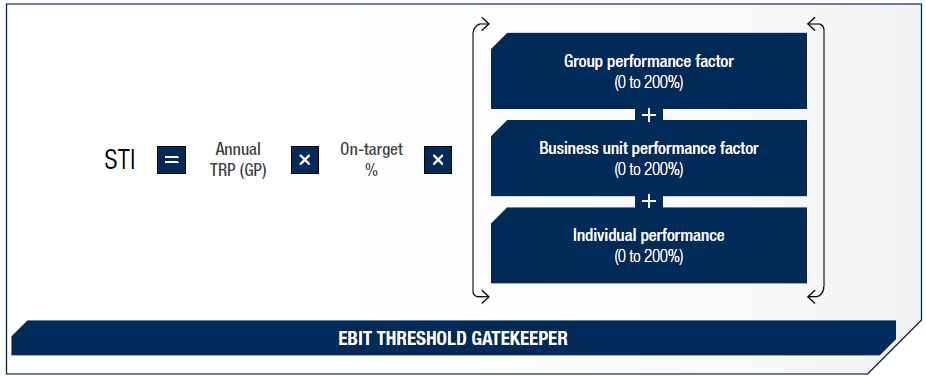
Predetermined weightings are applied to each of the performance factors ranging from 50% (threshold performance) to 200% (stretch performance). In respect of the individual performance factor, participants are rated on a rating scale ranging from 1 (poor performer) to 5 (exceptional performer).
Target and maximum
In FY26 the following ranges of STI awards will apply to the various categories of people covered by this report:
| On-target percentage of guaranteed package |
Maximum percentage of guaranteed package (based on the achievement of stretch performance) |
||
| CEO, CFO and executive directors | 60 | 120 | |
| Executive committee members | 60 | 120 | |
| Senior management (EU) | 40 | 80 | |
| Senior management (EL) | 35 | 70 | |
| Qualified and experienced specialists and mid-management (DU) | 17.5 | 35 | |
| Qualified and experienced specialists and mid-management (DL) | 12.5 | 25 | |
| Administrative, support, technical, skilled and supervisory employees (A to CU band)* | 8.5 | 17 |
* Employees in the bargaining unit are eligible for a 13th cheque, governed under agreement with relevant unions, and not included in the STI scheme
Group and business unit performance factors
The underlying values and weightings for each KPI are set and approved by the remuneration committee in advance of each year to determine parameters for the STI in the form of a balanced scorecard. The STI scorecard for 2026 shows two minor changes from 2025 yet retains sustained focus on key outcomes. The measure for safety is redefined from number of incidents resulting in injury to the globally accepted lost-time injury frequency rate (LTIFR) metric, which provides a standardised and comparable indicator of safety performance across different workplaces, industries or time periods, also accounting for the severity of incidents. The previous talent metric (% internal leadership appointments) was replaced with employee engagement, as measured by planned surveys. Below is the group STI scorecard for FY26 that will be applied to the CEO, CFO, executive directors, executive committee members and other participants:
| Strategic objective |
Weighting | Key performance indicator | KPI weighting |
Threshold Score = 50% |
Target Score = 100% |
Stretch Score = 200% |
|
| Performance and growth | 80% | Brand equity (focus brands' power index score) | 5% | 88% | 100% | 113% | |
|---|---|---|---|---|---|---|---|
| Sales volume growth | 5% | 70% | 100% | 105% | |||
| EBIT (absolute) | 25% | 99% | 100% | 105% | |||
| EBIT (margin) | 15% | 96% | 100% | 104% | |||
| Gross margin | 15% | 98% | 100% | 102% | |||
| Cash conversion rate | 15% | 86% | 100% | 114% | |||
| Enablers: People and sustainability |
20% | Environmental sustainability (reduction in water and electricity intensities) | 5% | 90% | 100% | 108% | |
| Quality and food safety (reduction in complaints per million sold) | 5% | 80% | 100% | 120% | |||
| LTIFR manufacturing (reduction in lost-time injury frequency rate) | 5% | 90% | 100% | 113% | |||
| Employee engagement | 5% | 93% | 100% | 107% |
Note 1: The actual targets are not provided as they are linked to budget and considered commercially sensitive information.
Note 2: The targeted percentages for "threshold", "on-target" and "stretch" as set out above per key performance indicator represent the targeted percentage achievement of the underlying budgeted amounts.
The group, business unit and individual performance weightings applicable are detailed below:
| Employee category | Group | Business unit | Individual | |
| CEO, CFO and executive directors | 80% | 0% | 20% | |
| Executive committee members: Functional executives | 80% | 0% | 20% | |
| Executive committee members: Business unit managing directors | 20% | 60% | 20% | |
| Other participants (Paterson grades CU to E band) | 0% – 40% | 40% – 80% | 20% |
Voluntary deferral into bonus shares
Senior management, executives and executive directors may elect to defer up to 50% of their earned STI (pre-tax) into bonus shares, which are then matched by the company on a "one-for-one" basis. Both the deferred bonus shares and the company matched shares will be classified as "restricted shares", that vest after three years.
Long-term incentive
Description
The LTI is aligned to our reward approach and operating model, taking into consideration the following principles:
Employees in Paterson grade D and above may be eligible to participate in the annual awards of the long-term incentive.
The table below provides further details regarding the performance and restricted shares awarded under the long-term incentive plan.
| Instrument | ||||||
| Employee category | Performance shares award multiple as a % of guaranteed pay |
Restricted shares award multiple as % of guaranteed pay |
||||
| Award mechanism | CEO Note: see table below for current |
81.3 | CEO | – | ||
|---|---|---|---|---|---|---|
| CFO | 81.3 | CFO | – | |||
| Executive committee members | 61.0 | Executive committee members | – | |||
| Senior management and below | 10.6 – 27.7 | Senior management and below | 8.2 – 22.9 | |||
| Performance multiplier |
|
|||||
| Calculation of award quantum |
|
|
||||
| Instrument | Performance shares | |
| Performance conditions applicable to performance shares |
HEPS growth (weighted at 50%)
The HEPS calculation is performed on an annual compound basis over the three-year vesting period. Linear vesting to apply between threshold and stretch. ROIC – (weighted at 50%)
The measurement will be the average ROIC compared to the average WACC over the three-year vesting period. Linear vesting to apply between threshold and stretch. In respect of allocations before December 2025: Operating income from total operations before impairments and non-operational items (reduced by the group's average tax rate, adjusted for the effect of interest), plus the after-tax share of income from associates as a percentage of average invested capital. Invested capital comprises the book value of total equity (which is inclusive of non-controlling interests), plus long-term and short-term borrowings (including the liability arising from IFRS 16), less the value of cash on hand and cash equivalents. Invested capital is also increased by the reinstatement of any write-offs/impairments (both historically as well as in the current period), which is included in non-operational income of any intangible assets, fixed assets and associates. The average invested capital is determined by calculating the simple average of the aforesaid balances based on their values at the beginning and end of the relevant financial year. In respect of allocations as from December 2025: The definition of ROIC as set out in the "definitions" section on page 104 of the annual financial statements for the year ended 30 September 2025 applies. |
|
|---|---|---|
| Share price | Based on the volume-weighted average price (VWAP) for a Tiger Brands share calculated for the 10-trading day period ending immediately prior to the date of award/grant. |
1 +4% for all allocations before December 2023
2 +2% for all allocations before December 2023
Bespoke share plan for Tjaart Kruger (relating to current contract ending 31 December 2025)
Details of Tjaart Kruger's conditional share plan were disclosed in the FY24 remuneration report. This plan will vest on 31 December 2025, at a vesting outcome of 110.8%. The settled shares will be held by the company's escrow agent for the disposal restriction period of 12 months from vesting. Further details are disclosed here.
BEE shares
The following two schemes were established as part of the company's black empowerment strategy:
Dilution
In compliance with the JSE Listings Requirements, the LTIP contains limits setting out the aggregate maximum number of shares that may be settled to all participants, as well as the aggregate maximum number of shares to be settled to any one participant. The LTIP rules provide that these limits are not applicable where shares acquired on the JSE are used to settle LTIP awards. Although it has been Tiger Brands' practice in the past to purchase shares off the market upon settlement of LTIP awards (which ensured that the LTIP did not result in a dilution to shareholders), it is to be noted that, during FY24, Tiger Consumer Brands Limited, a 100% subsidiary of Tiger Brands, acquired 1 104 486 Tiger Brands shares which, as at 30 September 2024, were held as treasury shares. These shares were specifically acquired for purposes of settling shares in terms of the LTIP. Any utilisation of these shares to settle LTIP awards will, therefore, result in a dilution to shareholders. During FY25, 616 519 of these treasury shares were utilised to settle shares in terms of the LTIP in December 2024, leaving a balance of 487 967 shares which can be used for future settlement purposes.
On 30 September 2025, the aggregate number of shares that may be acquired by participants under the various schemes was 1 768 925 (2024: 1 816 683).
MINIMUM SHAREHOLDING POLICY
We have a minimum shareholding policy, where senior executives are expected to build up their personal shareholding in the company over a specific period. In the case of the CEO, the target is 200% of guaranteed package while the target for executive directors and members of the executive committee is 100% of guaranteed package. Senior executives who were in service when the policy was adopted in 2016 have six years to build up their shareholding from date of adoption. Senior executives appointed after adoption have six years to build their shareholding from date of appointment. They may use any vesting LTIs or their own resources to acquire these shares.
In order to accelerate the progress towards achieving minimum shareholding, this policy was amended to compel a commitment of a minimum of 30% (thirty percent) of vested long-term incentives towards their shareholding, or such portion required to reach the minimum shareholding, should it be less than 30% below the requirement.
Exemption from compliance with the minimum shareholding requirements (MSR)
In the case of the MSR not being met, the board retains the overriding discretion to:
DEFERRED BONUS SHARES
An amendment approved and implemented effective in 2024, is the voluntary deferral of up to 50% of the short-term incentive earned by senior managers and executives, into restricted shares (deferred bonus shares). Performance against STI KPIs for the year forms the basis of the deferred portion of the STI, which is then utilised to issue restricted shares. The deferral is matched by the company on a one-for-one basis, also in the form of restricted shares. Deferred bonus shares and company matched shares vest after three years. Should an employee's service end on a fault basis, they shall forfeit the company matched portion. Where executives are subject to an MSR, and they have not yet achieved the required MSR, the company matched shares will be taken into account as part of their shareholding in Tiger Brands for MSR purposes. Any shares settled upon vesting of the company matching shares will automatically be committed to the MSR of the executive and held in a restricted account until expiry of the holding period.
MALUS AND CLAWBACK
The preventative aim of this policy is to remove the incentive for an executive to intentionally manipulate financial results or financial position or organisational information with the intention of financially benefiting from variable remuneration which would otherwise not have been due to such executive. These provisions align the interests of executives with the long-term interests of the organisation, as well as shareholders, and to ensure that irresponsible behaviour is not rewarded.
With respect to malus, if the remuneration committee, in consultation with the board and/or any committee of the board, believes that a trigger event has occurred, it has full discretion to reduce, in part or whole, unvested variable remuneration (i.e. STIs and LTIs) before the end of the vesting or payment period. In the case of clawback, the remuneration committee, in consultation with the board and/or any committee of the board, may implement clawback for the whole or portion of vested variable remuneration in the event of a trigger event occurring over a period of three years from the date on which payment was made of such vested variable remuneration. Trigger events include, but are not limited to:
PAY FOR PERFORMANCE LINK
The variable pay arrangements described alongside have various potential outcomes. These outcomes could be from zero (minimum) to the expected level of performance outcomes (target) to the maximum potential variable pay outcomes (maximum). In the illustrations presented alongside, it should be noted that:
Total remuneration potential for members of executive management for the year ended 30 September 2025
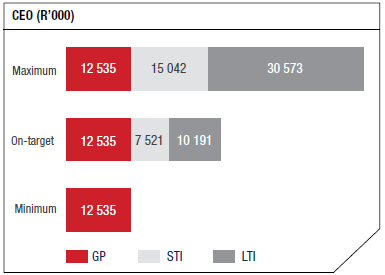
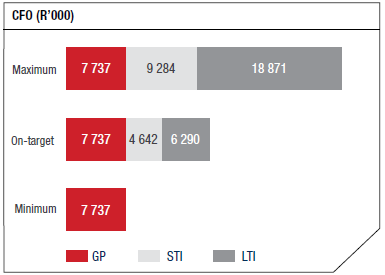

The values are based on Tiger Brands remuneration policy, applied to executives' 2025 total guaranteed pay. Maxima include any maximum personal performance multiples provided by policy, as well outcomes capped by scheme rules.
EXECUTIVE SERVICE CONTRACTS
Senior executives are employed full-time under standard agreements, with a notice period of three months and retirement age of 63. We bind all senior executives by a restraint-of-trade agreement to protect Tiger Brands' interests (including trade secrets, confidential information and customer connections), and to prevent economic prejudice to Tiger Brands, including loss of clients and goodwill. To the extent that executives have access to proprietary business insights and intellectual property, Tiger Brands will enforce the agreement should they join a competitor. The restraint comprises a three-month notice period or three months' special leave (paid as a three-month lump sum based on guaranteed package on termination).
SIGN ON AND SPECIFIC RETENTION PAYMENTS
In exceptional circumstances (mainly for the recruitment and retention of critical and/or scarce talent), Tiger Brands will award a sign on/retention payment which will be subject to the following conditions:
PAYMENTS ON TERMINATION OF EMPLOYMENT
| Remuneration policy component | Voluntary termination i.e. resignation | Involuntary termination (retrenchment, retirement and death) |
|
| Guaranteed package | Paid up to last day of service | Paid up to last day of service including notice period, where applicable. | |
|---|---|---|---|
| Medical aid | Benefit continues to last day of service | Benefit continues up to last day of service. Employees who qualify for post-retirement medical aid funding will continue to receive the employer contribution with effect from their normal retirement date. | |
| Retirement and risk plans | Employer contributions paid until last day of service. Employee is entitled to the value of the investment, but all risk benefits cease on termination of service. | ||
| Other benefits | Not applicable | Severance package in respect of retrenchments – two weeks for every year of service in terms of the relevant rules. | |
| Short-term incentives | No pro rata bonus paid | Pro rata STI payment, based on achievement of specified financial and strategic targets for the period and a personal performance agreement being in place at the date of exit. | |
| Long-term incentives | All unvested awards lapse, except for deferred bonus shares, as these shares relate to a participant's earned STI | Depending on the nature of the instrument and reasons for termination, a participant may retain all units or a pro rata portion. Accelerated vesting and settlement of retained units may apply in certain circumstances. | |
EXTERNAL BOARD APPOINTMENTS
Under a formal policy, an executive is limited to one substantive outside directorship. The chairman of the Tiger Brands' board and the nominations committee are required to authorise these appointments based on a recommendation from the CEO. Other than in respect of their appointment to the boards of associate companies, directors' fees under this policy may be retained by the individual. During the reporting period, none of the executive committee members has external directorships.
Non-executive directors
Fees and approval process
Non-executive directors are paid an annual retainer that reflects their overall contribution and input to the company, and not just for attendance at board and committee meetings. Fees are reviewed annually, and increases are implemented in April after approval at the relevant AGM.
Benchmarking is conducted on an annual basis to benchmark these fees against South African companies listed on the JSE, based on market capitalisation, turnover and total assets. As these are similar metrics to that of the benchmark group for executive directors it was decided that from FY20, in line with King IV and in terms of the current requirements of the organisation, a single comparator group be adopted for the non-executive directors and executive directors' remuneration benchmarking. The comparator group is detailed here.
The special resolution relating to the increase in non-resident, non-executive director fees achieved the requisite voting outcome (88.18% compared to previous 65.37%). This was achieved through the implementation of a non-resident non-executive director fee premium range that allows for flexibility based on prevailing circumstances, augmented by focused shareholder engagement that created understanding of considerations that drive these fees, specifically comparative fee positions, local and domicile benchmarks, local and foreign market trends, NED skills and experience, and consistency in practices.
Targeted remuneration for the 12-month period ending 28 February 2026 was determined through a fee benchmarking process against our selected comparator group, as well as JSE-listed companies where sufficient data is available, specifically for non-resident, non-executive directors. The chairman does not receive any additional remuneration for participating in committees of the board. Non-executive directors who perform services outside the scope of their ordinary duties will not receive additional remuneration. Shareholder approval will be sought for increasing non-executive directors' fees, including fees paid for attending special board meetings. Details of proposed non-executive directors' fees effective from 1 April 2026 appear in the notice of AGM of shareholders to be held on 26 February 2026. Details of non-executive directors' fees paid in the review period appear here.
VOTING STATEMENT
This remuneration policy is subject to a non-binding advisory vote by shareholders at the upcoming AGM.
In this section of the remuneration report we explain the implementation of our remuneration policy, providing details of the remuneration paid to our executive directors and members of the executive committee for the financial year ended 30 September 2025.
SALARY ADJUSTMENTS
In 2024, the remuneration committee approved a 5.5% annual increase effective December 2024. This excludes the negotiated increases for bargaining unit employees and targeted increases to reward exceptional performance, retain critical skills and execute day-to-day internal mobility practices, such as promotions, transfers and other deployments during the financial year.
2025 GUARANTEED PACKAGE
The following increases to guaranteed packages were implemented in the reporting period for executive directors. New amounts were effective as indicated below:
| Executive directors | 1 Dec 2024 to 30 Nov 2025 |
1 Dec 2023 to 30 Nov 2024 |
% increase | ||
| TN Kruger | 12 535 000 | 11 500 000 | 9% | ||
|---|---|---|---|---|---|
| TA Govender | 7 737 310 | 7 033 910 | 10% |
2025 SHORT-TERM INCENTIVE OUTCOMES
As indicated in the policy section, the STI for executive directors is based on the combination of a group performance factor and individual performance component.
GROUP PERFORMANCE FACTOR
The group performance factor (80% overall weighting) for executive directors is weighted according to the table below. Results for FY25 were as follows:
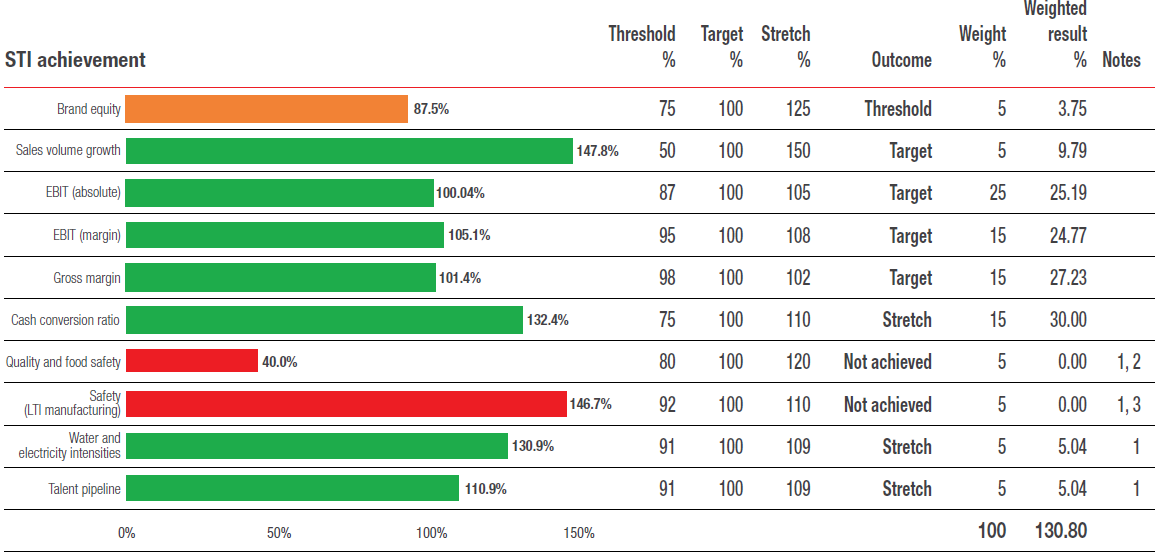
1 Enabler KPIs' outcomes are capped at the level of EBIT Absolute Outcome
2 The Benny product recall disqualified any outcome in the Quality KPI
3 One fatality at the Ashton plant resulted in a disqualification despite the overall KPI outcome
INDIVIDUAL PERFORMANCE FACTOR
The individual performance factor (20% overall weighting) for executive directors is weighted according to the table below.
The results for FY24 were as follows:
| TN Kruger | TA Govender | ||||||||
| Key performance indicators | Not met |
Partially met |
Met | Exceeded | Not met |
Partially met |
Met | Exceeded | |
| Individual KPIs |  |
|
|||||||
 |
Not met |
 |
Partially met |
 |
Met |
|
Exceeded |
Final outcomes for 2025
| Name | GP1 | On-target % |
Actual group performance factor % x weighting (80%)2 |
Actual personal performance factor % x weighting (20%)3 |
2025 STI (ZAR) |
2024 STI (ZAR) |
|
| TN Kruger4 | 12 535 000 x | 60% x | 104.64% + | 37% | 10 652 574 | 5 164 661 | |
| TA Govender | 7 737 310 x | 60% x | 104.64% + | 37% | 6 575 370 | 3 446 112 |
1 Annual guaranteed package in rand as at 30 September 2025
2 Actual group performance factor determined as: 130.8% x 80% = 104.64%
3 Actual personal performance factor determined as: CEO: 185% x 20% = 37% and CFO : 185% x 20% = 37%
4 Tjaart's 2024 STI was pro-rated to 11 months as his start date was 1 November 2023
In keeping with the Remco decision to acknowledge the exceptional effort by leaders and key talent that produced a remarkable turnaround in the operational performance of Tiger Brands, and in particular the successful implementation of strategies that resulted in portfolio optimisation, sustained growth and significant shareholder value creation, the discretionary awards to the CEO and CFO are:
| Name | ZAR | |
| TN Kruger | 2 400 000 | |
| TA Govender | 1 439 530 |
2025 LONG-TERM INCENTIVES
Awards made during FY25
In FY25, performance shares were awarded to executive directors, executive committee members, senior management and middle management.
Long-term incentive awards made during the year to executive directors are set out below:
Long-term incentive awards to executive directors for FY25
In accordance with the Tiger Brands 2013 share plan:
| Name | LTI personal performance multiplier1 |
GP | Award % | Number2 | Face value |
Expected value |
|
| TA Govender | 125% | 7 737 310 | 81.3% | 28 650 | 7 863 852 | 9 672 538 |
1 The personal performance multiplier is used to modify the standard quantum of performance shares and restricted shares, based on an individual's personal sustained performance and potential. This is a percentage ranging from 0% to 150%
2 Allocated on 19 December 2024 at 10-day VWAP of R274.48
LTI awards vesting or with a performance period ending in 2025
The outcome for awards due to vest in December 2025, for which the performance conditions ended by 30 September 2025, are shown below. This applies to all eligible participants.
Performance vesting shares granted in December 2022 and vesting in December 2025
| Targets | Weighting | Threshold (25% vesting) |
Target (100% vesting) |
Stretch (200% vesting) |
Actual achievement |
Performance outcome |
|
| Headline earnings per share (HEPS)1 | 50% | CPI + GDP | CPI + GDP + 2% | CPI + GDP + 4% | 5 600.2 cents | 0% | |
| Return on invested capital (ROIC) | 50% | WACC + 1% | WACC + 2% | WACC + 5% | 15.81% | 130.11% | |
| Total | 100% | 65.05% |
1 Cumulative HEPS over the three-year vesting period
Outcome: CEO Conditional share plan vesting 31 December 2025
| Targets | Weighting | Threshold (25% vesting) |
Target (100% vesting) |
Stretch (200% vesting) |
Actual achievement |
Performance outcome |
|
| Operating margin | 40% | 9.30% | 10.30% | 12.30% | 9.30% | 25.00% | |
| ROIC | 40% | WACC + 1% | WACC + 3% | WACC + 5% | 16.37% | 152.00% | |
| Cash conversion | 20% | 60% of EBITDA | 70% of EBITDA | 100% of EBITDA | 114.97% | 200.00% | |
| Total | 100% | 110.80% |
Current minimum shareholding summary
The CEO is not subject to the MSR policy by virtue of his contract term.
| Name | Date of appointment to the executive committee |
GP1 | Number of shares held |
Original value of shares held |
Current value of shares held2 |
Original value as % of GP |
Target % of GP |
Years remaining to meet target3 |
|
| TA Govender | 1 May 2021 | 7 737 310 | 21 737 | 6 317 017 | 6 711 516 | 82 | 100 | 1 | |
| CXO3 | 8 872 | 2 533 459 | 2 739 319 | 41 | 100 | 1 | |||
| CXO6 | 30 866 | 7 032 615 | 9 530 186 | 105 | 100 | 3 | |||
| CXO8 | 22 452 | 5 044 000 | 6 932 280 | 95 | 100 | 2 | |||
| CXO16 | 2 560 | 702 669 | 790 426 | 16 | 100 | 4 | |||
| CXO17 | 620 | 170 178 | 191 431 | 3 | 100 | 4 | |||
| CXO18 | 5 167 | 1 454 353 | 1 595 363 | 32 | 100 | 4 | |||
| CXO20 | 6 449 | 1 833 272 | 1 991 193 | 41 | 100 | 4 | |||
| CXO21 | 0 | 0 | 0 | 0 | 100 | 5 |
1 GP as at 30 September 2025
2 Value calculated with reference to the closing price of a Tiger Brands share as at 30 September 2025, i.e. R308.76
3 A three-year extension to reach MSR was provided to executives who were in service at time of the extension (May 2021)
Payments for termination of office
No payments to vacate office were made to executives.
Compliance with remuneration policy
There were no deviations from the remuneration policy in the financial year.
SINGLE TOTAL FIGURE OF REMUNERATION
The following tables disclose total remuneration received and receivable by executive directors and executive management for the period 1 October 2024 to 30 September 2025:
Executive directors
| TN Kruger | TA Govender | |||||||
| Remuneration element | FY25 (R’000) |
FY24 (11 months) (R’000) |
FY25 (R’000) |
FY24 (10 months) (R’000) |
||||
| Basic salary | 12 363 | 10 333 | 7 148 | 4 921 | ||||
|---|---|---|---|---|---|---|---|---|
| Retirement funding | 256 | 248 | ||||||
| Other benefits | 151 | 106 | ||||||
| Guaranteed package | 12 363 | 10 333 | 7 555 | 5 275 | ||||
| Short-term incentive | 10 653 | 5 165 | 6 575 | 3 446 | ||||
| Discretionary bonus | 2 400 | 1 440 | ||||||
| Cash remuneration | 25 416 | 15 498 | 15 570 | 8 721 | ||||
| Sign-on bonus | ||||||||
| Bonus matching shares | ||||||||
| FY22 long-term performance shares1 | 5 005 | |||||||
| FY23 long-term performance shares2 | 4 965 | |||||||
| FY24 conditional shares3 | 51 213 | |||||||
| Other | ||||||||
| Total remuneration | 76 629 | 15 498 | 20 535 | 13 726 | ||||
1 FY22 performance shares were awarded in December 2021 and vested in December 2024 at a multiple of 142.91%. Value indicative and based the Tiger Brands closing share price on 30 September 2024 (R233)
2 FY23 performance shares awarded in December 2022 and will vest on 19 December 2025. The shares will vest at a multiple of 65.05%. Value indicative and based on the Tiger Brands closing share price on 30 September 2025 (R308.76)
3 Tjaart Kruger's bespoke conditional share scheme will vest on 31 December 2025, and the settled shares will be transferred into a restricted account for a 12-month disposal restricted period. Value indicative and based on the Tiger Brands closing share price on 30 September 2025 (R308.76)
Members of executive committee
| Key | FY25 (R'000) |
FY24 (R’000) |
||
| CXO1 | 3 609 | 9 891 | ||
|---|---|---|---|---|
| CXO19 | 4 259 | 3 228 | ||
| CXO16 | 9 567 | 3 172 | ||
| CXO11 | 3 492 | 6 438 | ||
| CXO14 | 5 299 | 11 112 | ||
| CXO20 | 10 651 | 5 318 | ||
| CXO3 | 15 252 | 12 473 | ||
| CXO18 | 8 889 | 5 638 | ||
| CXO6 | 18 583 | 15 909 | ||
| CXO17 | 8 933 | 3 595 | ||
| CXO8 | 13 281 | 10 721 | ||
| CXO21 | 6 138 | |||
| Total | 107 952 | 96 382 |
Notes:
CXO1 retired 31/12/2024
CXO11 resigned 30/06/2025
CXO14 was retrenched 31/01/2025
CXO16 appointed to Exco on 01/05/2024
CXO17 appointed to Exco on 01/02/2024
CXO18 appointed to Exco on 01/02/2024
CXO19 appointed to Exco on 01/02/2024 and resigned 31/10/2025
CXO20 appointed to Exco on 01/02/2024
CXO21 appointed to Exco on 01/12/2024
NUMBER AND VALUE OF LTI SHARE AWARDS
Disclosure of the quantum and value of awards for the CEO and CFO outstanding at the beginning and end of the reporting period, as well as new awards made in the period, are provided in the tables here, with the cash value of awards settled during the reporting period indicated in the value-based tables.
| Name and awards | Award date |
Vesting date |
Grant price (ZAR) |
Opening number |
Granted during the year |
Forfeited during the year |
Performance condition achieved |
Settled during the year |
Closing number |
Face value at award (ZAR) |
Cash received (ZAR) |
Value of shares acquired (ZAR) |
Closing fair value vesting (ZAR) |
|
| TN Kruger | ||||||||||||||
| FY25 deferred bonus shares | 19/12/2024 | 19/12/2027 | – | – | 9 410 | – | – | – | 9 410 | 2 582 857 | – | – | 2 693 707 | |
| FY25 company matching shares | 19/12/2024 | 19/12/2027 | – | – | 9 410 | – | – | – | 9 410 | 2 582 857 | – | – | 2 693 707 | |
| FY24 conditional share award1 | 18/12/2023 | 31/12/2025 | – | 149 700 | – | – | – | – | 149 700 | 22 499 910 | – | – | 46 014 786 | |
| Total | – | 149 700 | 18 820 | – | – | – | 168 520 | 27 665 624 | – | – | 51 402 200 |
1 Tjaart Kruger's award of conditional shares is a bespoke conditional incentive award, associated with specifically agreed performance conditions over the period of service, to align with outcomes agreed with the board
| Name and awards | Award date |
Vesting date |
Grant price (ZAR) |
Opening number |
Granted during the year |
Forfeited during the year |
Performance condition achieved |
Settled during the year |
Closing number |
Face value at award (ZAR) |
Cash received (ZAR) |
Value of shares acquired (ZAR) |
Closing fair value vesting (ZAR) |
|
| TA Govender1 | ||||||||||||||
| FY25 deferred bonus shares | 19/12/2024 | 19/12/2027 | – | – | 6 280 | – | – | – | 6 280 | 1 723 734 | – | – | 1 797 713 | |
| FY25 company matching shares | 19/12/2024 | 19/12/2027 | – | – | 6 280 | – | – | – | 6 280 | 1 723 734 | – | – | 1 797 713 | |
| FY22 restricted shares | 15/12/2021 | 15/12/2024 | – | 16 110 | – | – | – | 16 110 | – | – | 3 259 165 | 1 401 570 | – | |
| FY22 performance shares | 15/12/2021 | 15/12/2024 | – | 5 370 | – | – | 2 304 | 7 674 | – | – | 1 552 561 | 667 580 | – | |
| FY23 performance shares | 19/12/2022 | 19/12/2025 | – | 24 720 | – | – | – | – | 24 720 | 5 179 334 | – | – | 7 602 883 | |
| FY24 performance shares | 18/12/2023 | 18/12/2026 | – | 30 240 | – | – | – | – | 30 240 | 5 718 988 | – | – | 8 973 720 | |
| FY25 performance shares | 19/12/2024 | 19/12/2027 | – | – | 28 650 | – | – | – | 28 650 | 7 863 852 | – | – | 8 201 349 | |
| Total | – | 76 440 | 41 210 | – | 2 304 | 23 784 | 96 170 | 22 209 642 | 4 811 726 | 2 069 150 | 28 373 378 |
1 Thushen Govender was appointed as CFO on 1 January 2024
Interests of executive directors in B-BBEE schemes
Prior to his appointment as chief financial officer, TA Govender was awarded the following shares in terms of the Black Managers Trust Scheme:
| Name and awards | Award date |
Vesting date |
Opening number |
Granted during the year |
Forfeited during the year |
Settled during the year |
Closing number |
Face value at award (ZAR) |
Cash received (ZAR) |
Value of shares acquired (ZAR) |
Closing fair value vesting (ZAR)2 |
|
| TA Govender | ||||||||||||
| Tiger Brands share allocation | 31/01/2022 | 31/01/2025 | 2 333 | – | – | – | 2 333 | 316 378 | – | – | 680 209 | |
| 31/01/2026 | 2 333 | – | – | – | 2 333 | 316 378 | – | – | 680 209 | |||
| 31/01/2027 | 2 334 | – | – | – | 2 334 | 316 514 | – | – | 680 501 | |||
| Adcock Ingram share allocation3 | 31/01/2022 | 31/01/2025 | 1 983 | – | – | 1 983 | – | – | 115 436 | – | – | |
| 31/01/2026 | 1 983 | – | – | – | 1 983 | 75 156 | – | – | 133 813 | |||
| 31/01/2027 | 1 984 | – | – | – | 1 984 | 75 194 | – | – | 133 880 | |||
| Oceana share allocation3 | 31/01/2022 | 31/01/2025 | 603 | – | – | 603 | – | – | 35 716 | – | – | |
| 31/01/2026 | 604 | – | – | – | 604 | 33 135 | – | – | 26 854 | |||
| 31/01/2027 | 604 | – | – | – | 604 | 33 135 | – | – | 26 854 | |||
| Total | 14 761 | – | – | 2 586 | 12 175 | 1 165 890 | 151 152 | – | 2 362 320 |
1 Calculated with reference to the market value of an allocated share (less the amount of the capital contribution) as at the date of the award
2 Calculated with reference to the market value of an allocated share (less the amount of the capital contribution) as at year end (30 September 2025)
3 In addition to the award of the Tiger Brands shares, the executive was also awarded Adcock Ingram and Oceana shares (as a consequence of the unbundling by Tiger Brands of its interests in Adcock Ingram and Oceana, the Tiger Brands Black Managers Trust, as Tiger Brands shareholder, also became a shareholder of shares in Adcock Ingram and Oceana). Participants in the trust are, consequently, also awarded shares in these two companies when awarded Tiger Brands shares
Non-executive directors' remuneration 2025
The non-executive directors' remuneration paid for the year ended 30 September 2025 is disclosed below, excluding VAT in rand:
| Committee | MO Ajukwu | FNJ Braeken | GJ Fraser- Moleketi |
GA Klintworth | TE Mashilwane |
M Sello | S Sithole | LA Swartz | OM Weber | DG Wilson | |
| Notes | 1 | 2 | |||||||||
| Board fees | 551 598 | 1 517 121 | 2 462 161 | 515 834 | 515 834 | 515 834 | 515 834 | 1 135 075 | 515 834 | ||
| Audit committee fees | 522 360 | 231 933 | 231 933 | 417 305 | |||||||
| Remuneration committee, nomination and governance committee fees | 149 477 | 34 865 | 135 860 | 291 489 | 222 252 | 67 930 | |||||
| Social, ethics and transformation committee fees | 134 090 | 239 133 | 125 164 | 125 164 | 141 329 | ||||||
| Risk and sustainability committee fees | 195 284 | 173 909 | 195 284 | 88 727 | |||||||
| Investment committee fees | 193 558 | 202 968 | 193 558 | 117 213 | |||||||
| Extraordinary fees in respect of special board meeting | 58 283 | 58 283 | 26 480 | 26 480 | 26 480 | 26 480 | 26 480 | 58 283 | 26 480 | ||
| Total FY25 | 939 255 | 2 440 799 | 2 488 641 | 1 013 380 | 1 108 185 | 881 141 | 958 967 | 1 945 781 | 1 233 489 | ||
| Total FY24 | 1 878 509 | 2 323 495 | 2 392 880 | 1 379 740 | 1 134 029 | 1 219 721 | 786 298 | 879 186 | 2 028 916 | 1 241 200 |
1. MO Ajukwu retired 20 February 2025
2. GA Klintworth resigned 31 May 2024