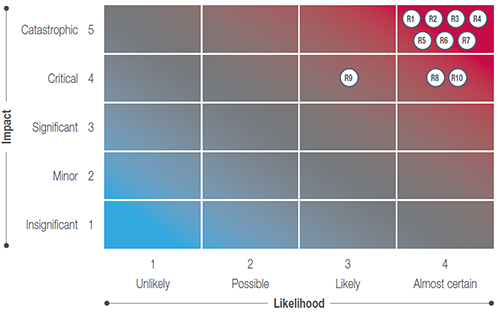
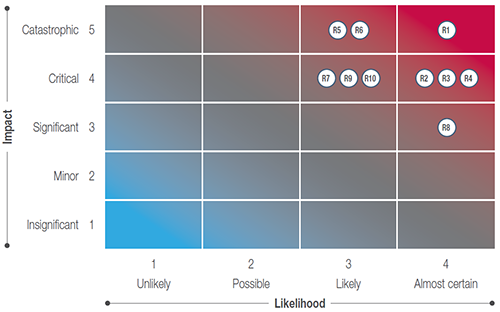
| Material risks |
|
|
Implications for value |
|
|
Mitigating actions |
|
|
|
|
|
|
|
|
|
|
|
| |
1. |
Albany route-to-market
Risk trend  2019 ranking (2)
 |
|
|
Increasing levels of violent crime against
drivers in the bakery route-to-market can
result in:
- employee and service provider loss
of life
- distribution disruptions
- reputational and brand damage
- potential loss of market share.
|
|
|
- All delivery routes are continually risk assessed, and
tailored response measures developed
- Security assessment reports have been compiled for
all facilities to address security-related improvement
opportunities
- A limited number of security service providers have
been appointed to service the bakeries. This will
promote compliance to the relevant legislation,
monitoring and management of key performance
indicators per bakery while ensuring overall
cost efficiency
- Exploring technological solutions for more effective
security provision at a reduced cost
- Exploring and piloting digital payment systems.
|
|
|
|
|
|
|
|
|
|
|
|
| |
2. |
Negative impact
of Covid-19
Risk trend
2019 ranking (n/a) |
|
|
The high rate of Covid-19 infections and
the response measures implemented by
government and business, increased
market uncertainty and challenged risk
management through the following:
- economic shutdown and reduced
growth
- production setbacks and declining
stock levels
- increased operational costs and revenue
loss
- employee unease, absenteeism, job loss and loss of life
- declines in customer experience and brand reputation.
|
|
|
- An executive committee Covid-19 task team was
set-up to manage our response across customers,
communities, employees and operations
- Measures have been implemented to align with
government, limit travel, accommodate sick leave,
distribute and digitise work arrangements, prioritise
manufacturing of critical products, bolster factory and
staff hygiene, and support delivery of food to
community beneficiaries
- In ensuring the ongoing availability of essential food
items throughout the lockdown alert levels, our
approach included daily meetings, running scenarios
and collaborating across the value chain to ensure
minimal disruptions, meet demand and continue to
support national food security.
|
|
|
|
|
|
|
|
|
|
|
|
| |
3. |
Business continuity
vulnerabilities
Risk trend
2019 ranking (6) |
|
|
Disruption at our facilities – for example,
following a significant technical
breakdown, floods or fire, political or
labour unrest, and/or interruption of IT
services, energy or water supply – can
lead to:
- interruptions in production, resulting in
lost sales, and reduced market share
and reputation
- damage to plant and equipment
- increased production costs.
|
|
|
- A business continuity steering committee has been
established and consists of a multi-disciplinary team
including IT, Supply Chain, HR, Finance, Corporate
Affairs, Internal Audit and Group Risk. The steering
committee is in the process of finalising a roadmap
which encompasses specific business continuity
training as well as consideration of best practice
standards such as the ISO 22301 as well as the
evolving practices and standards released as a result
of the Covid-19 pandemic. Business continuity plans
are in place for all high-priority packaging and raw
materials across the business; a formal management
process for the group’s manufacturing facilities is in
place. This includes IT business continuity and annual
technical testing of the IT disaster recovery plans
- A network upgrade project is currently underway to
implement secondary network links at all Tiger Brands’
sites. This will ensure that there is no disruption to site
connectivity when the primary network connection
is lost
- Annual external risk, control and environmental audits
inform improved business-continuity planning and
disaster-recovery processes
- Appropriate insurance cover is reviewed annually, and
disaster-recovery plans are in place.
|
|
|
|
|
|
|
|
|
|
|
|
| |
4. |
Operating
environment
Risk trend  2019 ranking (1)
 |
|
|
- Weakened consumer demand off the
back of lower economic growth
negatively impacts volumes, and has
heightened the consumer focus on
shopping on promotion, negatively
impacting profitability
- The rising cost of utilities, labour, general
input costs and regulatory requirements,
is increasing the cost base at a higher
rate than inflation, weighing on margins.
|
|
|
- Driving growth through customer strategies focused on
winning at the point of purchase and building on the
strength of our existing brands
- Creation of a health and nutrition strategy
- Being efficient by unlocking costs and cash through
incremental supply chain savings and driving
continuous improvement efficiencies
- A people strategy focused on talent, leadership and
creating a great place to work
- A sustainability strategy is aimed at health and
nutrition, enhanced livelihoods and environmental
stewardship.
|
|
|
|
|
|
|
|
|
|
|
|
| |
5. |
Food safety and
product quality
Risk trend
2019 ranking (3) |
|
|
Challenges with food safety and product
quality can have significant implications in
terms of:
- loss of life
- reputational and brand damage
- loss of market share
- disruptions to production
- expensive product recall
- potential litigation.
|
|
|
- Enhanced good manufacturing practice (GMP)
standards and food safety system certification
standard (FSSC 22000) implemented across the
group, supported by standardised quality self-assessments
for all our manufacturing sites, training
of quality teams, and a robust supplier quality
management process
- Manufacturing, group legal and regulatory compliance
functions collaborate to ensure products comply with
regulatory standards and meet consumer preferences
- Entrenched partnership with Stellenbosch University to
remain at the forefront of scientific trends, through the
Centre for Food Safety
- Adoption of European Hygienic Engineering and
Design Guidelines (EHEDG) in terms of manufacturing
hygiene standards.
|
|
|
|
|
|
|
|
|
|
|
|
| |
6. |
Occupational health
and safety
Risk trend
2019 ranking (4) |
|
|
Occupational health and safety incidents
can result in:
- loss of life of employees and service
providers
- reputational and brand damage
- regulatory non-compliance costs
- loss of market share.
|
|
|
- Robust safety programme implemented across the
group, supported by self-audits, annual independent
audits, and behavioural safety and awareness
initiatives, reinforced with disciplinary action
- Safety improvement targets signed off annually for
each division and manufacturing site
- Standardised occupational health and hygiene
programme and fitness to work standards have been
operationalised at all manufacturing sites.
|
|
|
|
|
|
|
|
|
|
|
|
| |
7. |
Information and
cyber security
Risk trend
2019 ranking (5) |
|
|
Increasing interconnectivity, globalisation
and commercialisation of cybercrime are
driving greater frequency and severity of
cyber incidents, including data breaches.
- This can compromise the confidentiality,
integrity and availability of information
and technology resources, leading to
disclosure of commercially sensitive
information, intellectual property and/or
disruption to operations
- In addition to non-compliance risks, the
release of any personal information also
has negative reputational and brand
implications.
|
|
|
- Various external security specialist providers are utilised
to ensure that we enhance our security posture
- Penetration testing is part of the standard project
lifecycle approach
- The new Cyber Security Bill has been drafted and is
out for public comment. The conditions and impact of
the Bill need to be assessed against our current
processes and controls
- IT policies have been established to support the
group’s approach to managing information security
- The cybersecurity landscape is monitored with a view
to implementing the latest security practices and
revising existing controls to safeguard the group
against cybercrime and maintaining cyber resilience
- Operational Technology (OT) Security Assessment will
be performed on our top five manufacturing facilities
in FY21
- Finalisation of cyber insurance, inclusive of our OT
environment
- Coverage of our vulnerability management programme
(i.e. security threat management programme) has been
extended to the entire Tiger domain, inclusive of the
site environments across the country
- Appropriate measures are in place to safeguard against
threats to information and cyber security that are a
consequence of remote working arrangements. These
include firewall monitoring that includes the virtual
private network, endpoint and full disk encryption,
email exchange management by service provider
Mimecast and network vulnerability scans.
|
|
|
|
|
|
|
|
|
|
|
|
| |
8. |
Data and information
risk
Risk trend
2019 ranking (7) |
|
|
- Suboptimal information management
could lead to inconsistent data quality,
compromising decisions and
contributing to privacy/identity
management and information security
risks
- Increased regulation is placing additional
demand on system capabilities and IT
teams and presents implications in
terms of compliance and potential
non-compliance costs.
|
|
|
The formation of a Tiger-wide Data Governance Council
(DGC) has been approved.
- As part of the PoPIA compliance programme, a privacy
compliance governance is being implemented through
the Tiger Information Office to adequately manage and
safeguard the processing of personal information
across Tiger
- The DGC will coordinate and streamline data risk
management and governance across Tiger and will
report to the risk and sustainability committee of the
board.
|
|
|
|
|
|
|
|
|
|
|
|
| |
9. |
Attract and retain
critical skills
Risk trend
2019 ranking (8) |
|
|
- A loss of critical skills can negatively
impact our ability to deliver our strategy
and maintain business viability and
profitability
- An inability to ensure sufficient level
of diversity in the executive team and
across the employee base also
undermines our effectiveness and
has reputational implications.
|
|
|
Comprehensive people strategy is in place to attract,
develop, reward and retain talent, with provision for:
- Performance management and incentive structures
aligning performance to group objectives
- Proactive talent mapping and engagement plans
by role and function to drive talent acquisition
- Skills development and leadership initiatives
- Robust induction and onboarding programme
- Initiatives have been developed to improve employee
engagement and experience across Tiger Brands
- Implementation of the engagement/employee
experience survey will enable the organisation to track,
report and close gaps on culture transformation and
employee engagement.
|
|
|
|
|
|
|
|
|
|
|
|
| |
10. |
Intensifying
competition
Risk trend
2019 ranking (16) |
|
|
Intensifying competition poses an
increasing challenge to our market
performance, threatening:
- Loss of consumers and market share
- Retailer dominance and customers
becoming competitors
- Inability to compete in high value categories
- Erosion of brand equity and profit margins.
|
|
|
- Review of business, with a fit-for-future restructure
and updated strategic growth drivers
- Key account forums and joint business plans
established with key customers
- Enhanced research and analytics, with monitoring
of customer and brand strategies and performance
- Increased investment in, and enhanced execution
of R&D, innovation and marketing
- Development of private label and value-brand
strategies
- Drive for talent and high-performance culture.
|
|