Our sustainability strategy supports us to deliver on our core purpose of nourishing and nurturing
more lives every day. The strategy frames our most material sustainability concerns, outlines our
critical anchors, identifies our priority SDGs, and states our key commitments across three
strategic pillars.
|
|
|
|
|
|
|
|
|
|
|
|
|
|
|
|
|
|
|
|
|
| HEALTH AND NUTRITION |
|
|
ENHANCED LIVELIHOODS |
|
|
ENVIRONMENTAL STEWARDSHIP |
Enable consumers to improve their
health and wellbeing |
|
|
Improving the livelihoods of
thousands of people |
|
|
Significantly reducing our
environmental footprint |
We will enable consumers to
improve their health and wellbeing
by providing affordable good
nutrition |
|
|
We will improve the livelihoods of
thousands of people by providing
opportunities across our value chain
for inclusive economic participation |
|
|
We will significantly reduce our
environmental impact through innovative solutions |
- Develop nutritional standards for our
products that meet or exceed globally
recognised nutritional guidelines
- Develop more nutritious, affordable
food products, including fortification
of new and existing products
- Leverage our brand and marketing
activities to promote consumer
nutrition and health awareness and
inspire positive behaviour change
- Play a leading role in modern food
labelling practices.
|
|
|
- Support new black/black women-owned
enterprises and create
sustainable livelihood opportunities
by 2030
- By 2030, 50% of our total local
procurement spend will be towards
black/black women-owned suppliers
- Annually contribute at least 1,5% of
net profit after tax towards socio-economic
development activities that
promote sustainable thriving
communities
- To attract, source and develop a
skilled and diverse workforce, create
an inclusive and collaborative work
environment where our people can
thrive, grow and innovate.
|
|
|
- Optimise our energy usage through
integrated and environmentally friendly
energy options
- Optimise our water consumption
through the evaluation of water reuse
opportunities and responsible effluent
discharges
- Develop innovative product offerings
that are “good for you” and “kind to
the environment”
- Provide innovative packaging solutions
that minimise environmental impact
- Implement circular economy initiatives
that stimulate sustainable economic
opportunities
- Leverage our brand and marketing
activities to inspire positive behaviour
change in consumers.
|
| |
|
|
 |
|
|
|
| |
|
|
|
|
|

| |
|
|
|
|
|
|
| |
|
|
|
|
|
Ethical
behaviour |
|
|
Purpose-led
culture |
|
|
Food safety and
quality |
|
|
Ethical supply
chain |
|
|
Safety,
health and
environment |
|
|
Responsible
marketing and
communication |
|
|
Partnerships and
transparency |
|
|
|
|
|
|
|
|
|
|
|
|
|
|
|
|
|
|
|
|
DELIVERING ON OUR STRATEGY
We aim to report meaningfully against the delivery of our sustainability strategy, and are working
to define 2030 targets with clear 2025 milestones for our core focus areas. Our strategic roadmap
of annual commitments and KPIs is a work-in-progress which guides our efforts towards clearer
longer-term goals. We disclose our progress here in the interests of strengthened transparency,
as we continue to drive better integration of sustainability across the business.
| Progress: |
 |
Priority SDGs 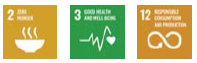 |
|
|
|
|
|
|
| PROGRESS |
Nutrition standards
- Tiger Brands standards to
meet or exceed globally
recognised nutritional
guidelines.
|
- Nutritional Information Centre of
the University of Stellenbosch
(NICUS) to review our nutritional
standards every three years
- Complete categorisation of
product range against criteria.
|
- Standards formalised through
NICUS
- Nutritional standards defined in
product lifecycle management
(PLM)
- Introduced a three-tier nutritional
categorisation of our products
- Commenced categorisation of
product range against criteria.
|
 |
Nutritious product portfolio
- Target percentage of nutritious
products in total portfolio
- Target percentage of reduced
sodium products in total
portfolio
- Target percentage of reduced
sugar products in total
portfolio.
|
|
- Product Lifecycle Management
(PLM) system baseline set
- Revised health and nutrition
strategy
- Commenced renovations of existing
products
- Launched new nutritious and
affordable products
- Micronutrient enrichment across
>30% of our portfolio.
|
|
EWLW communication plan
- Reach > 5 million per year
- Publish 12 articles per year
- Support four government initiatives per year.
|
- Publish State of Nutrition reports
- Run World Nutrition Day campaign.
|
- R3,3 million EWLW spend
- Published State of Nutrition report in December 2020
- Published State of Nutrition in South Africa report in September 2021
- Repositioned KOO to promote fruit and vegetable consumption
- Launched “Colour Your Plate with KOO” TV show.
|
|
Nutrition labelling
- 100% compliance with South
African front-of-pack nutrition
labelling regulations.
|
- Comply with new extended
producer responsibility (EPR)
regulations
- Adhere to EWLW and Be-Nutrient-Wise on-pack labelling
standards
- Protect EWLW front-of-pack
nutrition labelling ahead of South
African regulations.
|
- Achieved compliance with EPR regulations.
- 100% adherence to EWLW and Be-Nutrient-Wise standards
- Restructured label architectures to accommodate additional on-pack nutrition information
- Launched clean-label pouches through Project Step-Up
- Explored portion-control messaging for chocolates.
|
|
Priority SDGs 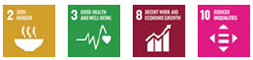 |
|
|
|
|
|
| PROGRESS |
CSI/SED
- Establish 500 food gardens
- Distribute 15 000 food hampers
- Set-up 20 community social enterprises
- Record a positive social impact and ROI
- Ten universities to be included
in the Plates4days programme
throughout the country.
|
- Reach 200+ schools through EduPlant
- Reach 30 000 through Family Food programme
- Expand Plates4Days to include nine university campuses
- Establish two community social enterprises.
|
- R2,9 million SED spend
- 200+ schools reached through EduPlant
- Seven university campuses included
in Plates4Days, and 5 200 food
hampers delivered
- 30 000 reached through Family Food programme
- R3 million spend on disaster food relief.
|
|
ESD
- Dipuno Fund at R200 million
- Create 4 000 jobs
- Support 100 non-agricultural
entrepreneurs
- Support 500 farmers under the
aggregator model
- Create/support 1 000 new
black/black women-owned
enterprises
- Create 10 000+ sustainable
livelihood opportunities.
|
- Dipuno Fund at R85 million
- 500 jobs created
- 100 farmers to be supported
- Three aggregators to be
supported
- Develop three initiatives for new
route-to-market in townships in
partnership with commercial
teams.
|
- R85 million Dipuno Fund
- 157 farmers supported under the
aggregator model
- 843 jobs created to date in small
farming sector
- Eight black aggregators cultivating
white beans, groundnuts, tomatoes,
wheat and sorghum
- Projects approved to the value of
R28,6 million
- Awards: First place for Empowerment
of Women in the Community and
Economic Empowerment.
|
|
Preferential procurement (PP)
- R1,5 billion cumulative PP
spend
- 50% of total spend towards
black/black women-owned
suppliers.
|
- R1 billion cumulative PP spend.
|
- R1,089 billion cumulative PP spend
- R13,5 billion total spend with
BBBEE-verified suppliers
- R5,6 billion with suppliers that qualify
as black-owned
- R4,3 billion with suppliers that qualify
as black women-owned.
|
|
Inclusion and diversity
2023 targets:
- Top management 60%
- Senior management 63%
- Middle management 70%
- Junior management 88%
- 2% people with disabilities
- 40% total female workforce.
|
- Top management 60%
- Senior management 63%
- Middle management 70%
- Junior management 80%
- 34% female workforce.
|
- 30% female workforce
- 63% ACI* management in junior to top management (2020: 62%)
- Top management 50%
- Senior management 55%
- Middle management 66%
- Junior management 81%
- 0,3% people with disabilities
- Awards: Southern Africa Gender Mainstreaming Champion.
|
|
* African, Coloured and Indian
Priority SDGs  |
|
|
|
|
|
| PROGRESS |
Energy and emissions
- 20% of all energy use from
renewable energy sources
- 25% reduction in GHG
emissions from 2019 baseline
- 10% reduction in energy
intensity from 2019 baseline.
|
- 15% year-on-year reduction in energy intensity
- 10% year-on-year reduction in GHG emissions.
|
- Continued with energy system
optimisation (ESO) and energy
management systems (EnMS)
programmes
- 20,4% year-on-year reduction in
absolute energy use
- 2,83% year-on-year reduction in
energy intensity
- 16% year-on-year reduction in
absolute direct (scope 1) carbon
emissions
- 30% year-on-year reduction in
GHG missions intensity.
|
|
Water and effluent
- 25% reduction in total water
consumption from 2020
baseline
- Target percentage reduction in
water intensity.
|
- 10% year-on-year reduction in
water-use intensity.
|
- Industrial water efficiency (IWE)
assessments conducted at most
water-intensive operations
- 13% year-on-year reduction in
absolute water use
- 6% increase in water-use intensity.
|
|
Plastic packaging
- Source 2 000 tonnes of
recycled plastic from recycling
hubs for use in manufacture of
plastic packaging
- Plastic recycling facility fully
functional.
|
- 10% to 15% of plastic packaging
recyclable
- Define plastic usage baseline.
|
- Baseline assessment of packaging
footprint completed representing
80% of volume and sales
- Lightweighting optimised across
portfolio
- Committed to the SA Plastics Pact
targets
- At least 70% of plastic packaging is
recyclable, in line with the SA
Plastics Pact 2025 target, which is
making all the plastic packing
recyclable.
|
|
Circular economy
- Zero waste to landfill
- Deliver waste recycling hubs
- Use of by-products to generate energy
- Implement at least two
by-product beneficiation
projects
- 50% reduction in food waste.
|
- Set baseline and KPI for food
waste reduction.
|
- Continue to work through CGCSA
to develop a voluntary industry
food-waste reduction framework for
South Africa.
|
|




 HEALTH AND NUTRITION
 ENHANCING LIVELIHOODS
 ENVIRONMENTAL STEWARDSHIP