Our centralised food safety and quality system, embedded at
group level, provides the direction and support needed to
empower each employee to take personal responsibility for
food safety and quality, particularly at the operations level. The
chief supply chain officer is responsible for executing the food
safety and quality system, with support from the quality
director. The board exercises ultimate oversight on food safety
and quality through the RSC.
Our 2022 quality strategy outlines short, medium and long-term
priorities that drive improvements in our end-to-end
management of food safety and quality, across functions. We
aim toward a fully integrated system, where robust and
contemporary processes, continuously updated, are supported
by talented and well-trained people who work with inspiration
in a culture of quality excellence.
In line with the strategy, we have developed a quality scorecard
which we have standardised across all our sites and
categories, with a monthly reporting cycle on performance.
Activities trackers have also been developed and aligned with
monthly reporting against the scorecard. These measures have
helped us improve quality governance across the group.
|
|
|
|
|
|
|
|
| Develop a world-class quality approach delivering the brand promise |
|
RAISING THE FLOOR
(RESTORING BASICS) |
|
|
BUILD QUALITY CAPABILITY
AND CULTURE
(QUALITY MINDSET) |
|
|
RAISING THE BAR
(CONTINUOUS IMPROVEMENT) |
|
- Supplier quality assurance
- Perfect execution at factories
- Food safety
- Quality in logistics.
|
|
|
- Structured quality organisation
- Quality talent pipeline
- Quality mindset
- Engagement with external entities.
|
|
|
- Voice of the consumer
- Quality through cross-functional teams
- Manufacturing excellence customs and practices (MECP) quality pillar
- Brand promise health check.
|
|
We hold ourselves, our suppliers, and third-party
manufacturing partners to the same stringent standards by
implementing ongoing risk assessment, gap closures and
certification. Our supplier quality assurance (SQA) programme
is currently being reviewed to ensure that it will result in
compliance and deliver the identified improvements. All
suppliers are required to have food safety certification,
preferably a certification recognised by the Global Food
Safety Initiative (GFSI), such as FSSC 22000, BRC, IFS, and
SQF. Hazard Analysis and Critical Control Points (HACCP)
certification is also conditionally accepted as a minimum.
We conduct all necessary product testing through in-house
and outsourced facilities.
Our product testing includes:
| Microbiological testing at our Central Micro Laboratory for
inland factories, or onsite for coastal factories |
|
| Pathogen testing (outsourced to Microchem) |
| Physiochemical testing (onsite and outsourced for more
specialised testing) |
| Sensory evaluation (onsite) |
| We also conduct precautionary testing for emerging quality/
safety concerns |
In 2021, we have made the following progress at our sites:
- We conducted quarterly self-assessments against the Global Food Safety Initiative (GFSI) protocol, and self-assessments against the Tiger Brands' quality standards for all our manufacturing sites
- Most of our sites are certified against FSSC 22000, but we still have a few certified under HACCP. The audits were conducted by DQS, an international certification body
- We completed audits for all our external warehouse facilities, including Tiger Brands facilities and third-party warehouses. Out of 22 warehouses, 11 have received certification, 10 have been recommended for certification and are awaiting certificates,and one will need to be re-audited due to the impact of the July 2021 civil unrest and looting in South Africa. The audits were conducted by DNV, an international accredited registrar and classification society. We maintained certifications against the FSSC 22000 or HACCP system for all our manufacturing facilities
- We completed an audit of our Home and Personal Care (HPC) site against the ISO 9001 quality management system standard. ISO 9001 is the world's most recognised quality management system standard, and this has replaced our system based on the HPC 420 protocol. The site performed well in the audit, and we expect certification in November 2021. The audit was conducted by DQS, an international certification body
- We have made good progress on implementing the ISO 17025 standard for laboratories at our Central Micro Laboratory, through which we conduct microbiological testing of our products from our inland factories. We expect certification from the South AfricanNational Accreditation System (SANAS) in 2022. This process was initially delayed in 2021 due to internal backlogs at SANAS
- We initiated HACCP risk assessment reviews with the assistance of an industry expert and the Centre for Food Safety at Stellenbosch University
- We remain a member of the European Hygiene Engineering and Design Group (EHEDG), and will use their guidelines as the manufacturing hygiene standards across our operations from 2022
- We completed the development of Manufacturing Excellence
Customs and Practices (MECP) for quality, and our
implementation of this initiative is largely on track. We have
successfully launched the MECP for quality, including quality
standard practices and quality assessment checklist, across
10 priority sites, and are nearing completion of the quality
pillar book. The baseline assessments for these priority sites
were conducted by our Quality Centre of Excellence (CoE).
The regular training of staff is a key part of our approach to
ensuring effective food safety and quality management.
We conduct ongoing quality and food safety-related training
and refresher training at all our manufacturing sites, and
conduct additional training as needed for quality and non-quality
functions. To support our identification of training
needs, we developed an online tool for conducting skills
assessments of the quality functions that cover both technical
and behavioural attributes. Together with Optimum, we
successfully tested and piloted the tool this year, and will
be rolling it out early in 2022.
In 2021, we delivered the following training initiatives:
- Quality e-learning modules rolled-out across all relevant functions
- A series of food safety lectures, delivered through Stellenbosch University
- Microbiological training for quality and non-quality functions, delivered by Microchem
- EHEDG hygienic design training for quality, maintenance and process engineering functions
- EHEDG equipment certification training for quality, maintenance and process engineering functions
- MEPPM quality training for selected production managers
- FSSC 22000 internal auditor training for the Quality Leadership Team (QLT).
Our 2021 quality performance
| |
| Number of public recalls |
|
0 |
1 |
0 |
0 |
| Percentage reduction in market place incidents (%) |
|
30 |
40 |
25 |
35 |
| Percentage reduction in complaints (%) |
|
12 |
25 |
5 |
18 |
| Percentage reduction in foreign object complaints (%) |
|
12 |
35 |
|
|
| Percentage reduction in health-related complaints (%) |
|
12 |
57 |
NR |
| Percentage reduction in insects complaints (%) |
|
12 |
2 |
|
|
NR – not reported.
We improved our quality performance significantly in 2021,
achieving a 25% reduction in consumer complaints (2020: 5%)
and a 40% reduction in marketplace incidents (2020: 25%).
Additionally, we defined three new KPIs that focus on issues
related to consumer complaints: foreign object complaints,
health-related complaints and insects complaints. We reduced
complaints in each of these areas by 35%, 57%, and 2%
respectively, as indicated in the table above.
We will continue to raise the bar during 2022 under the
guidance of our strategy and renewed annual targets.
Assessments throughout the distribution chain will continue,
with the inclusion of the return-centres and trans-shipment
warehouses. These facilities start their certification cycle with
gap audits aiming at certification in 2022.
Covid-19 response: Food safety and quality
We implement the following measures to ensure product safety during the Covid-19 pandemic
- We make decisions using a decision-tree that takes into account product shelf-life
- We implement a decontamination plan, to ensure a hygienic work environment
- We provide facemasks to all factory personnel
- We maintain a high level of response-readiness to ensure a quick response to the detection of a positive case
- We conduct microbiological testing of products from our inland factories through our Central Micro Laboratory based at Tiger Brands Boksburg, and have contingency plans in place to ensure continuity of testing.
CANNED VEGETABLES RECALLED DUE TO CAN DEFECT
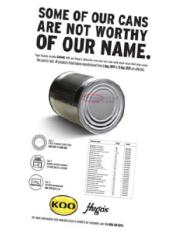
In July 2021, we recalled certain KOO and Hugo's canned vegetable products produced from 1 May 2019 to 5 May 2021, due to a small number of defective cans originating from a third-party packaging supplier. The cans potentially held a defective side-seam weld that could cause the can to leak. We identified the issue during routine quality control procedures.
While there was a low likelihood that illness or injury would result from the defect, we decided to respond in a precautionary manner, because ensuring high standards of food quality and safety are non-negotiable for our business. Therefore, in
consultation with the National Consumer Council (NCC), we went ahead with the recall of all potentially affected cans. We worked with our retail and wholesale customers to remove all affected canned vegetable products from store
shelves and replaced these with fresh stocks of quality-assured canned products. There have been no health issues reported to date relating to the affected product range.