

Sustainability governance and managementDownload pdf version
 |
SUSTAINABILITY GOVERNANCE |
Governance at Tiger Brands is centred on our purpose, to nourish and nurture more lives every day. This societal purpose shapes our governance and management structures and approach.
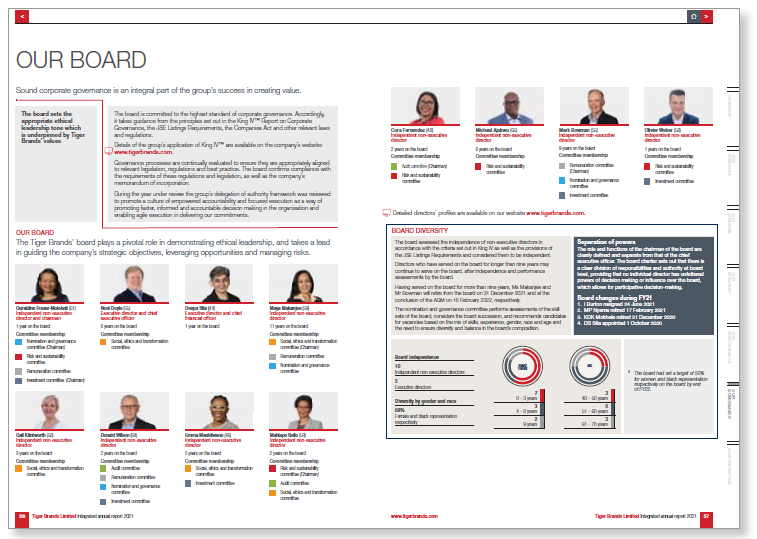
The Tiger Brands board is the highest-level body with oversight on sustainability. The board provides leadership and strategic direction in the best interest of the company and its stakeholders, embracing the principles of ethical leadership and good corporate governance outlined in the King IV Report on Corporate Governance, the JSE Listings Requirements, the Companies Act, and other relevant laws and regulations. The board is ultimately responsible for driving societal purpose through the business; establishing critical anchors for ethical and sustainable business practice; ensuring effective management of ESG impacts, risks, and opportunities; and for advancing the business model and strategy towards product-innovation as a solution to societal challenges. More information on the board is provided in the integrated annual report (see IR).
Two board-level standing committees; SETCO and risk and sustainability committee (RSC) play a key role in sustainability governance at Tiger Brands. These committees are mandated by the board to execute certain sustainability-related responsibilities on its behalf.
- The social, ethics and transformation committee (SETCO) is the primary vehicle for overseeing, monitoring, guiding, and reflecting on the ESG aspects of concern to the long-term growth and sustainability of the business. This includes a focus on impacts, risks, relationships and opportunities, and how these may affect, be managed, or actively harnessed by the business in execution of its growth strategy. The committee guides the CEO and the executive committee towards continual improvement within these performance areas and monitors and reports on performance to the board. Key matters of concern to SETCO include organisational ethics, responsible corporate citizenship, sustainable development, stakeholder relationships, BBBEE, ensuring compliance, and driving best practice. SETCO receives and considers reports from the RSC covering the environmental, health, safety, and security risks that they monitor
- The risk and sustainability committee (RSC) provides strategic guidance and leadership on environmental issues and oversees the implementation and revision of Tiger Brands’ environmental, health, safety, and security policy. This committee plays the role of assisting, monitoring and influencing the aspects of sustainability considered in relation to minimising the environmental impacts of the company and assessing and managing environmental risks and opportunities, including climate change. The committee ensures that the group’s environmental stewardship strategy positions the group as a sustainability leader in retail, and further ensures that the environment and sustainability initiatives and objectives of the group are effectively integrated into the business at an operational level. The RSC reports into SETCO, as well as reports quarterly to the board on these environmental issues.
Other standing committees that play a role in the governance of sustainability, include:
- The nomination and governance committee (NAGC), which independently monitors the performance of the board, ensures protocols for ethical governance and succession of leadership are achieved and maintained
- The remuneration committee (REMCO), which engages on and approves remuneration policy and strategy, and is the body responsible for approving any remuneration incentives linked to sustainability performance targets
- The audit committee (AC) reviews and approves the sustainability performance related data which is supported by our combined assurance plan where elements of independent assurance is provided.
SPOTLIGHT ON SETCO
In 2021, SETCO reviewed the following issues to ensure there is effective and ethical leadership and an integrated approach to how Tiger Brands carries out its business and sustainability activities.
Workplace
|
Social environment
|
||
Economy
|
Natural environment
|
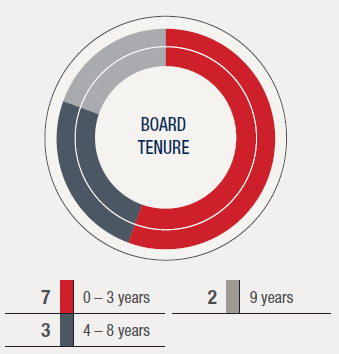
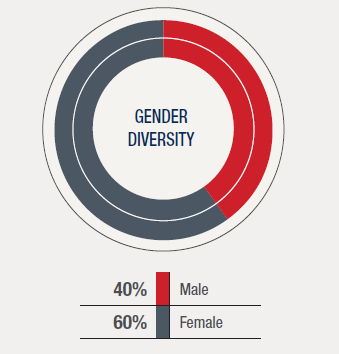
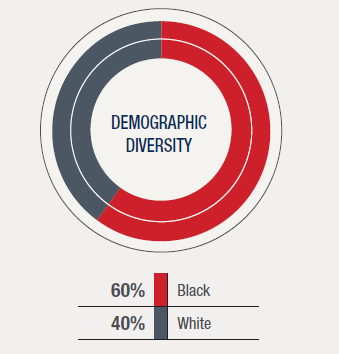
BOARD DIVERSITY
As at 30 September 2021
 |
 |
 |
BOARD OF DIRECTORS
For more information on our board of directors please go to www.tigerbrands.com


We assess our environmental and social impacts, and our exposure to sustainability-related risks at an operational level. The manufacturing-units report on environmental and social indicators, which are collated into an overall scorecard, and reported quarterly to the executive committee (EXCO). Any necessary mitigation plans are reviewed on a quarterly basis in the RSC and SETCO, and ultimately reported to the board.
Climate change risks are assessed as part of our enterprise risk management (ERM) process and included in the group risk matrix. Climate risks and opportunities are reviewed through the RSC and escalated to the next level where necessary. This includes the potential impact of climate change on our operations, strategy, supply chain and our markets.
We have evolved our Tiger Innovation Process (TIP 3,0) using design thinking methods and approach to guide the management of our pipeline of projects that drive value for the business (see IR), including societal value creation through addressing public health and nutrition (see here), and environmental concerns (see here). This governance process ensures all innovations, renovations and cost-saving projects are brought to market in a manner that guarantees thorough checks from a nutritional, regulatory and legislative perspective, while also driving speed to market, agility, and discipline, in the execution of projects. A key aspect of this process is ensuring that when our products go to market, they are aligned with appropriate responsible marketing and communication practices (see page 68).
We provide performance incentives for the management of sustainability-related issues through the short-term incentive scheme (STI). Remuneration incentives are currently offered for performance against the following sustainability targets: quality, safety and efficiency. The incentives are applicable across the group from senior executives to factory workers. We continue to enhance our remuneration strategy to improve alignment with the key performance indicators (KPIs) used to measure and reward performance against our business strategy (see here).
The key structures accountable for the management of sustainability at Tiger Brands, are the RSC and the EXCO:
- The risk and sustainability committee (RSC) ensures that the environment and sustainability initiatives and objectives of the group are effectively integrated into the business at an operational level. The RSC is made up of four non-executive directors as members, and normally attended by three chief growth officers, chief supply chain officer, company secretary, chief corporate affairs, chief financial officer, chief legal officer, corporate finance executive and the CEO.
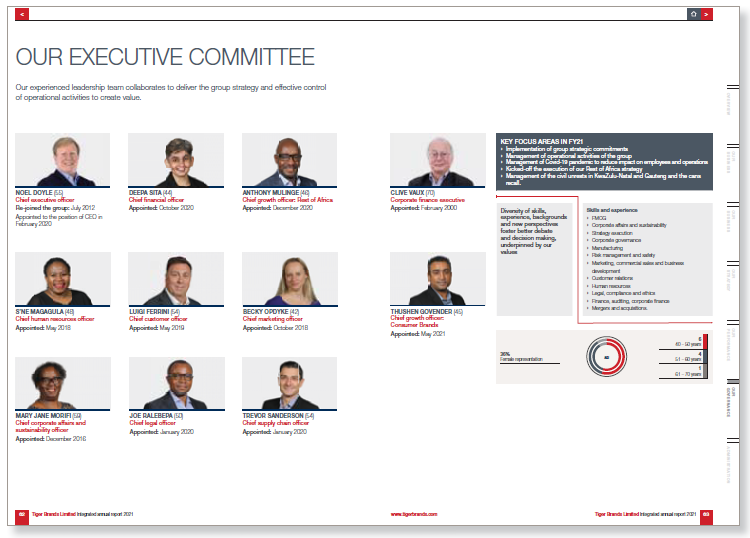
- Our executive committee (EXCO) facilitates the effective control of the group’s operational activities in terms of its delegated authority emanating from the board. EXCO is responsible for developing policies and strategy for recommendations to the board and for the implementation and execution in line with the board’s mandate. Progress towards meeting sustainability-related targets and goals, are also monitored at an operational level by EXCO, championed by the executive director, as an independent member. The EXCO meets at least monthly and meets more often when necessary. More information on EXCO is provided in the integrated annual report (see IR).
EXCO
For more information on our EXCO please go to www.tigerbrands.com

OUR KEY SUSTAINABILITY MANAGEMENT ROLES
- The chairman of the board is appointed through the nomination and governance committee (NAGC) and is responsible for the group as a whole. The chairman sits in the REMCO and NAGC to exercise oversight on all sustainability-related issues
- The CEO, who reports to the chairman, is appointed by the board for full accountability on management of sustainability issues, where purpose-aligned actions need to be taken, as the chief business lead. The CEO ensures that the sustainability strategy is effectively integrated into the business. He is also a regular attendee of the RSC and a member of SETCO
- The chief corporate affairs and sustainability officer (CCASO) plays a critical accountability and execution role in corporate social investment (CSI) initiatives and projects managed through external stakeholders and sustainable socio-economic development (SED) partnerships. The CCASO reports directly to the CEO
- The chief human resources officer reports directly to the CEO and is accountable for driving effective talent management, leadership development and succession, as well as creating a great place to work through driving diversity and inclusion, rewards and recognition, constructive employee relationships, and culture transformation
- The chief marketing officer (CMO) is responsible for research and development (R&D) and responsible marketing and communications. R&D plays a vital role in product development for health and nutrition, and to address packaging objectives. In 2021, R95 million was spent in R&D, including salaries (2020: R57 million). The CMO reports directly to the CEO
- The chief supply chain officer reports directly to the CEO, and takes operational accountability for safety, health, environmental, and security (SHES) performance, as well as food safety and quality. He is supported by the supply chain operations support director
- The chief growth officers (CGOs) have full responsibility and accountability for the sustainability performance of their divisions; Consumer Brands – Food, Exports and International, and Milling and Baking. The CGOs report directly to the CEO
- The risk and sustainability director reports directly to the supply chain operations support director, and is responsible for the management and coordination of sustainability and SHES initiatives across all our operations.