We continually implement and improve our programmes to
detect issues early, manage risks, and to prevent and reduce
harm to any of our employees, visitors, and contractors. Behavioural safety and exposure reduction are being
addressed through employee engagement, capacity building
and addressing any office and production ergonomic working
conditions. We are building synergy between our safety
management standards and operational discipline to achieve a
level of operational effectiveness that enables an LTIFR
improvement year on year. Our effective internal and external
auditing programme provides assurance on our SHE systems,
supports the monitoring of performance, and enables risk
management and continual improvement.
CHANGE SAFETY
CULTURE –
ROLL OUT A BBS
PROGRAMME |
|
|
RISK
MANAGEMENT |
|
|
OPERATIONAL SAFETY
MANAGEMENT
PROGRAMME |
|
|
COMPLIANCE
MONITORING AND
EVALUATION
PROGRAMME |
|
|
CAPABILITY AND
COMPETENCE
BUILDING |
- Build sustainable and
inspiring leadership
- Define engagement
processes
- Create measurement
and analysis tools
- Set clear goals and
define an aligned
recognition
programme
- Conduct training.
|
|
|
- Standardise hazard
assessment process
- Standardise
processes for
managing high risks
- Build capability and
awareness
- Define and implement
group life-saving rules
- Review effectiveness
of controls and plans.
|
|
|
- Implement a fail-proof
process safety
management
programme
- Build contractor risk
management
programmes.
|
|
|
- A structured and
consistent approach
to incident
management and
focused improvement
- Define and implement
programmes to ensure
continued legal
compliance
- Identify key skills/roles.
|
|
|
- Evaluate gap
- Define licence to operate standards
- Define training plan/approach and
implement.
|
| >> FOUNDATION << |
|
|
|
|
Behaviour-based
safety |
Demonstrated
leadership |
Effective
communication |
Responsibility and
accountability |
|
 OWNERSHIP AND INVOLVEMENT AT ALL LEVELS OWNERSHIP AND INVOLVEMENT AT ALL LEVELS  |
SAFETY
Our safety management system ensures that for every incident
that occurs, a root-cause analysis process is triggered, which
informs future preventive measures and contributes to the
continual improvement of our operational safety culture. We
continue to apply disciplinary action where appropriate and
where incidents have occurred due to employees not adhering
to the defined safe work practices. A detailed investigation is
carried out for every fatality and lost-time injury, involving a
multi-disciplinary team and senior management. The results
are reviewed at group level to ensure that the whole company
learns from the incident.
We are placing emphasis on the implementation of MECP
across all our plants. We prioritised our activities on 10 sites
with the greatest need for improvement. We started by building
safety capability at the shop-floor level, which enables better
communication and more practical application of hazard
identification. We subsequently conducted self-assessed
audits at our 10 priority sites to gauge the maturity of our
risk management programme.
The MECP programme is supported by the ongoing rollout
of our behaviour-based safety programme, which drives
employee safety through management, peer observation,
and the provision of initial non-punitive feedback to the
transgressor. We delivered capacity-building and safety initiatives this year to improve our operational safety culture
and inspire our employees to take personal responsibility for
their health and safety. We implemented a series of safety and
health campaigns across the group, which focused on robust
action-planning for topical risks that required closure. The
campaigns included interventions to curb the increase of
trauma injuries to hands and fingers, slip and fall incidence,
and unsafe conditions related to moving machinery and
machine guarding. We have seen significant improvement
in the reporting of near misses, and a reduction of unsafe
conditions and acts being observed and reported at our
sites. These results have empowered us to shift our focus
towards the leading, rather than lagging, indicators of
safety performance.
In 2021, we improved our total recordable case frequency
rate (TRCFR) from 0,79 in 2020 to 0,46. We recorded a 23%
reduction lost-time injuries (LTI) and improved our lost-time
injury frequency rate (LTIFR) from 0,34 in 2020 to 0,31. The
majority of our lost-time injuries were recorded in our
Grains division and related to Albany route-to-market
security incidents (see below). Despite these route-to-market
challenges, we are happy to report zero fatalities across
the business in 2021. These positive safety results show the
effectiveness of the initiatives we have delivered in this
fiscal year.
Our safety performance
| |
| Fatalities |
|
0 |
3 |
1 |
1 |
0 |
| Fatal injury frequency rate (FIFR) |
|
0 |
0,01 |
NR |
NR |
NR |
| Total recordable case frequency rate (TRCFR) |
|
0,46 |
0,79 |
1,86 |
4,03 |
2,42 |
| Lost-time injuries (LTIs) |
|
99 |
129 |
139 |
107 |
123 |
| Lost-time injury frequency rate (LTIFR) |
|
0,31 |
0,34 |
0,38 |
0,27 |
0,30 |
| Medical treatment cases (MTC) |
|
48 |
45 |
58 |
NR |
NR |
| First aid cases (FAC) |
|
131 |
101 |
149 |
NR |
NR |
NR – not reported.
HEALTH AND WELLNESS
Our core occupational health programme focuses on the
delivery of health risk assessments, occupational hygiene
surveys, medical surveillance, and the provision of primary
health care. Despite the ongoing pressure from Covid-19,
we continue to deliver health and wellness interventions
and initiatives, and invest in advancing our programmes to
safeguard our employees from all priority health risks. All our
health initiatives are underpinned by the delivery of continuous
health awareness campaigns and interventions.
Responding to Covid-19 has remained a key focus of our
occupational health and wellness programme since the beginning of the pandemic in 2020, and we continue to deliver
and adapt our health interventions and initiatives in response
to the prolonged presence and impact of the pandemic
(see We ignite our people through a purpose-led culture). Our focus has shifted this year from initial
preventative protocols to the proactive screening and
vaccination of staff. We have tested staff regularly for Covid-19
using antigen nasal swabs, and have conducted a total of
28 559 antigen tests to date. We further established pilot
vaccination sites in Gauteng to ensure accessibility of vaccines
to staff, with 23% of our staff having been fully vaccinated to
date. Both these health initiatives have been underpinned by
the delivery of continuous Covid-19 and health awareness
campaigns and interventions.
We continued with site occupational hygiene surveys and
health risk assessments for different tasks within the
manufacturing environment. We identify our top health risks
through these due-diligence processes, including any
abnormal or significant health-surveillance results, and these
are reported to top management for inclusion in operational
risk management planning and strategy, and to drive continual
improvement in our performance.
We continued to run routine staff medical surveillance
programme, where the monitoring and management of chronic
disease among our staff is a key concern. We screen all our
employees and contract labour for Covid-19 and lifestyle
diseases including diabetes, cholesterol, HIV/Aids and
hypertension. Employees who are found to have more than
one of these chronic conditions are encouraged to enrol in
THRIVE, an employee assistance programme for those at
high risk.
Our facilities continue to deliver programmes that drive
behavioural transformation in partnership with the wellbeing
department in human resources (see We ignite our people through a purpose-led culture). Through these
programmes we have delivered wellness support to employees
who have experienced health or wellness-related incidents or
challenges, including Covid-19-related bereavement and
support achieving better work-life balance. We also continue
the development of our leaders and supervisors to inspire a
culture of health and wellness, and to lead by example through
a practice of leadership that is visible and felt (see We ignite our people through a purpose-led culture).

Our employee wellbeing support programme offers
24-hour telephonic counselling and face-to-face
counselling from professional psychologists, social
workers, dieticians, bio-kineticists, and financial and
legal advisers. Our onsite clinic services include
occupational health support and essential primary
healthcare, which is free to all permanent
and temporary employees onsite. We
provide an ongoing primary
healthcare service to all employees,
and manage the risk and incidence
of infectious disease through the
primary healthcare programme.
We continued to build our capabilities for reporting work-related
illnesses, and are strengthening our tracking
mechanisms and occupational-health ways of working in
response to the impact of Covid-19 risk and the shift towards
digital-first work arrangements. Improving the flexibility of work
hours, providing advice and support on the ergonomics of
workspaces, and aiding the navigating of new challenges in
work-life balance have been key focus areas.
ENVIRONMENT
Over the last few years, we have improved our environmental
governance and legislative adherence through key industry
partnerships, and continue to invest in reducing our
environmental footprint in accordance with the environmental
stewardship pillar of our sustainable strategy (see Environmental stewardship).
Our focus is towards developing innovative environmental
solutions that address the key impacts relating to our processes,
manufacturing facilities, products and by-products.
We continue with our mandatory reporting to the DFFE,
and monitor relevant legislative developments with interest.
We have registered with DFFE in respect to the new EPR
regulations, and follow developments relating to the
forthcoming front-of-pack nutrition labelling regulations
in South Africa.
From a due diligence perspective, we continue to conduct
root-cause analysis on environmental infringements, and
ensure that corrective and preventive measures are
implemented and continually improved. We have increased
the frequency of our site reviews and internal reporting, and
this has improved our management of environmental incidents.
SECURITY
We make a continuous effort to understand current and
emerging security trends, including cyber security trends
(see We ignite our people through a purpose led culture), to ensure we have the necessary mitigation
measures in place to guard against our security threats.
Accordingly, consistent work is undertaken at all our facilities
to continuously improve our security controls and security
management. Guiding our actions are site-level security
risk-assessments that employ a security management system
methodology to review security and ensure the presence of
appropriate physical security measures and access controls.
We had multiple sites impacted by the civil unrest and looting
which took place in South Africa in July 2021. Most significant
was the R100 million direct and indirect loss we incurred from
the looting and vandalising of our Tastic and Snacks & Treats
sites. These sites have recovered from the impact, but our
business continuity plans were well-tested by these events.
We have reviewed these events and are currently implementing
security improvements based on lessons learnt through this
experience.
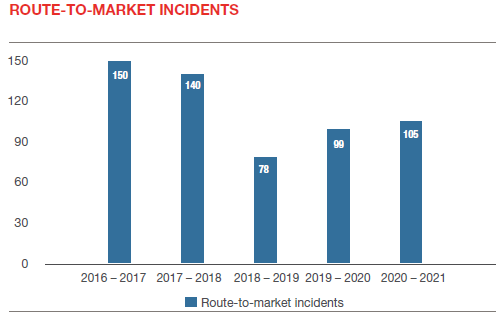
Our biggest security challenge and the most significant risk to
our business this year, continues to be the threat to our people
from route-to-market incidents in the Albany business. We
have recorded a total of 572 Albany route-to-market incidents
over the last five years, ranging from petty theft to major
robbery and violence, and with an increasing trend in incidents
over the last three years. We recorded 105 incidents in 2021,
fortunately with zero loss of life, yet with 83% of the LTIs in
Bakeries being route-to-market related. These incidents
amounted to a total loss of nearly R1 million over the year,
including the theft of a truck from one of our bakery sites.
Reducing these safety and security incidents in the
Albany business has been an area of key focus for
the business in recent years and will be a top priority
in 2022. While we continue to implement preventive
measures, including the provision of armed security
vehicle escorts on high-risk routes, the risk remains
very high and difficult to address due to the complex
and unpredictable nature of the external environment.
We are currently analysing route-to-market incidents
and investigating alternative interventions with the
aim to renew our strategy for reducing these
incidents significantly in 2022.