SUSTAINABILITY REPORT 2023
Supplement to the integrated annual report for the year ended 30 September 2023
Supplement to the integrated annual report for the year ended 30 September 2023
Our 2023 integrated reporting process comprises the following reports:
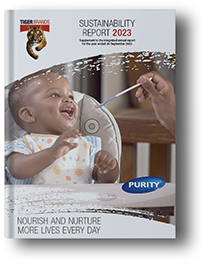
Reviews our performance in managing our most significant impacts on people, society and the environment (impact materiality), and in addressing the signifi cant sustainability-related risks and opportunities that could reasonably be expected to affect cash flows, access to finance, or cost of capital over the short, medium or long term (financial materiality).
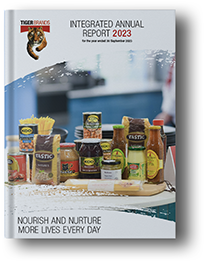
Provides a succinct review of our strategy and business model, operating context, operational performance, and governance. Aimed primarily at existing and potential investors and providers of capital, it is written for use by all parties who have an interest in Tiger Brand’s long-term performance.
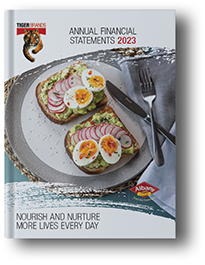
Comprehensive review of our financial results, with audited financial statements, prepared in accordance with IFRS accounting standards.
These reports are all available at www.tigerbrands.com.
Our sustainability report (SR) reviews Tiger Brands’ performance in managing our most significant impacts on people, society and the environment, and in addressing the most significant environmental, social and governance (ESG) risks and opportunities that could reasonably be expected to impact our business over the short, medium or long term. The SR is written as a supplement to the integrated annual report (IR), and targets a broad range of stakeholders, including shareholders, investors, ESG rating agencies, regulatory agencies, employees, non-governmental organisations (NGOs), customers, partners, suppliers and local communities. The report covers the activities of all our operations in South Africa and includes a report on our operations in Cameroon.
The reporting process across our reporting suite complies with the following regulatory requirements:
Our reporting has also been informed by the following disclosure standards and frameworks:
Noting the growing call from investors and analysts for transparent, reliable and comparable ESG data, we have also made provision for the disclosure expectations of relevant ESG rating agencies. We are committed to further improving our data collection and disclosure systems to ensure stronger alignment with the above sustainability-related disclosure standards and frameworks from 2024.
In response to recent developments in global disclosure standards and frameworks, we have adopted “double materiality” across our reporting suite:
We use a combined assurance model comprising assurance obtained from management and from internal and external assurance providers. More details on our combined assurance model are provided in our IR (About this report). Aside from our broad-based black economic empowerment (B-BBEE) performance, which has been externally verified by EmpowerLogic (Proprietary) Limited, the non-financial data in this report has not been independently assured. Marsh South Africa conducted risk control audits at our manufacturing sites and warehouses covering health, safety, security, fire protection and readiness.
The social, ethics and transformation committee (SETCO) and the risk and sustainability committee (RSC) review the draft sustainability report and make edits where necessary, prior to sending the draft to the audit committee (AC) for review. The AC oversees external assurance of select performance data and reviews the completeness of disclosures in the report before recommending it for board approval. Each of the chief officers has signed off relevant sections of this report that relate to issues under their control.
The Tiger Brands board, supported by the social, ethics and transformation committee, has overall accountability for this report. The audit committee reviewed the completeness of the disclosures and recommended it to the board for approval. The board is satisfied that the report addresses the most material sustainability concerns for the business, provides an accurate reflection of the group’s strategic commitments, and a fair account of our performance for the financial year ended 30 September 2023.The board approved and signed off the sustainability report on 30 November 2023.
Geraldine Fraser-Moleketi
Chairman
Tjaart Kruger
Chief executive officer
Donald Wilson
Chairman of audit committee