
SUSTAINABILITY REPORT 2023
Supplement to the integrated annual report for the year ended 30 September 2023
Supplement to the integrated annual report for the year ended 30 September 2023
 |
2023 highlights
|
The Tiger Brands Foundation was founded by Tiger Brands in 2009 to enhance our social impact relating to food and nutrition, and to deliver on our purpose to nourish and nurture more lives every day.
The Tiger Brands Foundation (TBF) operates under the governance of an independent board of trustees, and works in collaboration with various funders and partners in addition to Tiger Brands. Tiger Brands supports the TBF through its ownership structures, contributing approximately 5% of shareholding dividends annually. In 2023, the TBF received R31 142 803 in dividends funding from Tiger Brands and other companies (2022: R23 618 560). The social investment activities of the TBF run in addition to Tiger Brands' own SED activities and focus on in-school feeding: the delivery of in-school breakfasts, the construction of school kitchens, and the training of volunteer food handlers for in-school meal preparation. Furthermore, in support of informed decision-making, the TBF invests in research to facilitate evidence-based strategies to address school nutrition challenges in South Africa. The TBF strongly advocates for the inclusion of breakfast in the National School Nutrition programme (NSNP), overseen by the Department of Basic Education, and emphasises the importance of a comprehensive meal plan for students.
The Tiger Brands breakfast programme
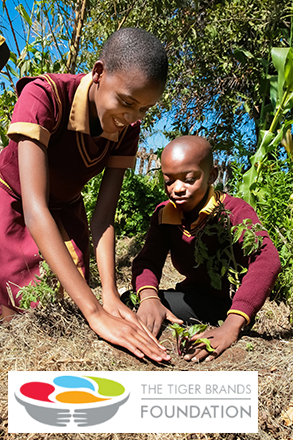
The Tiger Brands Foundation provides an in-school breakfast to non-fee-paying primary and secondary schools, facilitates the construction and refurbishment of school kitchens, and invests in capacity building for the volunteer food handlers who prepare the meals at participating schools.
The Tiger Brands breakfast programme provides the essential breakfast meal to 74 109 learners each school day at 91 schools across all provinces in South Africa (2022: 74 177 learners at 95 schools). The programme served 14 million breakfasts in 2023, contributing to a cumulative total of 125 million breakfasts served since 2011 (2022: 109 million). Unfortunately, we lost five schools in Kathu Northern Cape, as one of our sponsors did not renew their contract due to a strategic CSI refocus on their part. We have signed a partnership with a new sponsor, PG Quarries, to sponsor one new school in the North West Province.
School kitchens are essential to deliver the breakfast programme and ensure that food is prepared in a hygienic environment. In 2023, we delivered two kitchens at a total value of R1,6 million at Thabang Primary School in Bethlehem, Free State, and Gordon Primary School in Alexandra, Gauteng. In addition, we produced 500 posters on safety and hygiene for food preparation and gas storage areas, and distributed these to all partner schools at a total value of R67 675.
Successful implementation of the breakfast programme relies on the collective effort of district officials, school monitors, regional co-ordinators, school governing body members, and volunteer food handlers. Regional co-ordinators are full-time employees of TBF, and school monitors work a half-day to support the co-ordinators in some provinces. Volunteer food handlers prepare and serve the breakfast at participating schools, and are employed by the school to cook the daily meal for the National School Nutrition programme (NSNP) (see below). The TBF breakfast programme utilises the same food handlers as the NSNP, and pays an additional stipend for them to cook the breakfast.
The food handler training programme was restarted post-COVID in 2022 with funding from Tiger Brands. The training programme is attended by all key personnel involved in executing the breakfast programme, and is delivered through workshops that cover food hygiene, food safety, food nutrition, and food preparation, as well as food employment and entrepreneurship. The training is certified by City and Guilds, and the Culture, Arts, Tourism, Hospitality and Sports Sector Education and Training Authority (CATHSSETA).
Between 3 and 7 October 2022, we trained 55 individuals from our partner schools in the Free State, including 50 food handlers. These food handlers were from schools in Ficksburg, Phomolong and Botshabelo.
The National School Nutrition programme (NSNP)
The NSNP is the largest social support programme (after social grants) in South Africa, and delivers a cooked school meal to 9,2 million learners every school day. The NSNP recognises the value of adding a breakfast to the current single meal and this has been supported by the TBF's research and advocacy work (see below). The TBF works together with the NSNP to deliver an additional breakfast meal through the NSNP, with the aim of assisting learners who come to school hungry to get the most out of their school day. As a result, breakfast programmes are being piloted in the Eastern Cape and North West using existing NSNP funding, with the aim to launch a full breakfast programme for quintile one to three schools in these provinces.
Research and advocacy
In 2022, we resumed our research and advocacy efforts in collaboration with the Centre for Social Development in Africa (CSDA) at the University of Johannesburg (UJ). We completed two significant studies. The first, "The effects of COVID-19 on in-school nutrition: The voice of the child", investigated the pandemic's impact on in-school nutrition from the viewpoint of school learners. Our second study, "Assessment of the nutrient content of school-feeding programmes in South Africa: Effect on nutritional status of school children", evaluated the nutritional adequacy of in-school meals in selected schools across four provinces.
In 2023, we shared these findings in a webinar hosted by the CSDA at UJ. Our research revealed that children possess a strong understanding of the importance of nutrition. Their insights pointed to two key areas for improvement: meal variety and portion size. In response, we are piloting a diversified breakfast menu in two provinces, featuring a broader range of flavoured porridges. Additionally, we have adjusted portion sizes to ensure sufficient quantities for learners desiring second helpings. We are also in discussions with the Department of Basic Education to enhance the quality of the lunch meals provided.
Our interactions with the learners have enriched our perspective, empowering us to take targeted actions for the betterment of in-school nutrition programmes.