SUSTAINABILITY REPORT 2023
Supplement to the integrated annual report for the year ended 30 September 2023
Supplement to the integrated annual report for the year ended 30 September 2023
 |
Our key policies
|
Our goal is to operate in a manner that safeguards people and the environment. We prioritise zero harm in the pursuit of manufacturing excellence, and are building strong foundations in SSHE compliance and due diligence.
Our key safety-related impacts and risks are site-dependent, and include common workplace accidents like slips, trips, falls, and more serious machinery-related injuries. Inadequate risk assessments of specific activities and lack of mitigation of ergonomics risks were also key contributors to injuries in 2023. Transport-related accidents and route-to-market security incidents exacerbated by conditions and events outside of our control pose significant risks. Contractors or temporary staff unfamiliar with safety protocols further contribute to our safety risks. Improving risk assessments and contractor management will be key focus areas in 2024.
Our key occupational health impacts and risks include potential exposure of employees to materials or conditions that can lead to enduring health issues, such as noise-induced hearing loss or respiratory problems caused by dust, and exposure to heat or harmful chemicals. Another significant area of concern is ergonomic risks, including physical strain injuries from incorrectly lifting heavy loads, and musculoskeletal disorders from repetitive tasks and poorly designed workstations. We also recognise psychosocial risks, including stress, burnout, and harassment as critical factors that can substantially affect employees' mental health and overall wellbeing ( see – employee wellbeing). All these health impacts and risks are site-dependent, and operate over the medium to long term, with the exception of sudden physical strain from the lifting of heavy loads.
In South Africa, the socio-economic landscape and elevated crime rates, along with the locations of our facilities and the appeal of our products, expose our business to a myriad of internal and external security threats. Our labour negotiations, occasionally conducted in a strained atmosphere (refer to – employee relations), can incite strikes and disciplinary procedures, both posing security risks to our assets and personnel. Currently, our key security risks include internal theft of products, route-to-market hijackings and armed robberies in the Albany business, and workplace-related employee threats/intimidation. Tiger Brands' security concerns have been escalating, particularly in the tough economic environment post-COVID-19, exacerbated by high unemployment and inequality.
Our ability to manage safety, security, health, and environment (SSHE) is vital to our operations. Safety, alongside quality (refer to – food safety and quality), is an uncompromising facet of our business. Our objective is zero harm: no fatalities, no workplace injuries, and no process-safety incidents. We have robust backing from our Exco and board to enhance SSHE throughout the business.
Legal compliance underpins our SSHE approach, shaping our policies and strategies, especially as we continue to establish foundational capabilities, systems, and practices. Our SSHE policy framework is informed by key legislation including the Occupational Health and Safety Act (OHSA), the Private Security Industry Regulation Act (PSIRA), and the National Environmental Management Act (NEMA), respectively.
We take a risk-based approach to SSHE management, and place a strong focus on building a culture where safety is paramount, and managers lead visibly by example. We are continuously improving our processes to strengthen competencies, detect issues early, manage risks effectively, and audit our performance to prevent and reduce harm to our employees, visitors and contractors.
We have a five-year strategy for each sub-function within our safety, security, health, and environment (SSHE) function, focusing on compliance, clear risk management practices, building essential capabilities, and achieving excellence in performance. This strategy is endorsed by the chief manufacturing officer. Embracing digitalisation is a critical challenge we face, and a key shift that is pivotal to improving our SSHE performance across all aspects. Currently, our SSHE management potential is limited by manual systems for data management and reporting. Enhancing skills and technical competencies is another critical factor in our SSHE strategies, with ongoing SSHE training and coaching being a fundamental aspect of our approach. In 2023, we launched competence assessments for all our SSHE resources at all sites to identify improvement opportunities. The group SSHE team has been working with site resources to assist them in closing those competence gaps.
Management
Our management of safety, security, health, and environment (SSHE) is incorporated into our manufacturing, excellence, customs, and practices (MECP) management framework, which serves as our roadmap to achieving manufacturing excellence. This framework guides us by benchmarking our maturity level against industry best practice standards. The SSHE component of the MECP framework provides further tools and guidelines for systemising daily management practices at our operations, including standard operating procedures (SOPs), target-setting, risk assessments, and reporting. In 2022, we implemented the foundational stage of the MECP framework and established the SSHE pillar's management system. We assessed all our manufacturing sites on their compliance with our foundational requirements in the SSHE pillar, with the exception of our Chococam and peanut butter sites. In 2023, we progressed on the baseline maturity established in 2022, and plan to close out most of our foundational gaps in 2024.
Currently, our SSHE management efforts are concentrated on establishing compliance-related due diligence procedures and implementing standard operating procedures (SOPs). These SOPs define our approach to managing key SSHE areas and serve as a reference for auditing our management and operational processes. We have key performance indicators (KPIs) at group, category, site, and individual performance levels, enabling us to measure progress at all levels. Regular site-level reporting processes facilitate routine measurement and reporting of our KPIs, which are consolidated at group level. We review all SSHE incidents and performance monthly, holding discussions on performance across all sites in a SSHE forum held every second week of the month. Our internal and external audit programme ensures the robustness of our SSHE systems and plays a vital role in effective risk management and performance enhancement.
At all sites, plant managers and SSHE officers work alongside our group SSHE team. This central team facilitates compliance and performance by assisting site-level personnel in comprehending compliance requirements, addressing impacts and risks, and mitigating issues identified through risk assessments. Risks are prioritised based on their likelihood and impact, guiding resource allocation. In areas of security where we lack visibility into impacts and risks, we depend on our service providers for this information.
We've set reporting standards with service providers to ensure data and feedback are relayed to site managers and the group level. The application of the management system and standards is supervised through internal assessments and monthly progress meetings with the relevant site-level SSHE officers. We track the resolution of discrepancies and gaps through corrective action plans.
Updates on all priority risks are provided to the chief manufacturing officer, who oversees their resolution alongside the legally appointed representative from each manufacturing plant.
Looking forward, our aim is to provide targeted training to the SSHE community on key MECP topics, including monthly online and one-on-one engagement sessions to standardise practical application of these topics.
Performance
In 2023, our aim was to improve our SSHE pillar foundational practice score, setting a target of 70% compliance across all sites, excluding Chococam and peanut butter. We successfully achieved this goal and aim to get all sites to a 95% compliance level in 2024, as well as improve compliance to excellence requirements. Presently, we are constructing a new peanut butter facility, which will be included in future assessments once it becomes operational.
Our health and safety strategy strictly adheres to the Occupational Health and Safety Act (OHSA) and associated regulations, ensuring complete compliance for our operational licensing. We place emphasis on cultivating safety-oriented behaviour, focusing on consistent awareness initiatives and ongoing employee engagement to mitigate risk. As part of our commitment to safety, we have tied safety performance to remuneration incentives at management levels, contributing 10% to the individual's variable performance reward under our short-term incentive (STI) scheme ( see – Reward and recognition). In 2023, we made a significant breakthrough in our approach to handling route-to-market (RTM) injuries within our Albany business operations by focusing on the injuries caused by risks that were within our control.
The key aim of our safety management programme is to reduce our lost-time injury frequency rate (LTIFR) through better management standards and procedures, sharper operational discipline and behavioural compliance, and stronger synergy between our standards and discipline. Our safety management processes are integrated into the SSHE pillar of our MECP framework, and include clear annual targets, management systems and SOPs, strengthened operational discipline, and behavioural safety initiatives that foster a safety-oriented culture driven by visible demonstration and accountability from managers and leadership. Moreover, we work actively on identifying and rectifying any ergonomic challenges within our office and manufacturing spaces to ensure a safe work environment.
Our safety management protocols mandate a root-cause analysis for each incident, facilitating proactive prevention and ongoing improvement. We enforce disciplinary measures as necessary, particularly when incidents stem from employee negligence; however, we intentionally focus on addressing the real root cause of injuries rather than searching for someone to blame. Every fatality and lost-time injury is thoroughly investigated by a multi-disciplinary team and senior management. Findings are examined at group level to promote company-wide learning from each incident. The group safety team, chief manufacturing officer, and respective plant managers conduct individual sessions with each site that records a lost-time injury (LTI), which ensures accountability and supports targeted enhancement of our preventive strategies.
We remain dedicated to reinforcing robust safety management foundations and nurturing a culture that prioritises safety. With an emphasis on basic safety behaviour, we've conducted regular safety training, enhanced the reporting of unsafe acts, conditions, and both major and minor near misses, as well as acknowledged our staff's positive contributions to safety management. Despite needing to make further improvements, our consistent and constructive efforts have led to progress in preventing serious incidents. Key endeavours and advancements include launching behaviour-based safety programmes at our Milling, Bakery, and Ashton sites. We have also facilitated SSHE workshops focused on management in Mills and Culinary, extending from last year's bakery focus. These workshops aim to solidify the commitment of managers and operations directors, and boost visible safety leadership, both areas that have posed challenges in recent years.
A critical issue we identified and rectified this year involved the safety of cleaning staff in our manufacturing operations. The majority of our cleaners are contracted, and an unfortunate serious incident highlighted a lapse in their safety training, which unfairly exposed them to risks. In response, we initiated specific engagements with cleaning contractors and staff to address their safety concerns, and reinforce essential safety practices. We also evaluated the risks encountered by cleaning personnel, and implemented targeted control measures. Finally, we introduced the BIG 5 safety campaign, which included the Safer Together aspect to ensure that we all make an effort to care for the safety of each other. These improvements will be incorporated into our future training of cleaning staff.
In addressing persistent safety and security issues in the Albany route-to-market (RTM), we organised an interactive session with key stakeholders to dissect incidents and brainstorm on improvement strategies. The workshop revealed that many incidents previously attributed to external security threats were in fact due to internal behaviours and lack of basic safety practices. This discovery prompted a shift in our approach to managing Albany RTM risks. We have now made RTM a distinct area of focus in our behaviour-based safety efforts, incorporating drivers and van assistants into the process of reporting near misses, unsafe conditions, and risk observations. Prioritising these behavioural aspects in RTM has led to a notable reduction in lost-time injuries and is a standout aspect of our performance this year. In 2023, no lives were lost in RTM incidents. More information on our management and performance relating to RTM injuries is provided below – Security.
Tiger Safety Week 2023In May 2023, our yearly Tiger Safety Week event was held to re-emphasise the significance of safety. Throughout the week, we orchestrated numerous safety awareness initiatives and refresher discussions on diverse topics across our facilities. We brought significant attention to the BIG 5 Safe Behaviours campaign and continued our I'M SAFE campaign in manufacturing, expanding the reach to address route-to-market (RTM) injuries. |
 |
Health
Our occupational health management processes fall under the SSHE pillar of our MECP framework. These include clear annual targets, management systems and SOPs, reinforced operational discipline, and initiatives to promote health awareness in daily work activities. Our core occupational health programme emphasises formal health risk assessments, occupational hygiene surveys, annual medical surveillance programmes, primary healthcare, and employee wellbeing support.
We identify our top health risks through occupational hygiene surveys and health risk assessments for various tasks within our manufacturing environment. These processes, which include reporting abnormal or significant health surveillance findings, are relayed to upper management. This informs operational risk management planning, health awareness campaigns and training, and facilitates ongoing improvements in our occupational health performance. We also proactively address ergonomic issues within our office and production facilities to maintain optimal health conditions for employees. In 2022, we completed ergonomic risk assessments across our sites, and we have continued to conduct updates to our occupational hygiene surveys as required. In 2023, we focused on closure of the recommendations highlighted in the occupational hygiene surveys.
We conduct regular medical surveillance for our staff, focusing on the management of chronic diseases. All employees and contract workers are screened for lifestyle diseases, including diabetes, cholesterol, HIV/Aids, and hypertension. Those diagnosed with multiple chronic conditions are encouraged to join our THRIVE wellness programme ( see – employee wellbeing). We offer continuous primary healthcare to all employees, managing infectious disease risk and incidence through this programme. Our onsite clinics provide occupational health support and essential primary healthcare, available free of charge to all onsite permanent and temporary employees.
Performance
Regrettably, the past year saw one fatality and two serious injuries. We mourn the loss of an employee at Chococam in Cameroon due to a stack of sugar bags collapsing on him, a result of unsafe stacking practices. The incident, which occurred at an off-site warehouse, has been investigated and closed, with control measures implemented to avoid a repeat incident. We will continue to pursue further improvements at these operations.
In the first of two other serious injuries, a cleaning contractor lost three fingers in November 2022 after unknowingly inserting his hand into an active auger, exposing a gap in safety training for cleaning staff, and a shortcoming in risk assessment. We've comprehensively addressed this through additional risk assessments, the implementation of new control measures, and routine follow-ups while working in partnership with our cleaning service providers.
The second serious incident involved a contractor at our Ashton site who lost his thumb during trailer maintenance. The incident revealed a lapse in contractor management and site access controls, as the contractor was not authorised for site access. Members of the site management team were subjected to disciplinary action following this incident, and refresher training was conducted to bolster contractor management and access control. All incidents have been reported to the Department of Labour, as required by law, including non-injury-related incidents. We make every effort to maintain contact with injured employees and contractors to ensure they receive necessary care and rehabilitation support.
At group level, our emphasis on behavioural safety has resulted in a significant decrease in both incidents and lost-time injuries (LTIs). A significant decrease in manufacturing LTIs and Albany RTM incidents and injuries has been a key accomplishment. Consequently, our safety performance in 2023 has improved, and we aim to carry this positive momentum into the following year. Our total recordable case frequency rate (TRCFR) decreased from 0,62 in 2022 to 0,28 in 2023, and our lost-time injury frequency rate (LTIFR) decreased from 0,45 in 2022 to 0,25 in 2023. We recorded 72 LTIs in 2023, representing a 44% decrease from 128 in 2022. No lives were lost in RTM incidents.
In regard to occupational health, we significantly improved our compliance processes, particularly in relation to COIDA Section 24 incident reporting and occupational health conditions across our sites. This lays a solid foundation for future progress. In the same year, we contracted new service providers to boost our occupational health management procedures and ensure compliance at all sites, including our primary health clinics.
| 2023 | 2022 | 2021 | 2020 | 2019 | |
|---|---|---|---|---|---|
| Fatalities* | 1 | 3 | 0 | 3 | 1 |
| Total fatal injury frequency rate (FIFR)** | 0,004 | 0,01 | 0 | 0,01 | – |
| Total recordable case frequency rate (TRCFR) | 0,28 | 0,62 | 0,46 | 0,79 | 1,86 |
| Lost-time injuries (LTIs) | 72 | 128 | 99 | 129 | 139 |
| Total lost-time injury frequency rate (LTIFR) | 0,25 | 0,45 | 0,31 | 0,34 | 0,38 |
| Total medical treatment cases (MTC)*** | 46 | 53 | 48 | 45 | 58 |
| Total first-aid cases (FAC)*** | 229 | 334 | 131 | 101 | 149 |
| * | The fatality in 2023: one temporary employee in Logistics in Cameroon |
| ** | Only the manhours of manufacturing and route-to-market are included |
| *** | These figures apply predominantly to manufacturing, as this is where reporting is strongest. There has been an improvement in reporting of injuries in RTM but improvements are still required in sales and logistics |
| 2023 | 2022 | 2021 | 2020 | |
|---|---|---|---|---|
| Manufacturing fatalities | 0 | 1 | 0 | 1 |
| Manufacturing lost-time injuries (LTIs) | 37 | 72 | 46 | Not reported |
| Manufacturing lost-time injury frequency rate (LTIFR) | 0,13 | 0,25 | 0,17 | Not reported |
| Manufacturing medical treatment cases (MTCs) | 42 | 43 | 43 | Not reported |
| Manufacturing first-aid cases (FACs) | 219 | 317 | 130 | Not reported |
| Manufacturing near misses | 384 381 | 8 321 | 10 006 | 916 |
| Manufacturing unsafe conditions | 359 832 | 62 543 | 3 353 | 108 |
| Manufacturing behavioural safety observations | 187 225 | 47 463 | 16 375 | 737 |
Note: While we distinguish between employee and contractor injuries in the narrative text, both categories are included in our total injury statistics. This practice has been consistent since 2022. In prior years, contractor injuries weren't consistently reported, leading to the rise in our injury statistics between 2021 and 2022
We make a continuous effort to understand current and emerging security trends, including cyber-security trends ( see – cyber security), and we undertake consistent work at all our facilities to continuously improve our security controls and security management. We are currently focusing on ways to make our security execution more proactive than reactive. We are investing in security knowledge-building across the organisation to ensure that security is not viewed as the sole responsibility of the security function, but as a shared responsibility.
Our approach to managing security is informed by the Private Security Industry Regulation Act (PSIRA) and other related legislation such as the Firearms Control Act, and we remain in full compliance with all relevant requirements and regulations. Ongoing collaboration with law enforcement authorities and other key industry and security stakeholders, including networking with fellow security managers from other organisations, is a key part of our approach.
Our physical security policy, supplemented by a draft security strategy and corresponding procedures such as the access control procedure, is integral to our overall security governance framework, detailing the security model, structure, roles, and responsibilities. Our group security manager oversees these policy reviews and updates, designed to safeguard physical assets, personnel, business processes, and information from threats like theft, malicious attacks, personal harm, and violent protests through defined risk control measures and compliance requirements. In order to ensure a standardised site-level security approach, we have developed a site security design standard that outlines minimum standard site security measures to be fulfilled by all sites. The critical success factor lies in ensuring that policies, procedures and standards do not only exist on paper, but that they are fully implemented and consistently complied with.
Based on lessons learnt from the 2021 unrest, the organisation has continuously been working on improving its security response plans to be able to respond effectively to similar future events. We have engaged additional service providers and strengthened our focus on enhancing skills and capabilities to ensure a swift response to cases of immediate or sudden threats. We have also instituted a personnel protection policy, focusing on employee safety, as well as a gun-free zone policy, for which compliance procedures are currently being developed. The gun-free zone policy demonstrates Tiger Brands' commitment to ensuring the safety of its employees.
Management
Our management processes are governed by the SSHE pillar's MECP management framework (referenced above). Quarterly risk assessments guide our onsite security actions, helping us identify, prioritise, and mitigate significant security risks. Our internal site security design standards adhere to Marsh security design standards, aligning with industry best practices. Marsh South Africa performs security risk control audits at our manufacturing locations and warehouses as part of our combined assurance process ( see IR – About this report). We have physical security measures in place at our manufacturing sites and distribution centres, including perimeter fencing, security officers, CCTV cameras, access control systems and intruder alarm systems. Training and awareness raising are ongoing.
A group-level security steering committee, consisting of business managers, plant managers, and key directors, convenes quarterly to discuss risk management programmes, initiatives, and security capacity enhancement. Service-level agreements are in place with contracted security service providers, setting service and performance standards for all sites. Site managers, alongside the operational management of security service providers, regularly evaluate operational performance against the agreed targets. Our daily operations are assisted by security contract managers, who monitor performance, assess progress, and aid in compliance. The group security manager, in conjunction with site-level SSHE officers, oversees the enforcement of our security design standards and ensures compliance.
In addition to the virtual monthly SSHE forums for site-level resources, we host a separate monthly security forum involving site-level staff and service providers. This forum provides an essential platform for security personnel to stay updated, raise awareness on crucial developments, and propose improvements. Monthly team and individual performance evaluation meetings are conducted to monitor team and individual progress. These routine engagement sessions are aimed at ensuring effective collaboration and alignment between security and the business.
In 2023, our core focus remained on enhancing basic security compliance standards and practices under the SSHE pillar of our MECP framework and addressing gaps identified through risk assessments. We began a process to hire service providers for the regular upkeep of our CCTV security camera systems, a need identified in our risk assessment. We've now included CCTV maintenance as a standard operating practice, necessitating routine reports and actions to ensure consistent high-quality surveillance. We finalised arrangements for backup security services to supplement our in-house teams during emergencies or crises, such as the civil unrest witnessed in South Africa in 2021. We are continuously raising awareness through communications at both site and group levels. To augment this, we are initiating development of a more comprehensive employee security awareness training programme.
Route-to-market (RTM) incidents in the Albany business remain our biggest security challenge, and reducing these safety and security incidents is a top priority. We continue to implement preventive measures, including continuous risk assessment, the provision of armed security vehicle escorts on high-risk routes, and various site-level measures, yet the risk remains very high and difficult to address, due to the unpredictable nature of the external environment and the sophistication of criminal threats. In 2023, we held a workshop with key stakeholders to dissect incidents and brainstorm on improvement strategies. The workshop revealed that many incidents previously attributed to external security threats were in fact due to internal behaviours and lack of basic safety practices. This discovery prompted a shift in our approach to managing Albany RTM risks.
In addition to managing the issue through a security lens, route-to-market incidents have been included as a distinct area of focus in our behaviour-based safety efforts ( see – Safety). Prioritising these behavioral factors has significantly reduced RTM incidents, marking a key achievement this year. We are currently rolling out defensive driving training at our Bakery sites. While this may not eliminate the risk of robbery or hijacking, it equips our drivers with the skills needed to make informed decisions that minimise the risk of injury and loss of life.
Performance
We performed commendably this year, reaching our goal of an 85% security practice score across all sites, excluding Chococam and peanut butter. With plans to surpass this target next year, we've implemented our strategy, management systems, and SOPs more thoroughly than ever before. We've improved our service provider management, enhancing their performance and ensuring consequence management for those implicated in theft. We've conducted quarterly site-level risk assessments and strengthened reporting processes, resulting in an uptick in incident reporting. We've smoothed out inconsistencies in our site security plans and are advancing towards standardisation, including access controls and procedures, across all sites. Our personnel protection policy has been activated, with compliance procedures developed and enforced in response to threats against employees. Despite effectively managing common security risks such as petty crime, theft, and strike-related risks, these persistent challenges continue to present new scenarios with each incident.
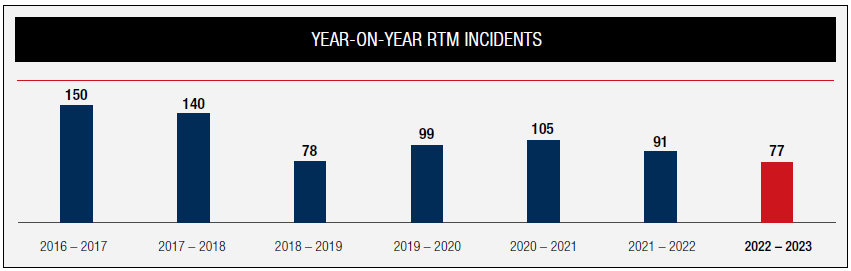
In 2023, we documented 148 security incidents, comprising 87 RTM and 61 site incidents. Of the site incidents, 45 were minor, mainly caught by security officers during patrols. Internal petty theft, largely by contractor employees, is rising due to tough economic conditions. Over eight years, we've logged 740 Albany RTM incidents, varying from petty theft to major robberies and violence. After an uptick from 2019 to 2021, incidents decreased in 2021/2022. This year, we noted 77 armed robbery/hijacking RTM incidents (2022: 91), including bread theft and two sales rep vehicle hijackings. No lives were lost. Despite fewer RTM incidents in 2023, we incurred a slightly higher financial loss of R497 699, compared to R446 000 in 2022.