SUSTAINABILITY REPORT 2023
Supplement to the integrated annual report for the year ended 30 September 2023
Supplement to the integrated annual report for the year ended 30 September 2023
Tiger Brands' SED aims to deliver on the company's core purpose of nourishing and nurturing more lives every day. Food security is an area of priority, and in partnership with food-focused NGOs working with food-insecure communities, we aim to build, nourish, and nurture sustainable, food-secure communities. Our social investment focuses on providing support to vulnerable households and communities within close proximity to our operations. This approach resonates with our core purpose and speaks directly to our business model. We maximise the impact of our social investments by building long-term relationships with partner organisations and by emphasising skills training and community enterprise development. Our aim is to move beyond traditional philanthropy to make a meaningful and lasting positive impact on local development and community food resilience.
Our SED strategy is housed within our external affairs strategy and supports our aim of achieving a positive, long-term, socio-economic impact. The SED strategy is centred around three community development impact areas: food and nutrition, skills development, and enterprise development. Across these pillars, the strategy aims to grow successful community enterprise programmes, extending the Plates4Days university food programme, and enhancing disaster relief partnerships, as well as conducting a Tiger in Society survey. Brand activations, employee volunteering, and occasional ad hoc initiatives further feed into these core focus areas.
We build strong partnerships with various local non-profit organisations (NPOs) that implement initiatives that help refine our programme and approach over time. We engage our partners regularly, receive quarterly and annual progress reports, and conduct follow-up site visits and workshop discussions to monitor progress, track performance and capture lessons learnt. The progress reports we receive from our partners are drafted according to set requirements, and include key performance information such as number of beneficiaries, details of activities, details of training delivered, key challenges, key opportunities and highlights.
We manage our initiatives and relationships with our partners using traditional tools, including email, virtual meetings, and in-person workshops and site visits. Digitalisation of our processes offers a range of benefits and is something we are looking to motivate internally.
We have assigned SED champions at each of our 40+ sites to identify socio-economic development needs in host communities and engage local stakeholders. Recently, there's been an increase in community groups approaching and protesting at various Tiger Brands sites, such as Beverages (Roodekop), Bakeries (Germiston), King Foods (Potchefstroom), Albany (Pietermaritzburg), All Gold (Musina), and Milling (Randfontein). These groups have a common goal of expressing concerns and have submitted memoranda, emphasising the need for more inclusive economic opportunities and visible social initiatives near our operations. Our external relations director has been actively engaging with each group and supporting plant managers. To enhance and sustain relationships with all stakeholders, we have acquired Anglo American's Social Way, an open-source community engagement and stakeholder management toolkit, and are adapting it for use across our sites. This will equip plant managers with the necessary toolkit to manage future interactions with community groups and small business forums.
Our primary SED initiatives drive impact in the areas of community food and nutrition, and community skills and enterprise development. Each year, we build on the progress and relationships of the previous year, and adapt our initiatives to respond to any emerging concerns. In addition to our flagship initiatives below, we sponsor ad hoc projects with various partners throughout the year and provide disaster food relief where needed in partnership with organisations such as Food Forward, SA Harvest and Gift of the Givers.
Food and nutrition
Our food and nutrition initiatives positively impact lives at all stages, providing targeted support for early childhood, primary school, university, family life, community life, and old age.
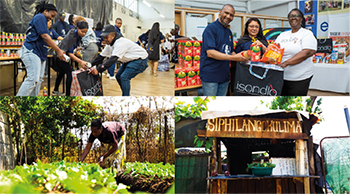
In partnership with the Nelson Mandela Children's Fund, we invested R42 million in our Isondlo initiative. This supported 10 000 food-insecure families and their children under the age of five, amounting to roughly 41 690 people, with a monthly food hamper from October 2022 to June 2023. Additionally, each family received a one-time vegetable garden starter kit in their first hamper distribution to enable them to plant food gardens throughout the year.
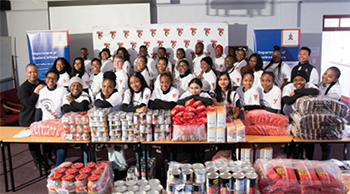
Through our Plates4Days initiative, we deliver 5 209 monthly food hampers to vulnerable students at South African tertiary institutions, supporting them in completing their studies and entering the workforce. In 2023, we provided hampers to 9 237 students at seven universities and 14 campuses. We conducted a food packing event at the University of Pretoria to highlight the issue of food insecurity among higher-education students, enrolling our young talent to spend a day packing hampers and engaging with students and media.

In partnership with Food and Trees for Africa (FTFA), the EduPlant programme integrates food gardening and nutrition into the national primary school curriculum. Endorsed by the Department of Basic Education and contributing to the National School Nutrition programme (NSNP), it is one of South Africa's leading school garden initiatives. The gardens both supplement in-school feeding schemes and act as outdoor classrooms for subjects such as biology and geography. Through EduPlant, we support over 300 schools, helping learners grow food for their schools, families, and communities.
The Tiger Brands Foundation's in-school breakfast programme further extends food and nutrition support for primary school children. We sponsor three schools for participate in this programme and finance the training of food handlers to prepare in-school meals ( see – The Tiger Brands Foundation).
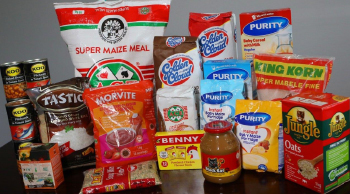
Through the Family Food Initiative, we distribute 3 845 food hampers every month across South Africa, excluding the Northern Cape, North West, and Mpumalanga. These hampers are directed toward families identified as food insecure by our NGO partners. The hampers fulfil various purposes: they supplement after-school programmes and feeding schemes, and serve as incentives for families engaged in skills development programmes. The initiative reached 32 637 direct and 26 374 indirect beneficiaries in 2023.
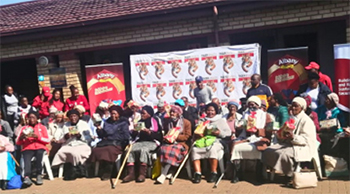
To bolster community engagement and food security, Tiger Brands and Albany Pretoria partnered with Rose Happy Times, an elderly care center in Saulsville. The project established 110 household food gardens and a central 200m2 vegetable garden. Implementing partner Reel Life set up the garden and trained volunteers.
The initiative has multi-faceted benefits, extending beyond food security to improve the elderly's wellbeing and foster community support. In addition to the garden, we donated essential products to Rose Happy Times, aiding in the preparation of nutritious meals for the elderly. This aligns with Albany's mission, providing not just food security but also a stronger sense of community and wellbeing.
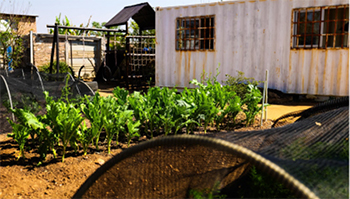
Our Community and Household Food Gardens initiative complements our food hamper distribution by focusing on education and skills training for greater community food self-reliance. In 2023, we partnered with Reel Life to set up food gardens at community centres in Diepsloot, Lion Park, and Atteridgeville in Gauteng. The aim of this programme is to provide communities at risk of food insecurity with the resources for sustainable household food gardens. We host food gardening workshops and give each family a "garden-in-a-box" kit to start their own gardens at home. These gardens are monitored to ensure they remain productive, helping households maintain a consistent supply of fresh, nutritious vegetables.
Skills and enterprise development
Our community skills and enterprise development initiatives seek to scale the impact of our sponsorships by supporting our project partners to gain the business management skills and know-how needed to build self-sufficient ventures for long-term social impact.
A highlight this year was kicking off our SED Acceleration Programme, where we enrolled our legacy partners in a "start your business" training course developed and run with support from Zevoli Growth Partners and AMI. While some of our partners completed the training and others did not, the promising ideas from those who did were pitched to our SED team. African Children's Feeding Scheme (ACFS) in Gauteng and Yabonga Children's Project in the Western Cape both pitched ideas for a commercial bakery that would provide loaves of bread to supplement their after school feeding programmes as well as to sell bread and confectionary to generate profit for their organisations. We are now advancing with these two ventures and recently purchased generators for them to ensure that production continues even during loadshedding. For ACFS, we also financed light refurbishments at their Tembisa facility. Yabonga also received funding for security cameras for their centre. A key learning has been that our legacy partners are at different levels of maturity, and as a result, the accelerator programme, and any future training we run, cannot be "one size fits all". We are formulating a plan to further assist those organisations that were not ready to move on to the next phase of the programme.
We also concentrated on supporting Rivlife with community development initiatives near our Albany bakery in Pietermaritzburg, aiming to lay a foundation for future income-generating activities. Efforts included refurbishing an early childhood development (ECD) centre, providing monthly food support to the ECD centre, installing a borehole, creating a community food garden, and equipping a community-run bakery. Over the next three years, we will support activities that combine social enterprise and community development.
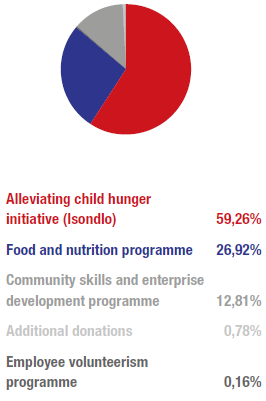
In 2023, our total SED spend was R70,8 million, including the Isondlo child nutrition programme, compared to R25,8 million in 2022. We distributed a total of 228 648 food hampers across all food and nutrition initiatives, reaching 78 275 direct and indirect beneficiaries monthly. We spent R9 million on community skills and enterprise development. In the past we have made efforts to calculate the social return on investment (SROI) of our SED programme and initiatives. Our most recent SROI exercise in 2020 revealed that our SED programme returned R4,65 for every R1,00 invested, with the Plates4Days initiative returning the highest value at R5,00 for every R1,00 invested. We will be conducting a Social Return On Investment study in 2024.
 |
Additional SED projects in 2023
|
|
BREAKDOWN OF SED SPEND PER PROGRAMME
|
||
|