
SUSTAINABILITY REPORT 2023
Supplement to the integrated annual report for the year ended 30 September 2023
Supplement to the integrated annual report for the year ended 30 September 2023
 |
Our key policies
|
Our goal is to cultivate a culture where ethical behaviour is not only promoted and expected but also naturally manifested through everyday interactions and engagements.
We actively foster an ethical workplace culture, implementing mechanisms to ensure that our ethics-related principles are understood, accepted, and practised daily by our team. As a member of the Coalition for Ethical Operations, Tiger Brands supports initiatives to fight unethical behaviour and corruption within our industry. Our ethics policies, including our code of conduct, are routinely reviewed, updated, and made accessible to staff on our intranet. We promote ethics awareness through regular internal communications, utilising posters and banners both online and at our facilities. We translate these policies into practice by providing regular and specialised ethics training, conducting prompt and thorough Ethics Line investigations, and internally publishing trends in ethical behaviour along with actions taken against violators.
Our code of conduct (code) signifies a strong commitment to ethical practice within the workplace, aligning with our human rights policy, diversity policy, and disciplinary code. All employees and suppliers adhere to this code. The code offers clear guidance on everyday workplace ethics, emphasising respect for human rights, the promotion of diversity, and equal opportunity. It explicitly prohibits all discrimination and harassment, regardless of gender, race, nationality, ethnicity, age, religion, marital status, sexual orientation, or disability, subject to our transformation strategy. The code was last reviewed in 2022, with the next review in 2024.
| Consistent with our code and other ethics policies, we ensure that: | |
 |
We supply products that are safe and of good quality |
|
We contribute to the communities in which we operate |
|
We minimise our impact on the environment |
|
We establish ethical and responsible sourcing practices |
|
We engage ethically and respectfully with all our stakeholders |
|
We facilitate inclusion and diversity |
|
We maintain a healthy and safe working environment |
|
We remunerate fairly and support employee wellbeing |
|
We promote fair competition |
|
We promote and protect whistle-blowers |
|
We act with integrity in everything we do |
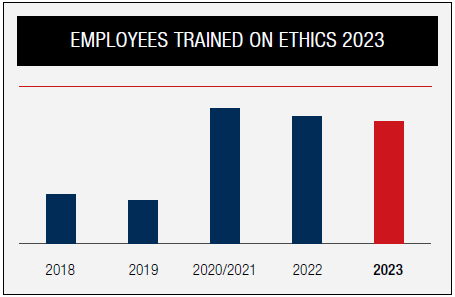
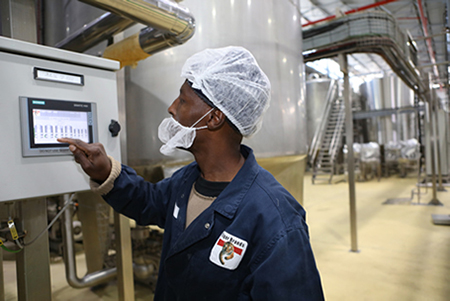
We regularly provide our employees with ethics training, including specialised instruction on human rights and combatting corruption and bribery, particularly among senior managers. Training is conducted both in person at various sites and online via a digital e-learning platform. This year, we extended in-person ethics training to our Beverages business, and additional Bakeries and Milling sites. All employees must complete an annual e-learning module on our code of conduct, and all new hires must attend an in-person induction session on compliance and ethics. This mandatory ethics training took place in February and July 2023. Our corporate communications department organises annual ethics awareness activities, and we conduct antibribery and anti-corruption training every two years for senior management (above grade DL) in risk-prone roles.
Performance
In 2023, 77% of employees completed mandatory ethics training (2022: 65%). We have implemented consequence management for those who have not completed the mandatory training, with warnings issued to employees who have not completed the mandatory training.
Human rights are a key concern for Tiger Brands, especially within our supply chain where exposure to human rights risk is greatest. Factors such as climate change may add complexity to the social and economic landscape, increasing the risk of human rights concerns.
We are committed to advancing and safeguarding human rights within our operations and supply chain, continually refining our management practices. Our human rights policy, last updated in 2022, emphasises the protection of individual rights and the group's assets and reputation. It outlines principles for monitoring, managing, and reporting human rights impacts and risks, aligning with our ethical code of conduct. The policy applies to our operations, suppliers, employees, temporary staff, contractors, service providers, and consultants. It can be accessed online at www.tigerbrands.com.
Human rights awareness raising is embedded in our annual communications, including promotion of our whistle-blowing Ethics Line for reporting potential abuses by employees or stakeholders. This focus extends to our mandatory ethics training and new employee induction, where human rights content related to our code of conduct is included, along with online learning modules for staff. We monitor media and corruption watch reports for potential abuses in our supply chain, and conduct audits in our own operations for compliance with our ethics and human rights policies through our combined assurance plan.
Performance
In 2023, we incurred no human-rights-related infringements, and received zero human-rights-related complaints through our Ethics Line.
We strictly adhere to a zero-tolerance policy against any violations of our code of conduct, including bribery and corruption. Our anti-bribery and anti-corruption policy expressly forbids lobbying, facilitation payments, and political donations. Our declaration of interest policy identifies potential conflicts of interest and mandates their disclosure either annually or as soon as one becomes aware of them. Additionally, our gifts, entertainment, and hospitality policy defines the guidelines for giving or receiving such items and requires disclosure.
We maintain a customised fraud risk register and incorporate an informal fraud risk management programme into our combined assurance plan, utilising specific analytics to identify potential concerns. Compliance audits with our ethics policies, including our gifts policy and code, are part of this process. Monthly results are reported to the executive committee (Exco), and quarterly updates are provided to the board. We subscribe to a procurement tool to scrutinise current and prospective suppliers for conflicts of interest, sanctions, criminal activity, or other ethical concerns. Anti-bribery and anti-corruption training is conducted every two years for senior management in risk-prone roles ( see – ethics training).
Performance
In 2023, we recorded four confirmed incidents of bribery and corruption, with two incidents currently under investigation, and two investigated and resolved.
Promoting, supporting, and protecting whistle-blowers is vital for fostering an ethical culture, especially given the real risks of fraud, bribery, crime, and corruption in South Africa and Africa. By offering a secure channel for whistle-blowers to report unethical behaviour, we empower those in our network to act responsibly and enable the company to identify and address violations that could compromise our integrity and reputation. Our approach complies with South Africa's Protected Disclosures Act, and our whistle-blowing policy enforces a principle of non-retaliation.
We operate a whistle-blowing facility for secure and anonymous reporting of unethical behaviour, dishonesty, or fraud related to our business, personnel, or relationships. This facility is independently managed by Tip-offs Anonymous, a division of Deloitte, and includes a 24/7 Ethics Line, supporting all local languages, accessible to employees, suppliers, customers, consumers, and the public. We frequently inform our employees about the Ethics Line's availability and confidentiality via corporate communications, and this year held a number of town hall presentations at site level to enhance awareness of our code of conduct and whistle-blowing facility. Consumer product complaints are handled separately through a different channel ( see – food safety and quality).
The responsibility for Ethics Line reporting falls under the group compliance director, guided by our ethics investigation framework for managing ethics-related complaints. This framework has systematised the screening and reporting of all Ethics Line complaints, accelerating investigations and ensuring the satisfactory resolution of issues. Complaints made via the Ethics Line are received by the internal audit and risk director, the group compliance director, the employee relations director, the chief financial officer and the chief legal officer. Each complaint is allocated to an investigator within three days, with every investigation accompanied by a formal report issued to the relevant line manager and the relevant chief officer. When a complaint is received from Deloitte, it is assessed by way of a triage by the internal audit director, the employee relations director and the group compliance director. The complaints are allocated in terms of a tiering process as set out in the ethics investigative framework, whereby each tier of cases are investigated by different management levels of the business, based on the level of the alleged perpetrator.
 |
Tip-offs Anonymous
Toll-free 0800 80 80 80 |
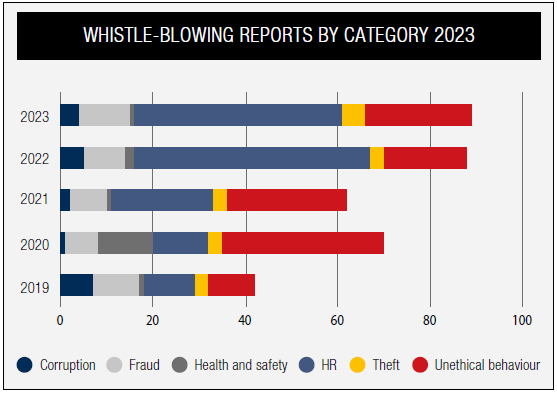
Complaints are organised into categories such as alleged corruption, fraud, health and safety, human resources (HR), theft, human rights and unethical behaviour to streamline management response and enable more profound analysis and learning from incidents. In 2022, we revised the categorisation of complaints to address a recurring misclassification issue, specifically where human resources-related complaints were incorrectly labelled. This update allows for more precise and fitting analysis and response. A monthly ethics report, detailing the status of all cases, including closed ones, is presented to Exco before being tabled at social ethics and transformation committee and audit committee meetings.
We also disseminate the results of ethics reports internally to foster ethical behaviour and advocate for the use of the Ethics Line.
Performance
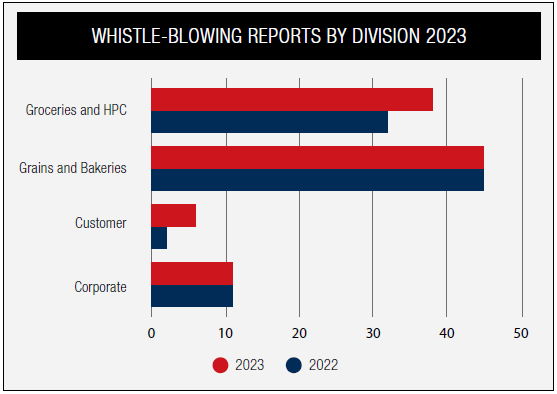
In 2023, 99 cases were reported via the Ethics Line, compared to 88 in 2022. We have investigated 82 of these cases, with 49 closed, 33 unsubstantiated, and 17 still under investigation. There has been an increase in the total number of cases reported in 2023. This year saw a rise in code of conduct and other policy violations, particularly in our Grains and Bakeries division. This uptick may be due to the reclassification of some complaints previously categorised as HR issues. Additionally, we noted an increase in fraud and theft, mainly in our Albany and Culinary businesses, attributable to control issues and policy non-compliance. Remedial action has been taken, and criminal proceedings have been initiated where applicable.
Our tax objective is to protect and enhance shareholder value through adherence to tax laws in the jurisdictions where we operate, aiming for a sustainable tax result. Emphasising good governance remains crucial, and we have made it a priority to embed robust and pertinent tax controls within the group's tax framework. By continually monitoring the evolving tax landscape across various jurisdictions, we ensure compliance with all regulations, maintaining the integrity of the group's reporting requirements. The foundation of our tax objectives lies in our corporate values, which guide us to uphold and shield our reputation. We refrain from engaging in transactions that may jeopardise our integrity and remain committed to fostering openness and transparency in our interactions with tax authorities.
Tax compliance will always remain a high priority for the group as well as paying the right amount of tax at the right time.
Our approach does not include a formal tax strategy; however, we have a strong governance framework and effective controls in place to mitigate risk, and highly skilled tax specialists that ensure the function is well managed. Our tax controls are subject to an annual internal audit review, ensuring applicability across all taxes, including but not limited to income tax, VAT, carbon and sugar taxes. Controls were co-developed with the group's internal audit team to ensure that tax risks across the group are adequately mitigated. External auditors independently test our controls annually, ensuring compliance with the control activities defined in our governance framework. The tax team must provide various documents for testing, chosen through an independent sample selection by the auditor. The audit committee is ultimately responsible for group tax matters, and receives reports on any control failures.
Performance
In 2023, the group's effective tax rate was 29% (before impairments, non-operational costs and income from associated companies) in comparison to the 2022 effective tax rate of 29,4%.
We are committed to building a security-smart digital culture. Keeping our customers' trust in the safety of their information is vital, and we prioritise enhancing security and privacy in line with the rapidly evolving technology and cyber-security landscape. We implement continuous plans to improve our practices and develop cyber-security capabilities, reflecting on our actions and applying lessons learnt. Our approach aligns with the Protection of Personal Information Act 2013 (POPIA) and EU General Data Protection Regulation, ensuring compliance with these laws.
 |
Our key policy
|
We have established roadmaps to enhance cyber resilience across our environment, including manufacturing plants. These are guided by clear management commitments and monitored by the risk and sustainability and audit committees. The group information officer ensures ongoing compliance with POPIA requirements and reports progress to the risk and sustainability committee. We also recruit independent assessments to measure our performance against best-practice and industry standards, prioritising and remedying any identified gaps.
Training and awareness are central to enhancing our capabilities and addressing insider threats. We run quarterly security campaigns on specific topics through newsletters, videos, podcasts, and email inserts. Our policies are reinforced by our defined roadmaps, through which we are embedding cyber-security principles and protocols across the organisation. To ensure readiness for potential cyber attacks, we continue to conduct cyber-incident simulations as a fundamental part of our training at all levels.