SUSTAINABILITY REPORT 2023
Supplement to the integrated annual report for the year ended 30 September 2023
Supplement to the integrated annual report for the year ended 30 September 2023
We use energy to produce our food products, and greenhouse gas (GHG) emissions are a factor at all stages across the value chain. Upstream in agriculture, energy is consumed for machinery, irrigation, and the production of fertilisers and pesticides with certain types of farming, such as rice production, releasing methane emissions. The manufacturing and processing stages within our operations are energy-intensive, resulting in both direct (scope 1) emissions from the combustion of fossil fuels and indirect (scope 2) emissions from off-site electricity generation. While we do not directly manufacture packaging materials, the energy consumption and GHG emissions associated with their production and post-consumer processing contribute to our upstream/downstream (scope 3) emissions. Energy is consumed and emissions are generated during the distribution of our products through transportation fuels. Consumer use of our products also leads to indirect energy consumption and emissions, particularly during cooking and refrigeration. Finally, the disposal and decomposition of waste at the end of the product's life can generate potent greenhouse gases like methane and consume energy in waste management processes.
We are committed to achieving net zero across our scope 1 and 2 emissions by 2050 and are making some progress on unpacking the implications of climate change for our business. We are taking steps to mitigate our impact and better identify and manage our risks ( see – risk management). Board and Exco engagement is growing in part due to external factors, including new legislation, growing cost pressures, rolling power cuts in South Africa, and the first IFRS Climate Change Disclosure Standard. New legislative developments on the horizon in South Africa include the forthcoming Climate Change Act and a planned carbon tax increase. We support the We Mean Business coalition and NBI's Just Transition initiative, and our science-based emissions reduction target aligns with requirements of the Science-based Target initiative (SBTi). Science-based targets provide a credible mechanism for holding us to account on decarbonisation, while simultaneously supporting us to reduce energy costs and strengthen energy self-reliance.
Management
Our current energy and climate-related activities focus predominantly on compliance, energy optimisation, GHG-emission reduction through efficient systems, and onsite renewable energy installations. We continue to identify impacts and risks relating to energy and emissions as part of our routine operational environmental management procedures, including efficiency audits on equipment and equipment upgrades, addressing air leaks and recurring maintenance, improving condensate return on our boilers, and other energy efficiency measures. Our site-level reporting of electricity use has improved this year, but consistency and accuracy challenges remain.
We continue with our mandatory GHG emissions reporting to the Department of Forestry, Fisheries and the Environment (DFFE), and monitor further legislative developments with interest. We have set an internal price for carbon in response to the South African carbon tax. By 2030, our projected carbon tax liability could exceed R100 million annually. This represents a substantial financial burden and potential risk for the business if not addressed. To mitigate this impact, we are committed to climate-change initiatives and investing in projects aimed at reducing our greenhouse gas (GHG) emissions. These efforts seek to significantly lower this financial exposure over time.
Our South African operations are fully compliant with national GHG emission-reporting regulations and the Carbon Tax Act. Our projected carbon tax obligation for 2023 is R7 994 321 (2022:
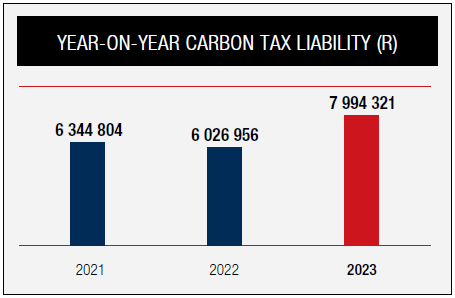
R6 026 956). We are monitoring planned increases in the tax, as well as the development of a new Climate Change Act in South Africa.
We have set a science-based emissions reduction target of 45% by 2030 (from a 2021 baseline) for scope 1 and 2 emissions to help us achieve our net zero by 2050 commitment. We also establish annual performance targets at the start of each financial year. These annual targets drive incremental year-on-year improvements and are based on our 2030 goals, current performance, and planned initiatives. Our annual targets for 2023 aimed for a 2% reduction in electrical energy intensity, a 7% reduction in thermal energy intensity, and a 6% reduction in absolute GHG emissions (scope 1 and 2). Performance on emissions reduction has been included in the short-term incentive scheme (STI) for executives for the first time ( see – Reward and recognition).
Our clean energy plan will see the installation of onsite solar power and other renewable energy solutions at 35 of our manufacturing plants by 2030. These renewable energy installations will enhance the energy security of our manufacturing plants, while supporting our decarbonisation goals. Currently, our self-generation capacity is heavily reliant on diesel generators, augmented by solar at four sites – Hennenman Mill in the Free State, King Foods in North West, Beverages, Roodekop and Home and Personal Care (HPC) in Gauteng – where we have power purchase agreements in place with independent power producers.
We are actively identifying and implementing energy-use reduction initiatives across our sites, driven by our process optimisation department. Our electrical energy intensities are highest at our S&T plants, and although we make year-on-year improvements, these sites remain inefficient. Based on the equipment and process at our milling sites, these locations have very high absolute electrical energy usage, and reducing this high base usage remains an internal opportunity for us. We have identified actions for our sites, but improved metering is required to accurately address this issue; securing these meters remains an internal challenge. Our thermal energy intensities are highest at Musina and our S&T plants, but the total impact on the Group's thermal energy is most affected by our Boksburg and Ashton plants.
Beyond energy efficiency, we seek to identify further projects to integrate into our clean energy plan and reduce our GHG emissions. We operate boilers that burn coal to generate steam at nine of our manufacturing sites, and this activity contributes significantly to our direct GHG emissions. Our highest emitting facilities, based on direct emissions from onsite coal boilers, include Culinary Boksburg, LAF and King Foods. Culinary Boksburg is our biggest emitter, and we have explored options to reduce emissions at this site.
In addition to the release of GHG emissions, our coal-fired boilers lead to the emission of air pollutants, including NOx, SO2, and particulate matter (PM). In South Africa, national air quality standards are published under the National Environmental Management: Air Quality Act (AQA). We operate four boilers that are registered as controlled emitters at three of our sites, for which we are required to submit annual reports to the DFFE. In 2023, we remained compliant with the national air quality standards across all air pollutants for this boiler.
| Atmospheric emissions | 2021 | 2022 | 2023 | AQA limit |
| NOx emission (Mg/Nm3) | 548 | 553 | 631 | 1 100 |
| SO2 emissions (Mg/Nm3) | 910 | 836 | 809 | 2 800 |
| PM10 emissions coal (Mg/Nm3) | 76 | 45 | 46 | 250 |
Performance
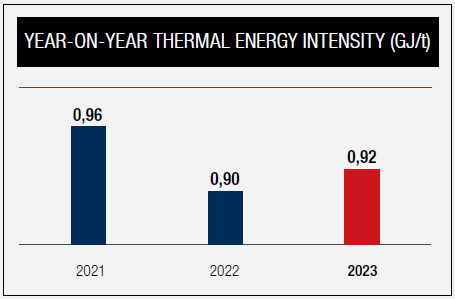
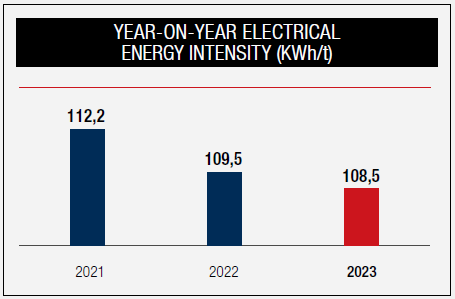
In 2023, our total energy consumption was 2 958 084GJ, with 30% from grid electricity and 0% renewable. Renewable energy installations across four of our sites currently contribute 0,17% to our total electricity usage, making a minimal impact on energy consumption overall. We did not achieve our annual targets for reducing electrical energy intensity and thermal energy intensity. We recorded a 0,3% decrease in absolute electrical energy consumption, and a 0,9% decrease in electrical energy intensity (kWh tonne) from the previous year. We recorded a 0,3% increase in absolute thermal energy consumption, and a 1,9% increase in thermal energy intensity (GJ/tonne) from the previous year. We did not achieve our annual targets for reducing GHG emissions due to the lack of reduction of thermal and electrical intensities in FY23. We recorded a 0,6% decrease in our total GHG emissions, and a 0,9% decrease in GHG emissions intensity (CO2/tonne) from the previous year.
We include both stationary sources (such as generators) and mobile combustion (emissions from our owned vehicles) in our overall emissions calculations. These figures have undergone external verification by a third-party. This year marks our inaugural reporting against a thermal energy intensity reduction target, as 2022 served as the baseline year for this metric. Going forward, strategic imperatives include enhancing the management and operational performance of our coal boilers, implementing clear asset management plans for older boilers, increasing condensate return rates, better aligning boiler operations with production schedules, and investigating alternative fuel options.
| GHG emissions (tCO2e) | 2023 | 2022** | 2021* | 2020 |
| Scope 1 (direct) | 208 079 | 199 799 | 210 042 | 350 143 |
| Scope 2 (indirect) | 228 568 | 239 625 | 231 140 | 280 633 |
| Total scope 1 and 2 emissions | 436 647 | 439 423 | 441 182 | 630 775 |
| * | The significant reduction in GHG emissions recorded between 2020 and 2021 is attributable to our sale of the Value Added Meat Products (VAMP) business |
| ** | Our 2022 GHG emissions figures have been restated in 2023 due to changes made on our diesel reporting where errors from 2022 were detected in 2023, and due to electrical energy reporting errors for some sites in 2022 that were detected in 2023 |