
SUSTAINABILITY REPORT 2023
Supplement to the integrated annual report for the year ended 30 September 2023
Supplement to the integrated annual report for the year ended 30 September 2023
 |
Our key policy
|
Our goal is to make our quality and food safety a competitive advantage.
Millions rely on Tiger Brands products for daily nutritional and health needs, including our Home and Personal Care items. Our commitment to product safety and quality, including food safety, is an unwavering foundational aspect and core value of our business. Over the last five years in particular, we have substantially strengthened our food safety and quality systems, enhancing food safety in South Africa and improving our overall performance in these areas.
Tiger Brands' approach to food safety and quality is guided by globally recognised food safety and quality certification standards, which include FSSC 22000 for our food manufacturing facilities and ISO 9001 for our HPC manufacturing facility.
We adhere to all relevant food-safety legislation and regulations, retaining government certificates of acceptability for all our manufacturing operations. Our quality and product safety management aligns with applicable laws and regulations, forming a solid foundation. Our manufacturing processes undergo annual external certification and surveillance audits by a global body. We validate our product safety and quality management systems through both internal and independent third-party audits, addressing any non-conformances and sharing lessons learnt to continually enhance our processes.
We maintain well-defined supplier quality management processes, applying the same stringent standards to ourselves, our suppliers, and third-party manufacturing partners. This involves requiring globally recognised certifications, implementing continuous risk assessment, closing gaps, and maintaining certifications. Our approach to supplier quality assurance (SQA) includes regular engagements with our suppliers to discuss, plan, audit and implement gap closure for continuous improvement.
In 2023, we significantly advanced towards a digitally-enabled approach by securing funding for an IT system dedicated to quality and food safety management. This system aims to incrementally enhance our management and reporting on food safety and quality over a three-year period. While our existing manual data management process meets site-level management and reporting needs to a limited extent, it falls short of consolidating information at group level, hindering our ability to gain more strategic insights.
We are working towards a fully integrated food safety and quality system, where robust and contemporary processes, continuously updated, are supported by talented and well-trained people who work with inspiration in a culture of quality excellence. Our strategy guides us in this endeavour, aiming for a point where quality and food safety are a competitive advantage for the business. The strategy outlines priority actions for driving this improvement across three core focus areas: restoring the basics to raise the floor of our foundational practice, enhancing capabilities and culture to reflect a quality and food safety mindset, and enabling continuous improvement to raise the bar on our performance.
Our centralised food safety and quality system, anchored at group level, sets the policy, strategy, and direction, empowering each employee to take personal responsibility for food safety and quality, especially at the operations level. The chief manufacturing officer, supported by the group quality and food safety director, is responsible for executing this system. Ultimate oversight on food safety and quality resides with the board, exercised through the risk and sustainability committee.
All our food manufacturing operations comply with the Global Food Safety System Certification 22000 (FSSC 22000) standard, recognised by the Global Food Safety Initiative (GFSI). Furthermore, all our manufacturing operations conduct GFSI self-assessments quarterly. Our Home and Personal Care manufacturing operations are ISO 9001-certified. The IT system for quality management, which we are implementing over three years, will enhance our reporting and enable compliance with disclosure requirements related to GFSI audit conformance and corrective actions.
As part of our certification commitments, we continually conduct internal audits and risk assessments at all manufacturing facilities, targeting specific opportunities to mitigate or eliminate identified risks. These assessments encompass elements related to products, processes, equipment, and infrastructure. In 2023, with assistance from external experts, we reviewed our risk assessment process and initiated a new audit process in alignment with the American Institute of Baking (AIB) Standard for some food categories. While the AIB Standard is not GFSI-recognised, it is a stringent and credible audit standard emphasising the production environment and operational aspects, complementing our FSSC 2220 certification audit processes. The work to audit all our food manufacturing sites against the AIB Standard is still in progress.
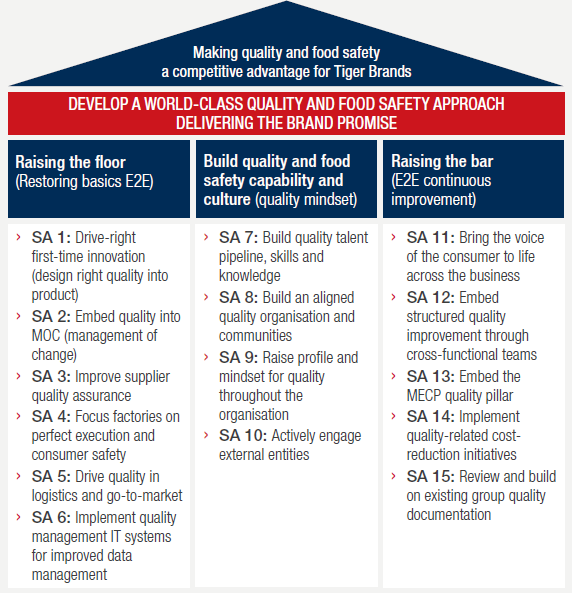
SA: Strategic action MECP: Manufacturing excellence customs and practices
All our suppliers, especially third-party manufacturers, must possess food safety certification, ideally recognised by the Global Food Safety Initiative (GFSI), such as FSSC 22000, British Retail Consortium (BRC) Global Standards, International Featured Standard (IFS), or Safe Quality Food (SQF) programme. At a minimum, Hazard Analysis and Critical Control Points (HACCP) certification is conditionally accepted. In 2023, all our third-party logistics warehouses were certified against the BRC Global Standard for warehousing and distribution.
We possess well-defined supplier quality management processes and recently fortified our risk assessment procedures to increase coverage of raw materials, packaging, manufacturing, hygienic design, cleaning, sanitation, finished products, and monitoring and validation. Our supplier quality assurance (SQA) process is executed with support from multi-disciplinary internal teams, along with external expert consultants to address gaps and strategise improvements. In 2023, we conducted numerous audits, especially of third-party manufacturers producing finished products for Tiger Brands.
The IT system we are implementing over three years will enhance our reporting and allow us to fulfil disclosure requirements including the percentage of suppliers' facilities holding a GFSI-recognised certification.
We significantly restructured the resourcing of our Quality and Food Safety Centre of Excellence (CoE) this year to enhance management oversight, promote continuous improvement, and ensure we are equipped with future-fit capabilities. This change was supported by an independent expert and guided by a benchmarking exercise against peers and industry best practices.
We conduct all necessary product testing through in-house and outsourced facilities. In 2023, we achieved accreditation from the South African National Accreditation System (SANAS) against the ISO 17025 standard for our central micro-laboratory, where we conduct microbiological testing of product samples from our inland factories. Our key testing activities include the following:

This restructuring introduces clear oversight lines and distinct roles and responsibilities across five focus areas: food safety management, quality management, supplier quality management, category quality management, and go-to-market quality management. We have incorporated new capabilities in all these areas, including positions such as microbiologist and hygienist manager, food safety specialist, food safety regulatory specialist, sensory specialist, quality systems specialist, quality compliance specialist, go-to-market specialist, category quality specialist, and supplier quality specialist. Additionally, we initiated monthly "town hall" meetings with the entire food safety and quality team to facilitate discussions and reflections on performance, challenges, and progress.
Regular staff training is pivotal in our strategy for effective food safety and quality management. We administer ongoing food safety and quality training through our e-learning platform and onsite at all manufacturing plants. Targeted training is provided as necessary, and we have piloted a digital tool to assess skills in quality functions, helping us identify specific technical and behavioural competencies and training needs. Our collaboration with the Centre for Food Safety at Stellenbosch University persists, including a series of lectures for our technical teams delivered by top academics. In 2023, key training efforts encompassed the certification of 30 new lead auditors for supplier audits and internal self-assessments.
To cultivate the appropriate culture, we are presently piloting a key initiative: a food safety and quality culture survey index, intended to evaluate the quality and food safety culture throughout the entire organisation. We've initiated this process at 15 pilot sites, including the head office. The survey will serve as a fundamental tool to identify our strengths, weaknesses, and opportunities related to enhancing our food safety and quality culture and performance. Additionally, in our efforts to build this culture, we have begun hosting an annual food safety week and an annual quality week across the organisation, and this year we are planning similar annual events, in line with the global calendars for these events.
The Centre for Food Safety is an applied food science research consortium, where Stellenbosch University researchers work together with the food industry and other stakeholders on real-world food safety challenges. The centre was launched in 2018 by Stellenbosch University together with Tiger Brands, and we continue to support the centre as a way of contributing to the advancement of food safety knowledge and practice in South Africa. The centre continues to partner with Tiger Brands on various projects, including support with microbiological risk assessments, and the provision of independent food safety research, advice and input.
Our food quality management system incorporates the Manufacturing Excellence Customs and Practices (MECP) management framework, serving as our roadmap to achieving manufacturing excellence. This framework guides us by benchmarking our maturity against industry best practices. We have been implementing MECP by establishing foundational pillars, including Quality, at 10 priority sites. The Quality pillar of MECP provides tools and guidelines for systematising daily management practices at our operations, encompassing standard practices, target setting, assessments and reporting. We are in the third year of implementing this framework, and are actively establishing the Quality pillar's management system at 10 priority sites: Culinary Boksburg, Davita, Pasta, King Foods, Jungle Oats, Albany Germiston, Baby Nutrition, Isando Beverages, S&T Mobeni and S&T Jacobs.
The establishment of the MECP quality pillar is progressing at the 10 priority sites. Furthermore, we've begun to implement all the quality standard practices at non-priority sites, to get a head start on the future advancement of MECP across all our sites. In alignment with our strategy, we've established measurable product safety and quality objectives across all our operations and at the group level to foster continuous improvement and adherence to all standards. We monitor performance against these annual targets through a standardised quality scorecard, implemented across all sites and categories, and report on performance on a monthly basis.
In 2023, we achieved a 17% reduction in overall complaints (per million units sold), a 5% reduction in insect complaints, and a 23% reduction in foreign objects complaints. We recorded a 5% increase in the number of health-related complaints. On the back of two major product recalls over the past two years, we are happy to report zero product recalls in 2023, as well as zero notices from government authorities for regulatory food safety violations.
| % | 2023 Target |
2023 | 2022 | 2021 | 2020 |
| Number of public recalls | Zero | 0 | 1 | 1 | Zero |
| Increase/(decrease) in marketplace incidents (%) | (40) | 0 | 11 | (40) | (25) |
| Increase/(decrease) in complaints (%) | (14) | (17) | (14) | (25) | (5) |
| Increase/(decrease) in foreign object complaints (%) | (15) | (23) | 17 | (35) | |
| Increase/(decrease) in health-related complaints (%) | N/A | 5 | (26) | (57) | Data not available |
| Increase/(decrease) in infestation complaints (%) | (12) | (5) | (25) | (2) |
| KEY | ||
| Better than target | ||
| Worse than target, but better than prior year | ||
| Worse than target and prior year |
The 2018 listeriosis outbreak was a tragic event in South Africa. We cannot overstate the significant and far-reaching consequences of the listeriosis crisis, particularly for the victims of the outbreak and their families. A class action lawsuit was instituted against the company for its alleged role in the outbreak. Tiger Brands remains committed to participating fully in the legal process, which will determine whether the company is liable for the outbreak. We will continue to follow due process to ensure that the lawsuit is resolved expeditiously and fairly within the confines of the law, and that a conclusion is reached in the shortest time possible in the interests of all parties, particularly the victims of listeriosis. Tiger Brands sold its value-added meat products (VAMP) business at the end of 2020. The company has in place insurance cover appropriate for a group of its size.
Various third parties contested subpoenas issued by Tiger Brands for disclosure of information related to the testing for and incidence of listeriosis. On 23 June 2020, the High Court in Johannesburg ruled in favour of Tiger Brands, compelling the National Institute for Communicable Diseases (NICD), the South African Bureau of Standards (SABS), two accredited national laboratories and various meat producers to provide critical epidemiological information required for the listeriosis class action lawsuit. All of the third parties (except the SABS) who applied for leave to appeal the decision were granted leave to appeal to the Supreme Court of Appeal (SCA). On 4 February 2022, the SCA handed down its judgment in which it overturned the earlier order of the Gauteng Local Division of the High Court.
The next steps in the litigation process entail working towards completion of preparations for trial, where liability will be determined by the court. The parties have continued to attend to pre-trial preparations, including discovery in terms of the rules of court in efforts to ensure a speedy resolution of the class action. The company is engaging with the plaintiffs' attorneys to ensure that the matter is resolved as expeditiously as possible.